
Introduction
Pink flowers get their color from anthocyanins, the water soluble pigments sitting inside petal cells. Which pigment the plant builds sets the shade you see. Pelargonidin, one of those pigments, is a pink anthocyanidin. A 2020 review in the International Journal of Molecular Sciences ties cyanidin to pink and red-purple blooms. So a petal is not pink because of the name on the nursery tag. It is pink because of the chemistry the plant is running that week.
You can watch that play out in a front yard. The same bigleaf hydrangea blooms pink in one bed and blue in another, and it is the same plant with the same genes. Soil decides. Alkaline soil keeps aluminum away from the roots and the flowers come up pink, and acidic soil frees that aluminum so the color swings blue.
Most people land here wanting pink flower names and photos, so you get 10 to grow, with the light, soil, and bloom time details for each one. You also get the reason behind the color, because that reason changes what you plant and where. The types of pink flowers below run from low growing garden pinks to a cherry tree, and a few of them shift shade with heat, soil, or plain old age.
Treat pink as a readout, not a fixed trait. Pink flowering plants answer to soil pH, light, temperature, and water stress, and the pigment they build moves with all of it. Buy the plant for its shape and for the spot you have open. The exact shade of pink is the part your garden gets a vote in.
10 Types Of Pink Flowers To Grow
Ten plants, not seventy. Every one of these types of pink flowers earns its spot by doing a job in the bed. Together they cover the season, from the first tree bloom in late March to the last nectar stop before frost. Some are pink perennials that come back for decades. Others are pink flowering shrubs you plant once for structure, and two are annuals you sow in spring for color the same year.
Hydrangea leads the list because its color is the one you can argue with. Mississippi State Extension puts pink flowers at a soil pH of 6.0 to 6.5, with blue down at 5.0 to 5.5. Iowa State reports its own soils running 6.5 to 7.5, where the heads read purplish-pink rather than clean rose. Only bigleaf and mountain types shift at all. A white panicle hydrangea stays white no matter what you pour on it.
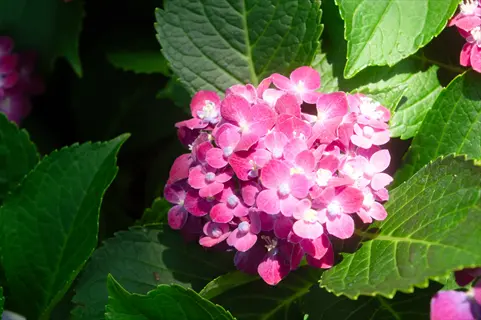
Bigleaf Hydrangea (Hydrangea macrophylla)
- Shade of pink: Mophead and lacecap heads range from pale blush through deep rose, and the tone shifts with soil chemistry.
- Why it is pink: Pink appears when aluminum stays unavailable to the roots, which happens as soil moves toward neutral.
- Bloom window: Flower heads open in early summer and hold color for weeks before drying to softer antique tones.
- Color control: This is the one pink flower whose color you can steer, and only bigleaf and mountain types respond.
- Grower note: Run a soil test before you add anything, since amendment rates are guesswork without a starting pH number.
- Watch for: Soil drifts back toward its natural pH over time, so any color treatment has to be repeated.
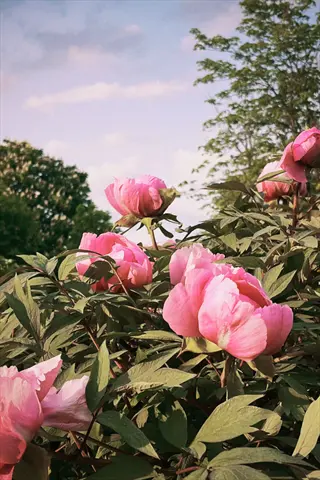
Peony (Paeonia)
- Shade of pink: Petals run from soft blush to saturated rose, often deepening toward the middle of a full double bloom.
- Why it is pink: Anthocyanin pigments held in the petal cells set the color, and their concentration decides how deep it reads.
- Bloom window: Late spring brings one heavy flush that ends fast once summer heat and hard rain arrive.
- Garden role: The foliage stays presentable well past bloom, so the plant holds its place in a border all season.
- Grower note: Peonies are long-lived plants, so treat the planting spot as a long-term decision rather than a trial run.
- Watch for: Heavy double flowers flop after rain, so set hoops or grow-through supports before the buds swell.
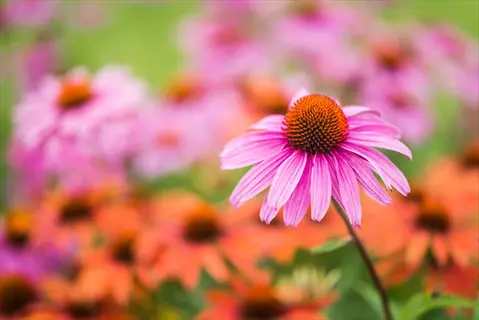
Coneflower (Echinacea purpurea)
- Shade of pink: Ray petals show a dusty rose-pink that fades as each flower ages on the stem.
- Why it is pink: Anthocyanin pigment in the ray florets carries the color, with a copper-brown seed cone at the center.
- Bloom window: Flowers open through midsummer and keep going for weeks when you cut the spent stems back.
- Pollinator note: The wide flat face gives butterflies the landing surface Penn State Extension says they need to feed.
- Grower note: Named selections such as Magnus hold a stronger pink than seed-grown plants from a mixed packet.
- Watch for: Leaving seed heads standing feeds birds in winter, but it also lets the plant self-sow into nearby beds.
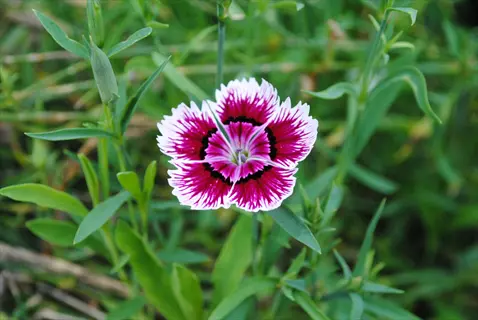
Garden Pinks (Dianthus)
- Shade of pink: Flowers appear in clear pinks, banded bicolors, and deep rose, set over blue-grey foliage.
- Naming note: This is the group gardeners call pinks, alongside sweet William (Dianthus barbatus) and the carnation.
- Bloom window: Flowering starts in late spring and repeats when you shear faded stems back before seed sets.
- Garden role: Low mounds suit path edges and gravel, where the tidy foliage stays neat once the flowers finish.
- Grower note: Sharp drainage matters more than rich soil, and crowns sitting in winter wet are the usual loss.
- Watch for: The carnation's older name, clove pink, points to the scent many in this group carry, so plant them where people pass close.
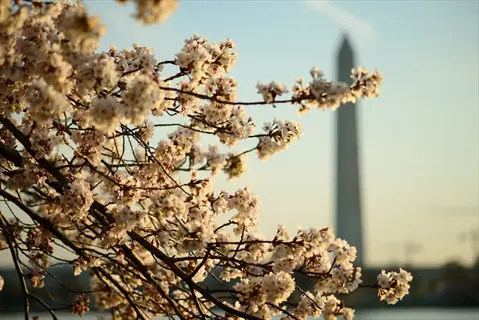
Yoshino Cherry (Prunus x yedoensis)
- Shade of pink: Blossoms open pale pink and drift toward near-white as each flower ages on the branch.
- Bloom window: The National Park Service puts the most likely peak bloom from the last week of March into the first week of April.
- Peak bloom meaning: Peak bloom is defined as the day 70% of the Yoshino cherry blossoms are open, not the first day of flowering.
- Weather effect: Cool calm weather stretches the display, while a rainy windy day ends it abruptly, per National Park Service observations.
- Garden role: One tree carries the whole early-spring show, so give it open space where the canopy can be seen from a distance.
- Watch for: A late frost can prevent blooming, and one across March 14 to 16 in 2017 destroyed roughly half the Yoshino blossoms in Washington.
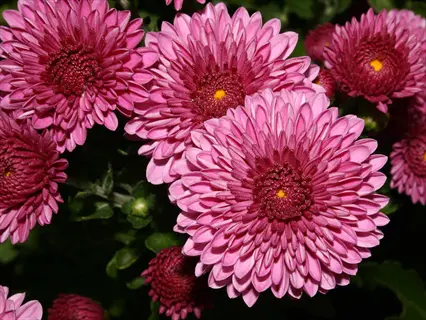
Chrysanthemum
- Shade of pink: Flowers run from clear pink through red-purple depending on how much pigment the ray florets hold.
- Why it is pink: Chrysanthemums accumulate cyanidin-based anthocyanins, which produce pinkish to red to purple flowers (Mekapogu et al., IJMS 2020).
- No natural blue: These plants lack the F3'5'H genes behind blue pigment, which is why no naturally blue chrysanthemum exists.
- Heat effect: Near 86°F (30°C), two cyanidin anthocyanins drop and pink genotypes come out paler.
- Bloom window: Flowering carries the garden through late summer and fall, long after most perennials have finished.
- Grower note: Pinching stems back through early summer builds a denser plant with far more flower buds later on.
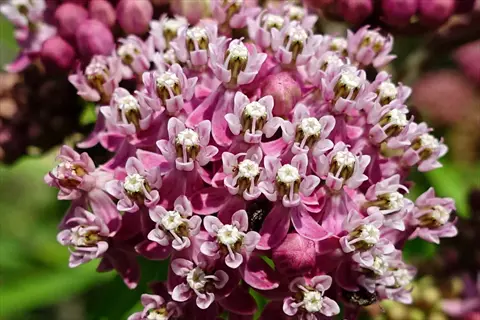
Swamp Milkweed (Asclepias incarnata)
- Shade of pink: Dense clusters of small mauve-pink flowers sit on upright stems well above the surrounding foliage.
- Pollinator note: Small flowers packed into a flat cluster give butterflies the same landing platform a coneflower does.
- Bloom window: Flowering runs through midsummer and fills the gap between the early perennials and the fall bloomers.
- Garden role: It is a native monarch host plant, so it feeds caterpillars as well as visiting adult butterflies.
- Grower note: Unlike common milkweed, this species stays clumping and suits a border rather than a rough meadow.
- Watch for: It tolerates damp ground far better than dry soil, so a low wet corner is an asset rather than a problem.
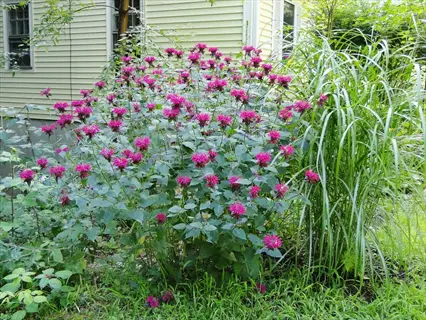
Bee Balm (Monarda)
- Shade of pink: Shaggy whorled flowers appear in soft pink through hot magenta depending on the selection grown.
- Pollinator note: Wild bergamot sits among the tubular natives hummingbirds prefer to feed from.
- Bloom window: Flowers open in midsummer and keep coming where faded heads are removed before they set seed.
- Garden role: Plant a large swath of one selection if you want hummingbirds to find it from a distance.
- Grower note: Named selections such as Pardon My Pink stay short enough for the front of a border without staking.
- Watch for: Crowded plants in still air develop powdery leaf coating, so give stems room and air movement.
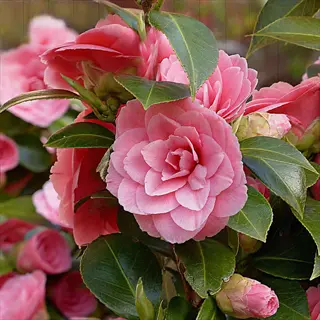
Camellia
- Shade of pink: Formal rounded flowers show clear pinks, blush tones, and picotee edges against glossy evergreen leaves.
- Bloom window: Flowering lands in the cold months, filling a stretch when almost nothing else in the garden is open.
- Garden role: The evergreen structure carries a border year-round, so the plant works even outside the flowering weeks.
- Grower note: A sheltered spot out of early morning sun keeps frosted buds from thawing too fast and browning.
- Flower form: Formal doubles, semi-doubles, and single flowers all occur across the group, so shape varies as much as shade does.
- Watch for: Spent flowers hold on the plant and turn brown, so pick them off and the display stays clean.
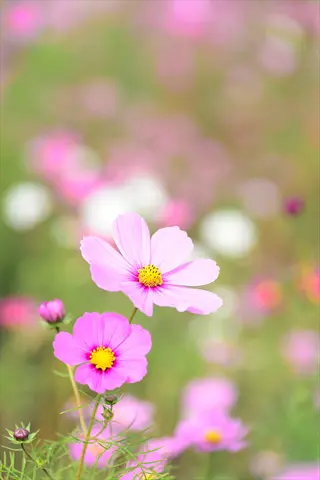
Cosmos (Cosmos bipinnatus)
- Shade of pink: Single flat flowers come in blush, clear pink, and deep rose above fine feathery foliage.
- Pollinator note: The open flat face suits butterflies, which need a surface to land on before they can feed.
- Bloom window: Sow the seed straight into the ground in spring and you get flowers from early summer until frost.
- Garden role: An annual that fills gaps fast, which makes it useful while slower perennials are still establishing.
- Grower note: Lean soil produces more flowers, while rich fed ground pushes tall leafy growth that leans and flops.
- Watch for: Cut stems for a vase and the plant keeps producing, since seed set is what shuts flowering down.
My own coneflowers sit 3 feet (0.9 m) from the kitchen window over the sink, close enough that I hear a swallowtail's wings scrape the ray petals when it lands. It sets down flat, walks across the face of the flower, then feeds. That wide flat surface is what a butterfly needs before it can feed at all. Swamp milkweed and cosmos further down give you the same platform in a different shape.
Pink flower names trip people up. Dianthus is the group gardeners call pinks, and it takes in sweet William and the carnation along with the low mounding types you edge a path with. Pick the two or three whose pink blooms open when your garden has nothing else showing, then build out from there.
What Actually Makes Petals Pink
What makes a flower pink? Anthocyanins do. These are water-soluble pigments that sit in the sap inside each petal cell, and the exact one a plant builds decides the color you see. Each is built around a core molecule called an anthocyanidin.
Pelargonidin is a pink anthocyanidin. Two enzymes, DFR and ANS, make it from a colorless starter compound called dihydrokaempferol. Cyanidin covers pink through red-purple. Delphinidin sends flower color into purple and blue. So a petal reads pink or blue based on which of these it stocks.
Dihydroflavanol 4-reductase (DFR) and anthocyanidin synthase (ANS) are two enzymes that are required to convert dihydrokaempferol to pelargonidin, a pink anthocyanidin.
Shades of pink come from two things. First, the pigment's own build. Add hydroxyl groups to the B-ring, one section of the anthocyanidin, and the color slides toward blue. Fewer of them holds it pink. Second, how much pigment the plant piles up, which shifts with light, temperature, the pH inside the cell, water stress, and the phosphorus and potassium it feeds on.
Chrysanthemums put all of this on one plant. Ray florets that build no anthocyanin open white. The ones that stock cyanidin open pink to red-purple. And in pink chrysanthemum genotypes held near 86°F (30°C), two cyanidin anthocyanins drop and the bloom fades pale. Same plant, same pigment path, three outcomes.
Keeping Hydrangeas Pink With pH
Pink shows up when the soil sits close to neutral. Mississippi State Extension puts the pink band at pH 6.0 to 6.5, blue at pH 5.0 to 5.5, and the muddy purple in between at pH 5.5 to 6.0. Iowa State Extension sets the bar for dependable blue at pH 5.5 or lower, and typical Iowa garden soil runs 6.5 to 7.5, which is why blooms there come out purplish pink. Get a soil test and learn your hydrangea soil pH before you buy a single bag of amendment.
Aluminum in the flower does the actual coloring. University of Georgia Extension lays out the pattern. Aluminum that reaches the bloom gives blue, small amounts give violet, and none at all gives pink. Soil pH works one step back from that, by setting how much aluminum the roots can pull up. How to keep hydrangeas pink? Keep the aluminum away from the roots, and lime is the tool for that.
Only bigleaf and mountain hydrangeas change color. White hydrangeas cannot be shifted at all, so no amendment will turn them pink.
Two lime routes get you there. Broadcast 1 cup of dolomitic lime per 10 square feet (0.9 sq m) around the shrub and water it in. The other option is a drench. Stir 1 tablespoon (15 ml) of hydrated lime into 1 gallon (3.8 L) of water and pour it over the root zone once a month for three months, from spring into early summer. Skip the bag of aluminum sulfate sitting next to the lime, because that product drives color the other way. Soil creeps back toward its own pH, so this is a yearly job.
The mophead beside my porch steps has never once opened blue. It grows in a bed I limed for a clematis years ago and kept liming out of habit, and that pink hydrangea comes back the same rose color every June. I run the drench three times each spring and do nothing else to it.
What Pink Signals To Pollinators
So who is pink actually for? Hummingbirds and butterflies. Penn State Extension reports that the colors hummingbirds prefer most are bright red, pink, and orange, and their eyes cover the whole range from ultraviolet through red. The USDA Forest Service says red or yellow flowers tend to draw both butterflies and hummingbirds. Pink flowers that attract pollinators are aimed at a narrower crowd than you would guess from a plant list.
Bees are the ones missing out. Bees cannot see red, though yellow and orange come through fine. Bee color vision runs on blue, green, and ultraviolet instead, which is why so many bee plants read violet, purple, blue, or white to you. Plenty of them also carry nectar guides. That is a patch of low ultraviolet reflectance near the middle of each petal. You will never see it and a bee picks it out at once.
- Hummingbirds prefer bright red, pink, and orange flowers, and see the whole range from ultraviolet through red.
- Butterflies are drawn to bright colors including red, orange, yellow, pink, and blue-purple.
- Butterflies need to land before feeding, so wide flat faces and dense flower clusters suit butterflies best.
- Tubular natives such as columbine, trumpet honeysuckle, cardinal flower, and wild bergamot are hummingbird favorites.
- Bees cannot see red, though yellow and orange come through fine.
- Bee vision works in combinations of blue, green, and ultraviolet rather than the red end of the range.
- Bee-attracting flowers usually read as violet, purple, blue, yellow, or white to human eyes.
- Many bee flowers carry ultraviolet nectar guides that you cannot see at all.
Plant around that split. Your pink border is a hummingbird and butterfly border, so add violet, purple, blue, yellow, or white blooms if you want bees working these beds too. The best hummingbird flowers are tubular. Try columbine or wild bergamot in your sunniest spot. Cardinal flower and trumpet honeysuckle work as well.
Two planting habits matter more than the species you pick. Plant a large swath of one thing instead of singles scattered down your bed, and aim for a succession of blooms so you have something open from spring into fall. A butterfly garden needs landing room too, because butterflies have to sit down before you see one feed.
The colors of flowers preferred most by hummingbirds are bright red, pink, and orange.
When Pink Blooms Peak
When do cherry blossoms bloom? The National Park Service sets peak bloom on the day 70% of Yoshino cherry blossoms are open. That day has come as early as March 15 in 1990 and as late as April 18 in 1958. The most likely window is the last week of March into the first week of April. Same tree, same city, and a five week spread on your calendar.
Weather does the rest. Cool calm days stretch the display out, and a rainy windy one can end it in an afternoon. A frost across March 14 to 16 in 2017 destroyed roughly half the Yoshino blossoms for that year. Treat any bloom time on a plant tag as an average, because the weather in a given year decides what you actually get.
Late Winter
Camellias open against evergreen foliage while most of the garden is still bare.
Early Spring
Yoshino cherry reaches peak bloom, most likely from the last week of March into the first week of April.
Late Spring
Peonies and garden pinks deliver one heavy flush before summer heat arrives.
Early Summer
Bigleaf hydrangea heads open and hold their color for weeks.
Midsummer
Coneflower, bee balm, swamp milkweed, and cosmos overlap through the midsummer weeks.
Fall
Chrysanthemums carry pink well past the point most perennials have finished.
Spring is where your choices pile up. Pink flowers that bloom in spring run from cherry and azalea through peony and garden pinks, so a bed you plant for April alone peaks hard and then goes quiet. Summer pink flowers cover the middle stretch. Common garden practice puts coneflower, bee balm, and phlox in those weeks, though the guides give no verified dates per species. The thin months are late winter and fall, which is why camellia and chrysanthemum earn their space in your beds.
The National Park Service notes that forecasting peak bloom more than 10 days ahead is almost impossible, and a late frost can end the display before it starts.
Warm Pink Versus Cool Pink
The split between warm pink versus cool pink starts in the pigment itself. Flower color shifts toward blue as more hydroxyl groups sit on the anthocyanidin B-ring, so the chemistry runs on a slide rather than a switch. What you see in the bed also depends on how much pigment the petal holds and on conditions inside the cells. Two plants can build the same pigment and still give you different shades of pink.
Grouping by tone is a design call, not a rule. Coral and salmon sit well beside orange and warm yellow, while blush and rose carry a blue undertone that holds up next to purple and lavender. A pink and purple pairing works for that reason alone. Keep the two families apart in a small bed, because light pink flowers go muddy beside a coral neighbor and hot pink flowers pull your eye off everything near them.
Coral and salmon pinks
- How they read: Coral leans toward orange and holds that warmth best in strong midday light rather than shade.
- Pairs with: Warm yellow, apricot, bronze foliage, and terracotta containers all sit comfortably beside a coral pink.
- Watch for: Placed next to a blue-leaning rose pink, both tones lose definition, which is why many gardeners keep the two apart.
- Typical plants: Some peonies, dianthus selections, and many annual cosmos and zinnias fall into this warm group.
Blush and pale pinks
- How they read: Very pale pinks wash out in full midday sun and look best in evening light or light shade.
- Pairs with: Silver foliage, soft white, and pale green hold a blush pink together without competing.
- Watch for: Against a dark fence a blush pink disappears, so give your palest plants a lighter background to sit on.
- Typical plants: Yoshino cherry blossom, many peonies, and pale hydrangea heads sit at this end of the range.
Rose and dusty pinks
- How they read: Rose and dusty pinks carry a blue undertone that stays cool and steady even in bright light.
- Pairs with: Purple, lavender, and deep blue flowers extend the same undertone and make the grouping feel deliberate.
- Watch for: Beside coral the blue undertone reads as gray, a common reason mixed pink borders look unsettled.
- Typical plants: Coneflower, garden phlox, and many bigleaf hydrangeas in less acidic soil land in this group.
Hot pink and magenta
- How they read: Saturated pinks hold up at a distance and carry a bed that pale tones cannot fill alone.
- Pairs with: Deep purple and plum foliage absorb the intensity, while a plain green backdrop lets it stay loud.
- Watch for: A little goes a long way, so repeat one magenta plant in a few spots rather than massing it across your bed.
- Typical plants: Some bee balm selections, zonal and ivy geraniums, and deep chrysanthemums reach this end of the range.
I checked the west-facing border beside my back gate at four in the afternoon in late August. The pink chrysanthemums there had gone chalky. Research put pink chrysanthemum genotypes near 86°F (30°C). Two cyanidin anthocyanins dropped and the blooms came out paler.
Light intensity, temperature, and vacuolar pH all change how much anthocyanin a flower stores, so the same plant can read warm in June and cool by September. Judge a shade in the spot where it will actually grow. A plant sitting under nursery shade cloth tells you very little about the tone it will hit in your own border.
Common Myths
Any hydrangea can be turned pink or blue by adding the right amendment to the soil around it.
Mississippi State Extension notes only bigleaf and mountain hydrangeas change color. White hydrangeas cannot be shifted at all.
Pink flowers are the best possible choice if your goal is a garden full of busy honey bees.
Penn State Extension notes bees cannot see red. Pink and red mainly signal hummingbirds and butterflies, so add blue, purple, and yellow for bees.
A flower's pink shade is locked in by its genes and looks exactly the same every single season.
Light, temperature, and vacuolar pH all shift anthocyanin levels. Near 86F (30C), two cyanidin pigments dropped and pink chrysanthemum genotypes paled.
Cherry blossoms reach peak bloom on roughly the same date every spring, so the date is easy to plan around.
National Park Service records put peak bloom as early as March 15, 1990, and as late as April 18, 1958, and forecasts beyond 10 days are almost impossible.
White flowers are simply very pale pink ones that never developed enough color to show properly.
In chrysanthemums, white ray florets come from no anthocyanin accumulating at all, not from pink pigment being diluted down.
Conclusion
Run a soil test before you buy a bag of anything. A test turns a guess into a number, and that number decides whether your bigleaf hydrangeas open pink or blue this year. Planting pink flowers is the easy half of the job. Holding a color the soil did not hand you for free is the part that needs a plan, so book the test this week and work from what comes back.
Lime raises hydrangea soil pH and puts aluminum out of reach of the roots. University of Georgia Extension gives two rates. One is a drench of 1 tablespoon (15 ml) hydrated lime in 1 gallon (3.8 L) of water. The other is 1 cup dolomitic lime per 10 square feet (0.9 sq m), spread on the bed and watered in. Mississippi State Extension runs that same tablespoon per gallon on a schedule, one drench a month, three months running, spring into early summer.
Here is the honest catch. Soils drift back to their natural pH over time, so a hydrangea you hold pink with lime needs the same treatment repeated, not done once and crossed off. Pink perennials ask far less of you. Coneflower and bee balm come back with no pH work at all, which is why they carry the midsummer stretch while the hydrangeas get fussed over.
Keep one line in mind as you plan the pink flower garden. Pink is a pigment readout, so soil, light, and heat all have a say in what opens on the stem. Test first, then amend on a schedule wherever the color depends on it. The pink flowers that never needed the help will fill in around them.
Glossary
- Aluminum availability
- How much aluminum in the soil the roots can actually take up, which is what decides whether a bigleaf hydrangea blooms pink or blue.
- Anthocyanin
- A water-soluble plant pigment held inside petal cells that produces pink, red, purple and blue flower colors.
- Cyanidin
- An anthocyanin pigment that gives flowers colors ranging from pink through red to purple.
- Dolomitic lime
- A ground limestone soil amendment that raises soil pH, used to move hydrangea blooms toward pink.
- Mophead and lacecap
- The two bigleaf hydrangea flower head shapes: a rounded ball of showy florets, or a flat cluster ringed by them.
- Nectar guide
- A pattern on a petal, often only visible in ultraviolet light, that points a pollinator toward the nectar.
- Pelargonidin
- The anthocyanin pigment type described as pink, one of the main reasons a petal reads pink rather than purple.
- Vacuolar pH
- The acidity inside a petal cell's storage compartment, which changes how much pigment builds up and how the color reads.
External Sources
Frequently Asked Questions
What is the most common pink flower?
There is no official ranking. Among the seven ranking guides reviewed, roses and peonies appear in six of them and hydrangeas in five.
Why do hydrangeas turn pink?
Pink appears when aluminum cannot reach the flowers. Soil pH controls that availability, and only bigleaf and mountain hydrangeas respond.
Do pink flowers attract bees?
Pink is aimed mainly at hummingbirds and butterflies. Penn State Extension notes bees cannot see red, and bee-drawing flowers read violet, blue, yellow, or white.
Which pink flowers come back every year?
Perennials regrow from the same crown where they are hardy. Pink choices named across the guides include:
- Coneflower (Echinacea purpurea)
- Peony (Paeonia)
- Garden pinks (Dianthus)
- Bee balm (Monarda)
- Garden phlox (Phlox paniculata)
Which pink flowers bloom in summer?
The reviewed guides name these pink flowers as summer bloomers:
- Coneflower (Echinacea purpurea)
- Cosmos (Cosmos bipinnatus)
- Garden phlox (Phlox paniculata)
- Bee balm (Monarda)
- Zinnia (Zinnia elegans)
Which flowers are actually called pinks?
Pinks are Dianthus. The group covers garden pinks, sweet William (Dianthus barbatus), and the carnation or clove pink (Dianthus caryophyllus).
What is a rare pink flower?
Rarity is not officially ranked. Pink flowers featured least often across the reviewed guides include:
- Angel's fishing rod (Dierama)
- Great masterwort (Astrantia major)
- Marsh orchid (Dactylorhiza)
- Pink meadowsweet (Filipendula rubra)
- Baneberry (Actaea)
What is the prettiest pink flower?
No source ranks beauty. Judge a pink flower on petal form, how long the bloom lasts, and whether its shade reads warm or cool in your light.
Which pink flowers are traditional gift flowers?
Florist custom links pink roses with grace and admiration, peonies with romance and prosperity, and carnations with gratitude. These are traditions, not verified facts.
What flower symbolizes Japan?
In popular tradition the cherry blossom, or sakura, is the flower linked with Japan. No source in this research documents that association formally.