Houseplant · Droseraceae
Venus Flytrap
Dionaea muscipula
Offer it bright sun, clean rainwater, and a restful cold winter, and a Venus flytrap will happily feed itself for years.
Full sun
Every 1–3 days
USDA 7–10
2–5 in · 5–13 cm
Overview
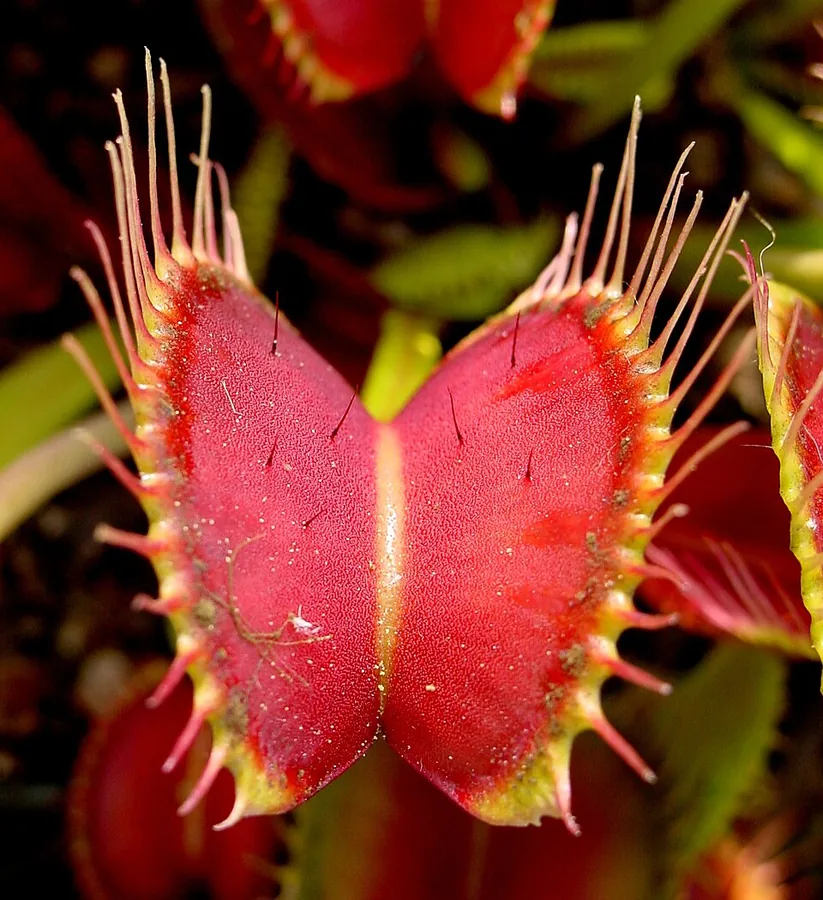
You have likely known the Venus flytrap since childhood, those little hinged jaws that clap shut on a passing insect. It grows wild in just a small stretch of Carolina bog, where the ground holds so little food that the plant learned to feed on bugs instead. That same clever habit is why it asks for care that feels backward at first, but there is no need to worry, since once you understand it the plant is far more forgiving than its reputation suggests.
It never grows big, only a few inches wide, spreading as a low rosette of traps close to the soil rather than a tall leafy stem. Think of it as a true perennial that likes to nap. Spring and summer are its busy season, and then it wants a cold winter rest. Missing that rest is the one slip that trips up most beginners, so knowing about it already puts you ahead.
Get a handful of basics right and the plant takes care of the rest on its own. Strong light, mineral-free water, lean acidic soil, and a cold winter are the whole list. Since it hunts and digests its own meals, the kindest thing you can do is mostly step back and let it work, and any small mistake is usually easy to undo.
Care
The short version: set it in full sun, water it only with distilled, reverse-osmosis, or rainwater, pot it in a lean peat-and-sand blend, skip fertilizer and meat entirely, and let it rest cold and dormant for 3 to 4 months each winter.
Light
Your flytrap will be happiest in full, direct sun, at least 6 hours a day and gladly more. Without it the leaves grow pale and stretchy and the traps stay small and green, so a sunny south-facing window or a summer spot outdoors will please it far more than any shady corner.
Water
Reach for only distilled, reverse-osmosis, or rainwater, never tap or bottled mineral water, since the salts they carry slowly build up and harm the plant. Through the growing season, rest the pot in a tray holding about 1 to 2 cm of water and keep the soil nicely damp. Come winter dormancy, ease off so the mix stays just barely moist instead of soggy.
Soil
Give it a lean, acidic carnivorous blend of sphagnum peat with perlite or silica sand, and nothing richer than that. Regular potting soil, compost, or anything fertilized will burn the roots, so it is best avoided completely. Aim for that very acidic pH of 3.5 to 5.0 and the plant will feel right at home.
Temperature
This is a tougher plant than it looks, comfortable across a wide span from about 41°F to 95°F (5°C to 35°C). Warm summers keep it growing, yet it truly needs a real cold spell each winter to rest, so resist the urge to keep it warm and cozy year round.
Humidity
Ordinary room humidity of around 50% to 70% suits it just fine, and that damp tray keeps the air around the traps pleasant enough on its own. There is no need to mist it or seal it in a terrarium, and skipping those actually helps you avoid mold.
Feeding
There is no need to fertilize, and in fact you never should. A flytrap makes its own meals by catching insects, while fertilizer in the soil burns its roots. Trust the traps to gather every nutrient the plant needs.
Pruning
With clean scissors, trim away any blackened or dead traps and tired leaves right at the base to keep mold from settling in. On a young or stressed plant, it also helps to snip off the tall flower stalk in spring, since blooming pulls energy the little rosette would rather keep.
Repotting
Plan to repot every 1 to 2 years in early spring into fresh carnivorous mix. Do it whenever the rhizomes press against the pot edge, the soil has broken down and gone compact, or several offsets have crowded in together, and treat it as a happy chance to divide.
Size & spacing
This is a petite plant, standing only 2 to 5 inches (5 to 13 cm) tall and spreading about the same. A single flytrap settles comfortably into one small pot, so spacing rarely matters unless you are gathering several together in a shared bog planter.
Troubleshooting
Nearly every flytrap struggle comes down to one of four easy-to-fix habits: the wrong water, not enough light, the wrong soil, or a skipped winter rest. The notes below help you spot which one is happening, and the good news is that a flytrap usually recovers well once you correct it.
Sudden collapse with a soft, rotting crown
Lift a suddenly failing plant and you may find a soft brown rhizome, nearly always from ordinary soil or a dose of fertilizer. Do not lose hope: repot right away into a lean sphagnum peat and perlite or sand mix, trim off the rotted parts, and return to mineral-free water. Any firm white rhizome that remains can still grow back.
Fix:
- Repot into nutrient-poor sphagnum peat and perlite/sand mix
- Resume mineral-free water only
- Remove rotted tissue; healthy white rhizome may still regrow
A slow yearly decline until the plant fades
A flytrap kept warm and awake all year gradually weakens because it never received its winter dormancy. Offer it a cold rest of 3 to 4 months at roughly 35°F to 50°F (2°C to 10°C) with less light and water. In a mild zone it can rest outdoors, and where winters bite hard an unheated space or the refrigerator works nicely.
Fix:
- Provide a 3-4 month cold dormancy at roughly 2-10°C (35-50°F) with reduced light and watering
- Overwinter outdoors in mild zones or in an unheated cold space/refrigerator in colder climates
Traps and leaves turning black and fading
More often than not this is mineral buildup from tap or bottled water, which leaves a pale crust on the soil and saps the new growth. Move to distilled, reverse-osmosis, or rainwater and flush the pot to rinse the salts away, and the plant should soon perk up. If only a few older traps blacken while the rest grows strong, you can relax, since each trap simply retires after several catches.
Fix:
- Switch immediately to distilled, reverse-osmosis, or rainwater
- Flush the media with mineral-free water to leach out salts
- Trim off fully blackened traps at the base
- Stop hand-feeding and let the plant catch its own insects
Pale, floppy growth with small traps that barely shut
This gentle warning almost always means too little light. The stalks grow long and floppy while the traps come in small and green instead of compact with red interiors. Ease the plant into full direct sun for at least 6 hours a day, letting it adjust over a week so the leaves do not scorch, and firmer growth should follow.
Fix:
- Move to full direct sun (a minimum of 6+ hours, ideally outdoors or a very bright sunny window/grow light)
- Acclimate gradually over a week to avoid scorch
Toxicity
You can relax about this one. The Venus flytrap is completely non-toxic to people and pets, with the ASPCA giving it a clear pass for cats and dogs. Its little traps are far too small and gentle to hurt anything bigger than a fly, so the only one who loses out is the plant if someone keeps snapping the traps shut for fun.
Safe for
People · Cats · Dogs · Horses · Rabbits · Livestock · Birds
Cats Safe
The ASPCA counts the Venus flytrap as non-toxic to cats, so a curious feline is in no danger. The tiny traps are simply too small and soft to pinch a paw or an inquisitive nose.
Dogs Safe
Dogs are safe here too, with nothing harmful in the leaves or traps. A dog that mouths one might get a little surprise when a trap closes, but no real harm follows.
Horses Safe
There is nothing toxic in a flytrap, so a nibble poses no risk to a horse. A bog plant only a few inches across was never going to feature in a horse's meal anyway.
Rabbits Safe
Nothing in a flytrap can poison a rabbit, and the traps are far too flimsy to cause any harm. Still, there is little sense in letting a rabbit graze such a slow grower down to nothing.
Livestock Safe
Cattle, goats, and sheep have nothing to fear from this plant. It is a harmless little curiosity rather than anything meant for a pasture.
Birds Safe
Birds face no danger from a flytrap at all. The traps close on insects, not feathers, and hold nothing that could poison them.
People Safe
It is completely safe to handle, children included. A trap closing on a fingertip gives only the softest pinch and cannot break skin, so the only real cost is the wasted energy when someone sets it off for fun.
Touching the trigger hairs makes traps close; repeatedly poking traps for fun wastes the plant's energy and should be avoided.
Varieties
Past the familiar green trap with red-lined jaws, growers have raised a few named forms prized for color, size, or unusual teeth. Here are three worth knowing.
'Akai Ryu' (Red Dragon)
This lovely form blushes a deep maroon-red right through, leaves and traps together, rather than the usual green foliage with red-lined jaws.
'B52'
Chosen for sheer size, 'B52' produces some of the biggest traps you will find on any flytrap for sale.
'Dente'
In place of the long bristly teeth most flytraps wear, 'Dente' fringes its traps with short, neat triangular spines.
How to propagate
There are three friendly ways to grow your collection: dividing a clump, rooting a leaf, or starting from seed. Dividing is the quick, beginner-friendly route, while seed rewards the patient gardener willing to wait a few years.
DivisionModerate
Early spring, during or just after dormancy when repotting · Several weeks to a few months
The easiest way to grow more flytraps is to gently split a clump in early spring, during or just after dormancy while you are already repotting. Carefully separate the offsets so each one keeps its own roots and growing point, then pot them into carnivorous mix. They will settle in comfortably over several weeks to a few months.
Leaf cuttingsModerate
Spring to early summer during active growth · About 1-3 months for plantlets to form
Take leaf cuttings in spring or early summer while the plant is growing strongly. Ease a whole leaf away along with a little of the white rhizome base, lay it flat on damp media, and keep it bright. Tiny plantlets will appear from the base over about 1 to 3 months, which is quietly rewarding to watch.
SeedDemanding
Sow after cold-moist stratification in late winter to spring · 3-5 years to reach mature size
Starting from seed is the slow, patient path. Sow in late winter or spring after a cold-moist stratification to wake the seeds up. Seedlings sprout willingly, yet they take 3 to 5 years to build full-size traps, so most growers begin with a division instead.
Myths
A flytrap should be fed raw meat such as hamburger or chicken.
Raw meat is far too fatty for a flytrap, so it rots inside the trap and turns it black. The plant is built to digest insects and spiders, which it manages beautifully on its own without any help from the kitchen.
Venus flytraps are tropical plants that must stay warm all year.
They are not tropical in the least. These are temperate bog plants from the Carolinas, and a cold winter rest of 3 to 4 months is what lets them live well beyond a season or two.
Tap water is perfectly fine for a flytrap.
The minerals and salts in tap and bottled water gather in the soil and slowly harm the roots. Stick to distilled, reverse-osmosis, or rainwater and nothing else, and your plant will thank you.
A flytrap must be hand-fed often to survive.
Given full sun, a flytrap makes its own food and catches plenty of insects without any assistance. Hand-feeding is a choice, never a duty, and doing too much of it simply tires the traps out.