Houseplant · Aizoaceae
Split Rock
Pleiospilos nelii
A little succulent shaped like a cracked pebble, happy with sunshine, a dry rest, and almost nothing else.
Full sun
50–86°F · 10–30°C
USDA 9–11
2–3 in · 5–8 cm
Overview
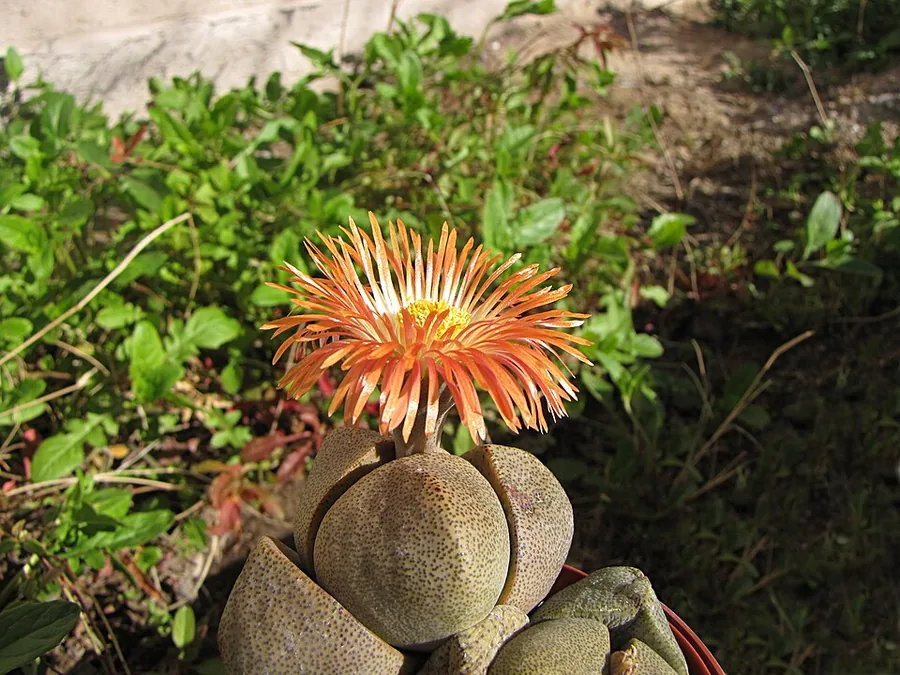
A plant that mimics a stone can seem daunting, but split rock is far kinder than its craggy looks let on. This tiny South African succulent sits in the mesemb tribe of the Aizoaceae family, and its plump, split leaves round out into a body about as big as a large pebble. Set it in a gritty pot and it could pass for a fragment of cracked granite, the very disguise it grew into back home in the wild.
Growth is gentle and unhurried, so there's no rush to keep up with. It tops out at just 2 to 3 inches (5 to 8 cm) tall and settles in nicely as a year-round houseplant on any bright windowsill, wearing only one or two leaf pairs at a time. Once a year a brand-new pair rises up from within the old one, quietly drinking the previous leaves down until nothing but a papery husk is left, and that is normal, healthy, and nothing to worry about.
Here is the one thing to watch, and it isn't feeding or pruning, it's water. Split rock lives by a strict rhythm and wants a completely dry summer rest, so the most common way to lose one is simply being too generous with the watering can. Time the drinks right and this patient little plant will thank you with a cheerful, daisy-like bloom in late winter or spring.
Care
The short version: give it the brightest light you can, a gritty mix that drains in a flash, and water only while it's actively growing in spring and autumn, never during its dormant summer or while it's renewing its leaves.
Light
Give your split rock the sunniest spot you can find, ideally full sun at a south-facing window. That strong light is what keeps its little body plump and stone-like, while a dim corner will coax it pale, leggy, and out of shape. Don't worry if you can't offer perfect sun everywhere, just aim for the brightest place you have.
Water
This really is the heart of caring for split rock, so go slow and trust the dry spells. Offer water only while it's actively growing in spring and autumn, and only after the soil has dried out all the way through. Keep it bone dry all through summer dormancy and for the whole time a new leaf pair is pushing out, since a drink at those moments makes the leaves swell, split, and rot.
Soil
Pot it up in a very gritty, fast-draining mineral or cactus mix that never sits wet. Anywhere from 6.0 to 7.5 on the pH scale will make it happy, so the exact reading matters far less than how quickly water rushes out the bottom.
Temperature
It feels right at home between 50°F and 86°F (10°C to 30°C), which is ordinary indoor warmth for most of the year. A cooler, dry stretch over summer is a welcome rest, though nothing to fuss over.
Humidity
Good news here, since low humidity is exactly what this desert dweller loves, and there's no target to hit. Dry air keeps it healthy, while the damp, stuffy air it dislikes is what leads to rot.
Feeding
Feeding is a light touch and a rare one, saved for the spring and autumn growth spells. A weak, low-nitrogen cactus or succulent feed is all it ever needs, because a heavy hand only pushes soft, floppy growth this little plant would rather do without.
Pruning
Happily, there's nothing to trim, and you should never take a blade to the plant. Just let the old leaf pair wither and be drawn back into the new one, then softly lift away the papery leftovers once they've dried up.
Repotting
Repotting is an occasional job, needed only every 2 to 3 years or whenever the plant has clearly outgrown its home. Keep a gentle eye out for roots creeping through the drainage holes or the plant lifting itself up out of the soil, both friendly hints that a fresh gritty mix is due.
Size & spacing
Split rock stays wonderfully small, rising only 2 to 3 inches (5 to 8 cm) tall and reaching about 3 to 4 inches (7 to 10 cm) across. A single plant is quite content filling a little pot all on its own.
Troubleshooting
Nearly every split rock worry comes back to water offered at the wrong moment, and the leaves are where it shows. Once you learn to feel whether they are firm, soft, or piling up, you can catch trouble early and turn things around. Find your plant's symptom below and respond promptly, and you'll usually be fine.
Leaves that split apart or go soft and see-through
Soft, splitting leaves almost always mean rot brought on by too much water, usually a drink given at the wrong moment. The risk peaks in summer dormancy and while a new leaf pair is emerging, times when your plant truly wants nothing at all. Set the watering can aside, trim away any squishy tissue with a clean blade, and settle it into a grittier mix that drains faster.
Fix:
- Stop watering immediately
- Cut away rotted tissue with a clean blade
- Repot into a much grittier, faster-draining mix
- Allow the plant to dry out fully before any further water
A pile of leaf pairs that won't shrink back
A content split rock keeps just one or two leaf pairs going at once. Spotting three or more stacked up usually means it was watered or fed during leaf renewal, so the old pair never got used up. Hold back water and let the plant draw on those old leaves, then ease back into the normal dry routine once the extras have been reabsorbed.
Fix:
- Withhold water so the plant draws on the old pair
- Resume the normal dry-cycle once excess pairs are reabsorbed
Washed-out, stretched growth that loses its stony look
When a split rock stretches upward and fades pale, it is crying out for more light. That snug, stone-like shape only stays put under strong sun, and a shady sill slowly pulls it loose. Shift it to the brightest place you have, somewhere that gets a good few hours of direct sun each day.
Fix:
- Move to the brightest available position with several hours of direct sun
Toxicity
Rest easy if you share your home with pets or little ones, because split rock is not toxic. It doesn't appear on the ASPCA lists, and the mesembs in its family carry no known poisons. The most that could happen is a brief tummy upset if a curious pet swallows a mouthful of the gritty, fibrous leaf.
Safe for
People · Cats · Dogs · Horses · Rabbits · Livestock · Birds
Cats None
A curious cat is perfectly safe alongside this plant. Should one nibble a leaf, the fibrous tissue might bring a little passing tummy upset, but there's nothing poisonous going on.
Dogs None
Dogs are in no danger of poisoning here. The most a persistent chewer might notice is some brief drooling or loose stool from the gritty leaf, and that eases up on its own.
Horses None
There's no poisoning risk for horses to speak of. And since the plant is so small, there's barely a mouthful for a horse to find anyway.
Rabbits None
Nothing about this plant will poison a rabbit. A nibbled leaf might just bring a bit of gas, since the dense succulent flesh isn't something a rabbit's tummy usually handles.
Livestock None
Goats, sheep, and cattle have nothing toxic to fear from this little plant. The worst a grazer might feel is a mild, short-lived grumble in the belly from the gritty bite.
Birds None
Pet birds are quite safe around it, with no poisoning ever recorded. A bird that pecks a leaf risks nothing worse than a slightly unsettled crop from the fibrous mouthful.
People None
Growing and handling it is completely safe for grown-ups and children alike. It simply isn't a food plant, so there's no need to taste it.
Its sharp gritty soil and fibrous leaf tissue could cause minor mechanical or digestive upset if a pet chews and swallows large amounts.
Varieties
You'll only meet a couple of forms in most collections, and the difference between them comes down to color. Here are the two that are good to know.
Pleiospilos nelii (species)
The wild species wears grey-green, cracked leaves that plump up into an almost round body, the spitting image of a split stone.
Pleiospilos nelii 'Royal Flush'
This selection swaps the everyday grey-green for rich purple to reddish leaves while holding on to the familiar cracked-stone form.
How to propagate
Split rock takes its time multiplying, and that's perfectly fine. You can grow new ones from seed or gently divide a settled clump the next time you repot.
SeedModerate
Sow in warm conditions during spring or autumn · Several months to over a year to reach a recognizable plant
Start seed in the warmth of spring or autumn by scattering it across the top of a gritty mix and keeping it just barely moist until the tiny sprouts appear. From there, move over to the strict dry cycle. Bring some patience along, since it can take several months to more than a year for a seedling to grow into a plant you'd recognize.
DivisionModerate
During active growth when repotting an established clump · Several weeks to a few months
Once a clump has filled out, you can gently divide it during active growth while you're already repotting. Ease away an offset that has a few roots of its own, let the cut edges dry and callus over, then set it into a dry gritty mix. A fresh division usually finds its feet within a few weeks to a couple of months.
Myths
Split rock is just a type of Lithops.
They belong to two separate genera, even if both sit in the mesemb group. Split rock is a Pleiospilos, with much fatter and fewer leaves than a real Lithops, so the family likeness only goes as deep as the surface.
You can water it on a set schedule like any other succulent.
This one follows a strict rhythm and insists on a bone-dry summer rest. Watering it steadily all year makes the leaves burst and rot, which is the surest way to lose the plant, so let those dry spells run their full course.