Shrub · Anacardiaceae
Smoke Bush
Cotinus coggygria
Give it sun and sharp drainage, and this easygoing shrub rewards you with summer haze and blazing fall leaves.
Full sun
Every 7–14 days
USDA 4–8
10–15 ft · 3–4.6 m
Overview
If a smoke bush is your first shrub, take heart, because this is about as forgiving a plant as you will find. It belongs to the cashew and sumac family, grows fast, drops its leaves each winter, and asks very little once it feels at home. Given room, it will reach 10 to 15 feet (3 to 4.5 m) across and up, so pick a generous spot and let it settle.
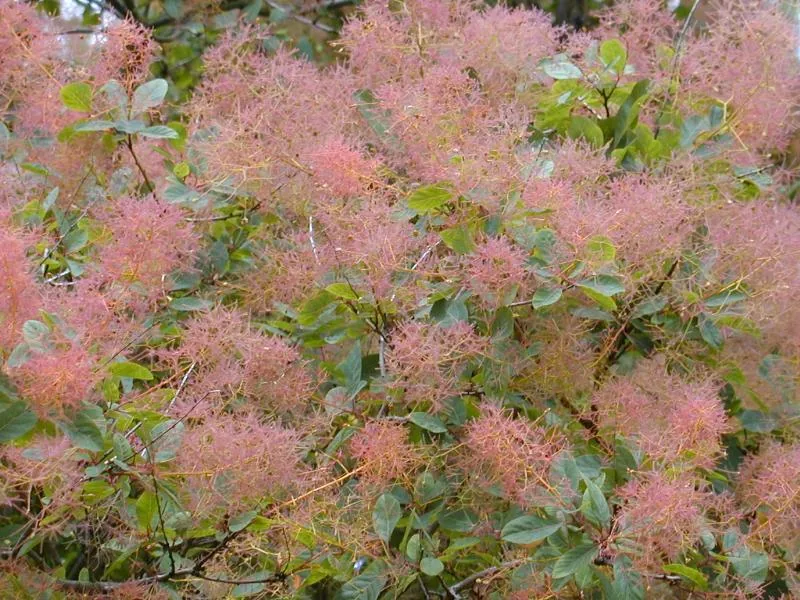
The reward for that patience is color you won't soon forget. Leaves range from gentle green to a deep, almost-black purple depending on which one you grow, and come autumn many turn warm shades of orange and red. Floating above them, soft plumes rise from the faded flowers and hover like haze settling in the branches.
Best of all, it is hard to get wrong. Sun, lean ground, and good drainage are really all it wants, and after the roots dig in it copes with dry spells without complaint. The one misstep to avoid is soggy soil, so if you steer clear of wet ground, you are already most of the way there.
Care
The short version: give it full sun and soil that drains sharply, water deeply while it's young, and then relax, because a settled smoke bush handles drought on its own, seldom wants feeding, and only needs the pruning that fits the look you are after.
Light
Settle it in full sun and you will see the richest leaf color and the fullest cloud of smoke. It will get by in partial sun too, though the purple types drift back toward green and the haze grows thin where shade is heavy, so brighter really is kinder here.
Water
While your shrub is still finding its feet, keep the soil evenly moist so the roots can settle. Once it's established it turns drought tolerant and much prefers a deep drink every 7 to 14 days over frequent sips. The one thing to spare it is standing water, which sits on the roots and rots them.
Soil
Don't worry about pampering the ground. A plain, well-drained loam suits it, and it is just as content in poor, rocky soil where fussier shrubs would sulk. It accepts a broad pH span of 5.5 to 8.0, but the drainage part is where you cannot cut corners.
Temperature
You can plant this one with confidence in a cold garden. It rides out a wide swing from -29°F to 95°F (-34°C to 35°C) without fuss, and that easy toughness is what lets it thrive across so many temperate yards.
Humidity
Ordinary outdoor air is all it needs, so there is nothing to fuss over on that front. What helps far more is steady airflow, since damp, crowded leaves are exactly where leaf spot and rust like to begin, and a little breathing room keeps them at bay.
Feeding
Feel free to feed it lightly or not at all, and know that skipping it is perfectly fine. A gentle spring helping of balanced fertilizer is plenty for the rare plant that wants any, because this shrub genuinely likes lean ground and grows floppy in soil that is too rich.
Pruning
The way you prune simply decides what you would rather enjoy. A light early-spring trim keeps the smoke display, since that haze forms on older wood. If bold leaf color on a purple cultivar is what you want, coppice hard in late winter and cut the stems to 6 to 8 inches, trading that season's smoke for fresh, glowing growth.
Repotting
Smoke bush is happiest in the open ground and seldom lives in a pot at all. Should you try one in a container, only shift it up when the roots start circling or water rushes straight through, both gentle hints that it is ready for more room.
Size & spacing
Give it plenty of elbow room from day one. A grown smoke bush spreads to 10 to 15 feet (3 to 4.5 m) in both height and width, so set it well back from paths, walls, and smaller neighbors, and you will save yourself any crowding later.
When to plant
This is a hardy shrub for zones 4 to 8, and it goes in during spring or fall once the hard frosts are behind you. The smoke builds slowly from late spring onward, with tiny flowers opening May to July before their stalks puff out into that soft cloud, so give it time to put on the show.
Northern hemisphere
Southern hemisphere
Typical months for a temperate climate: start earlier in warm zones, later where spring frosts linger.
- Plant: Spring or fall, after the last hard frost
- Harvest: Smoke display from late spring through summer (flowers May to July)
Hardiness
USDA hardiness zones: 4–8
Temperature: down to -34°C
Troubleshooting
Happily, a healthy smoke bush rarely gives you much trouble, and the few things that crop up are easy to spot once you know the signs. Keep a friendly eye on the branches for sudden wilting and the leaves for spotting, then step in early. The notes below will help you match what you see and put it right.
Whole branches drooping and dying, usually on one side
When limbs wilt, yellow, and die back for no clear reason, the culprit is usually verticillium wilt, a fungus in the soil that clogs the plant's water pipes from within until a branch simply gives up. Slice into a fading stem and you will notice dark streaks in the wood beneath the bark. No spray will cure it, so take heart in what you can do: prune away the dead wood, clean your tools between every cut, and if a plant is truly lost, lift it out rather than set another in the same ground.
Fix:
- Prune out and destroy affected branches, disinfecting tools between cuts
- Improve drainage and avoid overwatering
- Remove and destroy severely infected plants; do not replant susceptible species in the same spot
Little hard bumps crusting along the stems
Those small gray-to-brown crusts clinging to the bark are San Jose scale, sap-feeding insects tucked beneath a hard shield that slowly tire the branches. Nudge one and it flakes away. Cut out the worst of the affected wood, then coat what remains with a dormant horticultural oil in late winter, before the insects stir for the season.
Fix:
- Prune out and destroy heavily infested branches
- Apply dormant horticultural oil in late winter to smother overwintering scale
Freckled leaves or rusty spots underneath
Damp, crowded growth is what invites leaf spot and rust, dotting the foliage with clear spots or leaving orange-brown pustules on the undersides. Try not to fret, because it looks nastier than it is and rarely bothers a well-rooted shrub. Gather up and bin the fallen leaves, open the plant to a bit more air, and keep water off the foliage where you can.
Fix:
- Rake up and dispose of fallen infected leaves
- Improve air circulation and avoid overhead watering
Toxicity
Here is a relief for anyone with pets or little ones underfoot: smoke bush is not toxic. It does not appear on the ASPCA's poison lists, and there is no animal you need to fence away from it. The only small note is for people, since the sap can raise a mild rash on anyone who reacts to poison ivy, so slipping on gloves before you prune is a kind thing to do for your skin.
Safe for
People · Cats · Dogs · Horses · Rabbits · Livestock · Birds
Cats None
Smoke bush isn't on the ASPCA's toxic roster, so if a curious cat sneaks a nibble of a leaf, there is nothing here to worry you.
Dogs None
A dog can push through the branches or gnaw a leaf and come away just fine, since the shrub holds no toxin that would trouble one.
Horses Safe
No case of horse poisoning has ever been linked to smoke bush, so a stolen grazing mouthful is nothing to lose sleep over.
Rabbits Safe
Rabbits nibbling the lower stems stay perfectly well, as the plant carries no compound that could hurt them.
Livestock Safe
Cattle, goats, and sheep can graze happily alongside this shrub with no danger of poisoning at all.
Birds Safe
Birds that nest or forage around a smoke bush are safe from its leaves, its stems, and its fluffy seed heads alike.
People Safe
It's a friendly plant to live with, though anyone who reacts to poison ivy might get a mild rash from the sap, so gloves are a smart idea at pruning time.
As a member of the Anacardiaceae (cashew and sumac family), contact with the sap may cause mild contact dermatitis in sensitive people, especially those allergic to poison ivy. Wear gloves when pruning if you are sensitive.
Varieties
Nearly every smoke bush at the garden center is a named cultivar, picked for the color of its leaves or the size of its smoky show. Here are the ones you are most likely to meet.
Royal Purple
A neat, purple-leaved favorite whose foliage unfurls maroon-red in spring, then settles into a near-black purple that keeps its depth all the way through summer.
Golden Spirit ('Ancot')
Cheerful golden-yellow leaves that warm to orange and red as fall arrives, a lovely departure from the familiar green and purple sorts.
Young Lady
A compact, green-leaved form loved for the billowing smoky panicles it produces so freely, even while the shrub is still quite young.
Velvet Cloak
Deep purple leaves set against big pink panicles on a larger shrub that can stretch to the tallest end of the range.
How to propagate
Making more smoke bushes is easier than you might expect, though the cultivars only stay true when grown from cuttings or layers. If you would just like a plant or two more, layering is the gentlest and most reliable place to start.
Stem cuttingsModerate
Early to mid summer · Several weeks to root; a full season to establish
Snip softwood or semi-hardwood cuttings from this year's growth in early to mid summer. Give them several weeks to form roots and a whole growing season to truly settle, and a little patience pays off nicely here.
LayeringEasy
Spring to early summer · One growing season or more to root
The kindest method for a beginner is layering, done in spring or early summer. Ease a low, bendy branch down to the ground, pin it in place, and let it root across a season or more before you separate it from its parent.
SeedModerate
Fall sowing or after cold stratification · Slow; seedlings of cultivars will not come true to type
Seed is best saved for the plain species, sown in fall or given a cold spell first. It's a slow road, and seedlings from named cultivars won't match the parent, so grow those from cuttings or layers instead.
Myths
The pink haze on a smoke bush is a mass of flowers.
The real blooms are small, yellowish, and simple to overlook. What you see as smoke is the leftover flower stalks, which draw out into long, feathery hairs that shift from smoky pink to a purplish pink as the summer wears on.
Cutting it back hard every spring brings the most smoke.
Because smoke rides on old wood, a heavy yearly cut swaps the haze for leaves instead. Coppice in late winter and you gain bright foliage but no smoke that year, which is exactly why the purple kinds are so often grown for their color rather than their bloom.