Tree · Pinaceae
Scots Pine
Pinus sylvestris
Forgiving, fast, and content on dry, sandy ground, Scots pine asks for sunshine and little more.
Full sun
Every 7–14 days
USDA 2–7
30–60 ft · 9.1–18.3 m
Overview
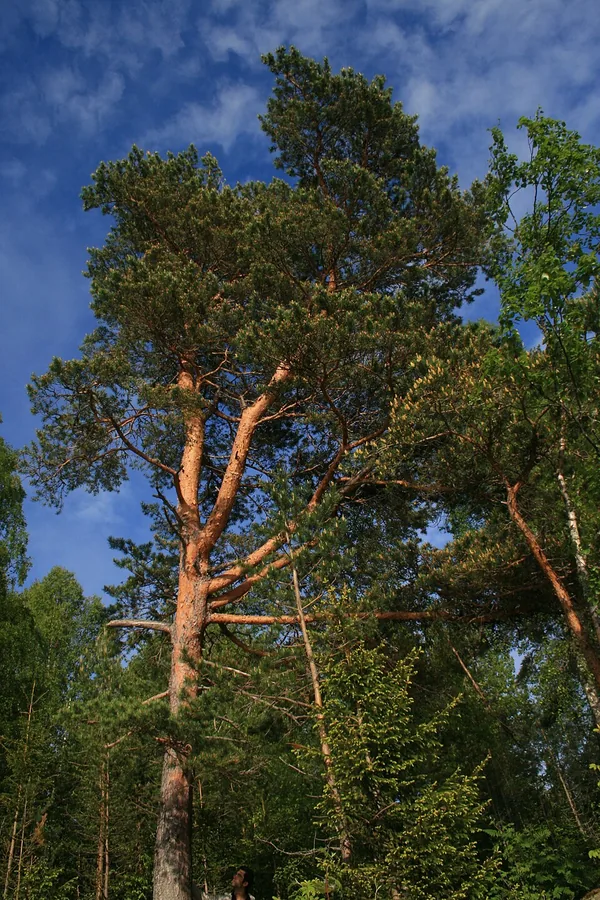
If you have never grown a conifer before, Scots pine is a kind place to start. It is one of the most widely planted pines on the planet, easy to recognize by its flaking orange-red bark that seems to glow against a gray winter sky. The needles grow in twisted blue-green pairs, and as the tree ages its crown loosens and turns wonderfully ragged, giving old specimens a windswept character all their own. It belongs to the Pinaceae family, grows wild across Europe and Asia, and has long been welcome in North American gardens and Christmas-tree fields.
The best part, especially if you worry about getting things wrong, is how little it needs from you. It grows quickly, laughs off cold down to -40°F (-40°C), and settles happily into dry, sandy, even fairly poor soil where pickier trees would struggle. That easygoing nature is exactly why it once filled so many yards and tree farms, and it is why small mistakes rarely set it back.
The one thing to keep an eye on is pests. Pine wilt disease has pushed Scots pine out of the nursery trade across much of the Midwest, and tip blight along with a few insects can wear on a tree that is already stressed. None of that should scare you off. Plant it somewhere wilt has not taken hold, keep it growing strongly, and this pine can stand tall for a very long time.
Care
The short version: give Scots pine full sun, well-drained sandy or loamy soil that leans acidic, and only a little water once its roots are down. It rarely needs feeding, prefers pruning in dry weather, and simply wants the elbow room a large tree deserves.
Light
Scots pine loves full sun and wants as much of it as you can give. It has almost no tolerance for shade, and a young tree hemmed in by taller neighbors tends to stretch thin, leggy, and weak, so an open, bright spot really pays off.
Water
Once its roots take hold, Scots pine is drought tolerant and gets by mostly on rainfall, even in dry, sandy ground. While a young tree is still settling, give it a drink through dry spells, then gradually step back. A good soak every 7 to 14 days during that first establishing stretch is plenty.
Soil
This pine is happy in well-drained sandy or loamy soil and is forgiving of poor, dry spots that discourage other trees. It leans toward acidic ground, roughly pH 4.5 to 7.0, though it will accept a touch of alkalinity without any sulking.
Temperature
Cold simply is not a problem here. Scots pine handles anything from -40°F to 95°F (-40°C to 35°C), which explains how it reaches so far north into zone 2 and still feels at home.
Humidity
Everyday outdoor humidity suits Scots pine just fine, so there is no reading to fuss over. What matters more is good air movement, because still, damp air is what encourages the tip blight this pine can be prone to.
Feeding
Think of Scots pine as a light feeder that seldom asks for anything extra. Established trees usually thrive on no fertilizer at all, and on the rare occasion growth looks weak, one gentle balanced feeding in spring will do the trick.
Pruning
Keep pruning light and occasional. Remove dead, damaged, or diseased branches in dry weather only, since cutting while things are wet can spread Diplodia tip blight, and rest easy knowing the tree takes shearing well when it is grown as a Christmas tree.
Repotting
Scots pine is really a landscape tree and is rarely kept in a pot for long. If you do container-grow a young one, roots circling the drainage holes, new growth that stalls, or water rushing straight through are all gentle hints that it has outgrown the pot and belongs in the ground.
Size & spacing
Remember that this is a big tree, climbing 30 to 60 feet (9 to 18 meters) tall and spreading 30 to 40 feet (9 to 12 meters) wide. Give it that generous room from the start, well away from buildings and other trees, so the crown can fill out in full sun.
When to plant
Because Scots pine is so cold-hardy, thriving across zones 2 through 7, planting is less about timing a harvest and more about helping young roots settle in. Aim for spring or fall, when the soil is easy to work and rain comes steadily, and let the tree get comfortable before summer heat or deep winter cold arrives.
Northern hemisphere
Southern hemisphere
Typical months for a temperate climate: start earlier in warm zones, later where spring frosts linger.
- Plant: spring or fall
- Harvest: Non-flowering conifer; produces gray to light brown cones about 3 in long. Often harvested as a Christmas tree.
Hardiness
USDA hardiness zones: 2–7
Temperature: down to -46°C
Troubleshooting
Most of the trouble a Scots pine runs into shows up first in the needles and the tender new candles, and the serious cases come from pests and fungal disease. Take heart: the key skill is simply telling a grave threat like pine wilt apart from something you can treat, then stepping in early. Find your tree's symptom in the list below.
Whole branches turning brown, a tree lost in a single season
When entire branches brown out and a tree can die within one season, the cause is nearly always pine wilt disease, spread by a tiny nematode that pine sawyer beetles carry from pine to pine. The needles slip from gray-green to a dull yellow-brown, and cut wood barely weeps any resin. Sadly there is no cure, so a confirmed tree must be taken down and then burned, buried, or chipped before the beetles move along to a neighbor.
Fix:
- No cure exists once a tree is infected
- Promptly remove and destroy (burn, bury, or chip) dead and dying trees to eliminate beetle breeding sites
- Do not leave cut pine wood on site, as it harbors the beetle vector
Sticky pitch blobs on the trunk with branches breaking at the whorls
Those sticky blobs come from the Zimmerman pine moth, whose larvae bore in under the bark right where branches join the trunk. The weakened joints give way, so a branch or even the treetop can snap off at a whorl. Prune out and destroy the infested wood, keep the tree growing strongly, and where this moth is a known nuisance, spray the trunk in mid-April and again in mid-August to catch the larvae before they tunnel in.
Fix:
- Prune out and destroy infested, broken, or dying branches
- Maintain tree vigor with proper siting and watering
- Apply a registered insecticide trunk spray in mid-April and again in mid-August to target larvae before they bore in
Little white specks on the needles you can scrape away
Those specks are pine needle scale, small white armored insects that cling to the needles and drain their sap until the foliage looks bleached and sparse. Go after the crawlers, the reddish nymphs that appear in late spring, with horticultural oil or insecticidal soap, then treat again for the second brood in midsummer. Trim off and destroy any branches that have become crusted over.
Fix:
- Treat crawlers (tiny reddish nymphs) with horticultural oil or an insecticidal soap in late spring
- Repeat for the second generation in midsummer
- Prune out and destroy heavily encrusted branches
Clusters of larvae eating last season's needles in spring
The feeders here are the European pine sawfly, with grayish-green larvae that line up side by side on the older needles while leaving the fresh tips alone. Pick or prune off the clusters and destroy them, or blast the larvae away with a firm jet of water. If the feeding gets heavy, choose an insecticide labeled for sawflies, since Bt has no effect on them.
Fix:
- Hand-pick or prune out clusters of larvae and destroy them
- Knock larvae off with a strong stream of water
- Apply an insecticide labeled for sawflies if defoliation is heavy (Bt does not work on sawflies)
New candles browning and staying stubby at the branch tips
This is Diplodia tip blight, a fungus that kills the fresh candles and leaves short brown needles dotted with tiny black fruiting bodies, and in long wet spells Dothistroma needle blight can join in. Prune and burn the infected twigs and cones in dry weather only, wiping your pruners with 10 percent bleach between cuts. Where the disease returns year after year, apply a fungicide at bud break and on through candle elongation.
Fix:
- Prune and destroy infected twigs, branches, and cones during dry weather only
- Sterilize pruners with 10 percent bleach between cuts
- Apply fungicide at bud break, half candle elongation, and full candle elongation where the disease is chronic
Toxicity
Here is some reassurance for anyone with pets at home: Scots pine is a genuine pine and not poisonous to cats, dogs, horses, or livestock. The only things worth a thought are the needles, sharp enough to prick a curious nose or mouth, and the sticky sap, which can bother skin or leave a stain.
Safe for
People · Cats · Dogs · Horses · Rabbits · Livestock · Birds
Cats Safe
Scots pine will not poison a cat. The real thing to mind is the sharp needles, which can jab the mouth, and a little nibbled greenery might trigger a brief bout of vomiting before your cat feels fine again.
Dogs Safe
A dog can mouth these needles with no risk of poisoning. The sticky sap and stiff needles may cause a bit of irritation, and a large mouthful of foliage can unsettle the stomach for a little while.
Horses Safe
Horses do just fine around Scots pine, unlike ponderosa and some of its cousins. There is nothing in particular to watch for beyond the simple scratch of the needles.
Rabbits Safe
Rabbits face no toxin in the needles or bark, and pine is sometimes handed over as a chew branch. Just be sure any wood comes from untreated, unsprayed trees.
Livestock Safe
Cattle, goats, and sheep can browse Scots pine safely, without the pine-needle abortion linked to ponderosa pine. In truth, grazing animals usually steer clear of the prickly foliage anyway.
Birds Safe
Birds are perfectly safe with this pine. Many happily shelter in its dense crown and tug the seeds right out of the cones.
People Safe
Scots pine is no poisoning threat to people, and its inner bark and needles have long been brewed into teas. The needles are sharp, though, so watch how little hands and mouths come into contact with them.
Sharp needles and sticky sap can cause mild mechanical irritation; sap may stain. No special handling required beyond normal care.
Varieties
Most Scots pines you will find for sale are simply the wild species, but a handful of selected forms show up when you want a particular look. These few are the ones worth learning by name.
Fastigiata
A slim, columnar Scots pine that shoots straight upward like an exclamation point, ideal when you want tall vertical interest in a narrow space.
Watereri
A slow-growing dwarf that settles at around 10 to 12 feet, wearing stiff, twisted blue-gray needles above bark that peels in orange-tinged scales.
Glauca
Prized for its deep blue-green needles, the strongest blue tone found in any common Scots pine.
How to propagate
Almost every Scots pine begins life as a seed, and grafting is saved for the named forms that will not breed true from seed.
SeedModerate
Sow stratified seed in spring. · 2 to 3 years to a sturdy sapling
Nearly every Scots pine you come across was raised from seed. The cones need two years to ripen, and the seed wants a cold, moist rest before it will wake up, so sow it in spring after stratifying. Allow it 2 to 3 years to grow into a sturdy young sapling.
GraftingDemanding
Late winter, onto seedling rootstock · 1 to 2 years
Named selections such as Fastigiata and Watereri will not come true from seed, so growers graft them instead. The graft is made in late winter onto seedling rootstock, and a good union knits together and settles over the following 1 to 2 years.
Myths
Scots pine needles make pregnant animals miscarry.
Pine-needle abortion is a genuine condition, but it belongs to ponderosa pine and a few near relatives whose isocupressic acid harms pregnant cattle, not cats, dogs, or horses. Scots pine simply is not the pine behind it, and the ASPCA actually lists ponderosa pine itself as non-toxic to dogs and cats.
Scots pine is invasive and should never be planted in North America.
The USDA Forest Service rates Scots pine noninvasive in North America, even though it has naturalized in pockets of the Northeast and Great Lakes. What has truly shrunk its place in the trade is pine wilt and other pests, not any habit of running wild.