Tree · Pinaceae
Douglas Fir
Pseudotsuga menziesii
Give it room, moist soil, and a little patience, and the Douglas fir will reward you by growing into one of the tallest trees in the forest.
Full sun
Every 7–14 days
USDA 4–6
39–79 ft · 12–24 m
Overview
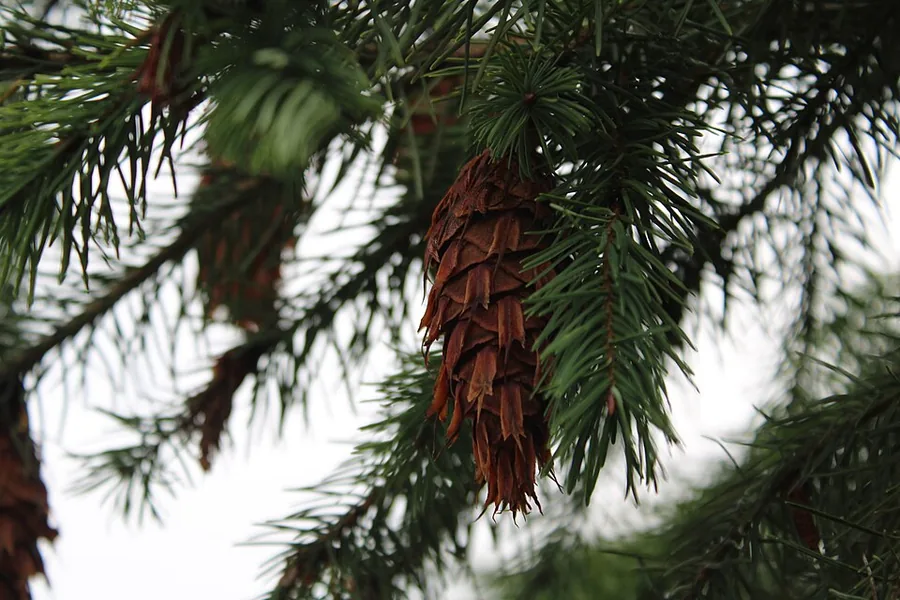
The Douglas fir is one of the great trees of western North America, a fast-growing conifer that can climb past 80 feet (24 m) in a yard and far higher in the wild, yet it asks less of you than its size suggests. Despite the name it is not a true fir but its own sort of evergreen, and you can spot it by the soft flat needles and the dangling cones whose papery bracts poke out like tiny mouse tails. It is the beloved Christmas tree of the Pacific Northwest and a mainstay of the timber world.
Two main forms show up in gardens, and picking the right one is the kindest favor you can do yourself. The coast type grows fast and tall and loves the mild, damp weather west of the mountains, while the Rocky Mountain blue form stays smaller, looks bluer, and shrugs off hard cold down to zone 4. Matching the form to your climate matters more here than with most trees, simply because the wrong seed source will fight disease, so a moment of choosing well saves you years of worry.
This is a tree for space and time rather than a fast screen, and that is no reason to feel daunted. It wants deep, moist, well-drained ground and full sun, and it dislikes drought, compaction, and soggy roots. Plant it well away from the house, give it light and water while it is young, and you will hand on a landmark tree that quietly outlives the person who set it in the soil.
Care
The short version: give it full sun, deep and steadily moist acidic-to-neutral soil that drains well, and plenty of open room, since this is a tree that can stretch to 40 to 80 feet in the yard.
Light
Give your Douglas fir full sun and it rewards you with the fullest, densest growth. It will put up with a little partial shade, especially while young, but a tree grown in too much shade turns thin and leggy, so brighter is kinder.
Water
This tree is intolerant of drought and wants soil that stays deep and steadily moist without ever sitting waterlogged. Water young trees on a regular rhythm until they settle in, every 7 to 14 days depending on the weather, and try not to let a long dry stretch pass without a drink.
Soil
Set it into deep, moist, organically rich loam that drains freely and leans acidic to neutral, anywhere from pH 4.5 to 7.2. It will not forgive poorly drained or compacted ground, where root rot can take hold, so loosen heavy soil before you plant.
Temperature
Douglas fir is tough about weather, handling anything from -29°F to 90°F (-34°C to 32°C) depending on the form you choose. The Rocky Mountain type takes the harshest cold of all, down to zone 4, so there is a fit for chilly gardens.
Humidity
Outdoor humidity is simply whatever your climate offers, so there is nothing for you to fuss over. Air circulation matters far more than moisture in the air, because crowded, stagnant spots are what let needle cast settle in.
Feeding
Feed in spring with a balanced fertilizer or one made for conifers and evergreens. The aim is not to push growth but to keep the tree unstressed, and a well-fed tree shrugs off needle cast much more easily.
Pruning
Pruning hardly comes into it. Remove only the dead, damaged, or diseased branches and let the natural shape be, unless you happen to be shearing a Christmas tree.
Repotting
This is a forest tree at heart, not a pot plant, so repotting rarely matters past the nursery stage. Keep an eye on a potted young tree for roots circling, stalled new growth, or soil that dries out very fast, all gentle hints it wants the open ground or a roomier container.
Size & spacing
A Douglas fir grows large and quickly, reaching 40 to 80 feet (12 to 24 m) tall with a spread of 12 to 20 feet (3.7 to 6 m). Plant it well clear of buildings, power lines, and septic lines, and give it the open space a landmark tree deserves.
When to plant
Douglas fir is a patient, long game rather than a seasonal crop, and that is part of its charm. Chill the seed through late winter, set young trees out in spring once the hard frosts are gone, and do not wait on flowers, because this conifer makes cones instead, ripening from late summer into fall.
Northern hemisphere
Southern hemisphere
Typical months for a temperate climate: start earlier in warm zones, later where spring frosts linger.
- Sow: Late winter after cold-moist stratification of seed for about 1-2 months.
- Plant: Spring, after the last hard frost, while trees are small and easy to transplant.
- Harvest: Non-flowering conifer; cones mature late summer to fall. No ornamental bloom.
Hardiness
USDA hardiness zones: 4–6
Temperature: down to -34°C
Troubleshooting
Most Douglas fir trouble turns up either in the needles or down at the roots, and almost all of it is easier to face once you know where to look. The needle troubles often come back to the wrong seed source in a wet climate, while the real dangers sit out of sight underground. Match what you see below and step in early, since a stressed tree gives way to disease much faster than a healthy one.
A pale, thinning crown with dieback and a fading tree
When the whole crown goes thin and pale and branches start dying back, the cause is often hidden at the roots. Armillaria root rot leaves thick white fungal fans tucked between the bark and wood at the root crown, along with black shoestring-like strands, while Phytophthora root rot turns roots dark and soft in soil that stays wet or compacted. No spray will cure a tree once it is infected, so the kindest path is to improve drainage, avoid planting too deeply, and lift any badly affected tree before replanting the spot with something tougher.
Fix:
- Improve drainage and avoid overwatering or planting too deeply
- Remove and destroy severely infected trees including small roots
- Replant the site with more resistant species
Older needles fade to brown and fall while the crown opens up
If the oldest needles go patchy and drop while only the freshest growth hangs on, you are almost surely looking at needle cast, a fungus that works through the older needles first. Take heart, because it is readable: Swiss needle cast lines the needle undersides with tiny black dots, and Rhabdocline marks second-year needles with reddish-brown blotches. You can help your tree a great deal by thinning crowded stems for airflow, keeping the roots watered, and, in a damp climate, choosing Pacific Coast seed sources, which cope far better than Rocky Mountain stock.
Fix:
- Improve air circulation by thinning crowded trees and increasing spacing
- Keep trees adequately watered and properly fertilized to reduce stress
- Apply a labeled fungicide at budbreak and as new needles expand where infection pressure is high
- Remove and dispose of heavily infected fallen needles
Needles eaten off the branches, worst near the top
Bristly caterpillars stripping needles from the top of the tree downward usually mean the Douglas-fir tussock moth or the western spruce budworm, and in a bad year either can strip a tree bare. The good news is you get a warning if you look for the egg masses on the bark before they hatch in spring. A spray of Btk while the larvae are young handles most outbreaks, and in many seasons the natural enemies and a native wilt virus quietly end the trouble within a year or two on their own.
Fix:
- Monitor for egg masses before spring hatch
- Apply Bacillus thuringiensis (Btk) or a labeled insecticide while larvae are young
- Allow natural enemies and the naturally occurring wilt virus to collapse outbreaks over a season or two
Cottony white tufts on the needles, which curl and pale
Those soft white puffs are the Cooley spruce gall adelgid, a small sap feeder that bends Douglas-fir needles rather than building the cone-shaped galls it raises on spruce. The reassuring part is that a light scattering rarely needs your hand at all, since natural predators tend to handle it for you. Where the tufts get heavy, a dormant horticultural oil before budbreak settles things, and it helps to keep the tree clear of nearby spruce, the insect's other host.
Fix:
- Tolerate light infestations; natural enemies often suppress populations
- Spray dormant-season horticultural oil or treat before budbreak
- Soil-applied imidacloprid can control populations on high-value trees
Toxicity
Here is the reassuring news for homes with pets and small children: Douglas fir is not toxic. That is exactly why it has been the traditional Christmas tree across so much of the country for so long. A pet that chews a fallen needle might get a slightly upset stomach, but there is no poison here to lose sleep over.
Safe for
People · Cats · Dogs · Horses · Rabbits · Livestock · Birds
Cats Safe
You can relax about cats and this tree. A curious cat that mouths a needle or two might drool a bit or cough one back up, but there is no real toxin in it to fear.
Dogs Safe
Nothing here will poison a dog. A pup that gnaws the sharp needles may end up with a mildly grumbly tummy, so it is still kind to nudge them off a fallen branch.
Horses Safe
Horses are fine grazing near a Douglas fir. It is not one of the pines blamed for mare abortion, and the needles carry no listed toxicity.
Rabbits Safe
There is no harm in this tree for rabbits, and out in the wild they often nibble the bark and twigs as winter browse.
Livestock Safe
Cattle, sheep, and goats can browse Douglas fir with no worry. Unlike ponderosa pine, its needles are not tied to lost pregnancies in grazing animals.
Birds Safe
Birds have nothing to fear here, and many shelter happily in the thick branches and feed on the seeds held inside the cones.
People Safe
Douglas fir sits easy around people. The tender spring tips are even steeped into a citrusy tea, though it is wise to keep the stiff older needles away from little hands.
Eating needles can cause mild mouth/stomach irritation with possible vomiting, drooling, or diarrhea, and large quantities of sharp needles could rarely cause GI blockage.
Varieties
Most Douglas firs you will find for sale are just the straight species, but a handful of named forms are well worth knowing when you have a certain spot or climate in mind.
var. glauca / 'Glauca' (Rocky Mountain blue Douglas-fir)
This is the smaller, blue-green Rocky Mountain form, hardy all the way to zone 4 and braver in deep cold than the coast type, though it takes its time and is more prone to needle cast where things stay wet.
'Fastigiata'
A slim, columnar pick that reaches upward instead of spreading wide, which lets it settle into tighter corners than the species ever could.
'Pendula'
A weeping form whose branches drape and tumble, kept purely as an ornamental specimen for that graceful shape.
How to propagate
Douglas fir comes from seed for everyday trees and from grafting for the named cultivars, and neither path is fast, which is fine. Both ask a couple of patient years before you have something ready to plant out.
SeedModerate
Sow in spring after 1-2 months of cold-moist stratification. · 1-2 years to a transplantable seedling
Seed is the everyday way these trees come to be, and it is gentler than it sounds. Chill the seed in something cold and moist for 1 to 2 months over winter, sow in spring, and plan on 1 to 2 years before a seedling is ready to move. The young trees lift easily while still small, so settle them in before the taproot dives deep.
GraftingDemanding
Late winter onto seedling rootstock. · 1-2 years
Grafting is the trickier path, saved for the named cultivars like the weeping and columnar forms that will not come true from seed. The work happens in late winter onto a seedling rootstock, and a graft that takes still needs 1 to 2 years to grow into a tree you can count on.
Myths
Douglas fir is a true fir, like the firs in the genus Abies.
It is not a true fir at all. That little hyphen in Douglas-fir is your clue, and the tree stands in its own genus, Pseudotsuga, which simply means false hemlock. True firs carry their cones upright and let them break apart on the branch, while Douglas-fir cones hang down and fall whole, with papery three-pointed bracts peeking out between the scales like the back ends of tiny mice.
Sources
- USDA Forest Service, Silvics of North America
- USDA Forest Service FEIS
- USDA Forest Service FEIS
- NC State Extension Gardener Plant Toolbox
- Pacific Northwest Pest Management Handbooks (OSU/WSU/UI Extension)
- Pacific Northwest Pest Management Handbooks (OSU/WSU/UI Extension)
- Colorado State University Extension
- Pacific Northwest Pest Management Handbooks (OSU/WSU/UI Extension)
- UC Statewide IPM Program (UC ANR)
- ASPCA
- Pet Poison Helpline
- Oregon State University Extension
- USDA NRCS Plant Fact Sheet