Tree · Pinaceae
Norway Spruce
Picea abies
Tough, fast, and cold-hardy down to -40°F (-40°C), the Norway spruce grows into a towering evergreen with sweeping, pendulous branches.
Full sun
Every 7–14 days
USDA 2–7
39–59 ft · 12–18 m
Overview
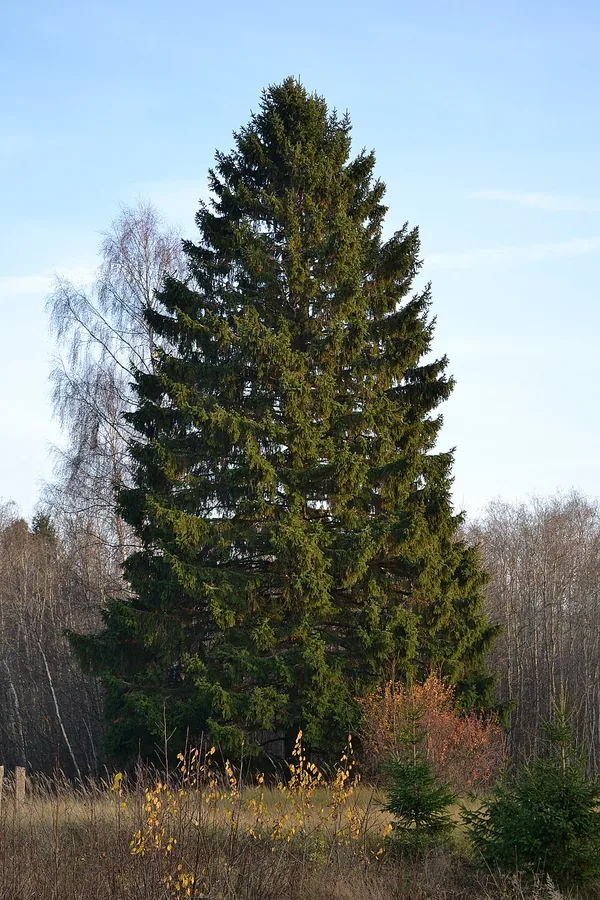
If you're new to trees, the Norway spruce is a wonderful place to start, forgiving and quick to reward you. It's the big evergreen behind so many windbreaks, screens, and old farmyard plantings across the cold north, and it settles happily into gardens far from its European home. Grown trees wear gracefully drooping branchlets that hang from upswept limbs, lending the whole tree a soft, weeping look you'll come to treasure.
The main thing to plan for is space and patience. In the wild it climbs well over 100 feet, and in a yard it makes a comfortable 40 to 60 feet, with a broad pyramidal crown and shallow roots that spread wide rather than plunge deep. Long cones, the largest of any spruce, sway from the upper branches and add to the charm. Give it elbow room and it grows into a landmark you'll be proud of.
What makes this tree so easy to love is its toughness. It weathers harsh cold, accepts a range of sites, and stands up to the needlecast and canker troubles that undo fussier spruces, so small missteps rarely set you back. Keep its feet moist and its head in the sun, and it will ask almost nothing more of you.
Care
The short version: full sun, moist but well-drained slightly acidic soil, and room to grow. It's cold-hardy and forgiving once settled, so you'll rarely need to feed it and only have to prune it lightly.
Light
Norway spruce loves full sun and grows its densest, healthiest self in all-day light. It will tolerate a little partial sun, but a shaded tree thins and opens up, and generous sun helps keep needle diseases away, so pick a bright spot and it will thank you.
Water
Aim to keep the soil consistently moist but well-drained, watering deeply while the tree is settling in and through any dry spell. It has little patience for extremes, sulking in soggy ground and struggling on hot, dry sites, so water roughly every 7 to 14 days when the rain falls short.
Soil
Offer it moist, well-drained, sandy loam on the acidic side, ideally a pH of 5.0 to 6.0. It adapts to a fair spread of ground, though it resents heavy, waterlogged clay where its shallow roots can't breathe easily.
Temperature
Few trees take the cold as bravely, handling temperatures from -40°F to 95°F (-40°C to 35°C). It flourishes in the cool north and grows poorly where summers run long and hot.
Humidity
Ordinary outdoor humidity suits it just fine, so there's no figure to fuss over. Air movement matters more, since still, crowded conditions invite the needlecast fungi that trouble stressed trees.
Feeding
A settled Norway spruce rarely needs feeding and does nicely on its own in decent ground. If growth seems to lag, a balanced slow-release feed in spring is all it takes, and rich soils may need none at all.
Pruning
Keep pruning to a minimum, taking out dead, damaged, or crossing branches in late winter. Never top the tree, since that spoils its lovely form. If a weevil takes the leader, gently train one upright side shoot to step into its place.
Repotting
none
Size & spacing
This is a forest giant in the making, rising to 40 to 60 feet (12 to 18 m) tall and spreading 25 to 30 feet (7.5 to 9 m) across. Plant it well clear of buildings, drives, and utilities, because its shallow roots reach wide and the crown only keeps growing.
When to plant
There's no harvest clock to chase with a spruce, only the right moment to tuck it in. Plant it in spring or early fall so the roots can settle before summer heat or deep winter cold arrives, and rest easy, because it's hardy enough for the coldest gardens, right down through zone 2.
Northern hemisphere
Southern hemisphere
Typical months for a temperate climate: start earlier in warm zones, later where spring frosts linger.
- Plant: spring or early fall
Hardiness
USDA hardiness zones: 2–7
Temperature: down to -46°C
Troubleshooting
A healthy Norway spruce rarely gives you grief, and when something does slip, it usually traces back to a stressed or crowded tree. Keep a gentle eye on the top shoot and the inner needles, since that's where the earliest clues appear. Match what you notice below, then act early, and most setbacks pass without lasting harm.
When the top shoot dies back and curls into a shepherd's crook
If the very top of your tree wilts and hooks over, take heart, because this common visitor is fixable. The culprit is the white pine weevil, whose grubs bore down inside that leader and kill it. In mid to late spring, before the adults escape, snip the dead top out below the damage and coax one upright side shoot to become the new leader. A canker called Cytospora can look much the same on a branch or leader, so give it a close look if the weevil clears.
Fix:
- Prune out and destroy the infested dead leader below the damage in mid to late spring before adults emerge
- Train an upright side shoot to become the new leader
- Maintain tree vigor with adequate water and mulch
Inner needles going purple-brown and falling from the bottom up
When the older needles deep inside flush purple-brown and drop, working their way up from the lowest branches, a stressed tree is usually inviting Rhizosphaera needlecast or a cousin fungus. Don't worry, a hand lens tells the story: a cast needle shows rows of tiny black dots where a healthy one wears neat white waxy specks. You can turn this around by opening the canopy with spacing, clearing crowding growth, watering at the base, and trimming the worst branches, since drought and root stress only deepen the trouble.
Fix:
- Improve air circulation by spacing and removing competing vegetation
- Avoid overhead irrigation and wetting foliage
- Remove and destroy heavily infected branches
- Maintain consistent soil moisture and mulch
Stippled, bronzed needles with a hint of webbing in spring and fall
Needles that turn stippled and bronzed under a veil of fine webbing usually mean the spruce spider mite is feeding, and it favors the cool of spring and fall. To be sure, tap a branch over white paper and watch for tiny specks creeping across it. A firm jet of water knocks most of them loose, so start there; save horticultural oil for stubborn outbreaks, and skip broad sprays that harm the good bugs holding mites in check.
Fix:
- Spray foliage with a strong jet of water to dislodge mites
- Apply horticultural oil or an approved miticide when populations are high
- Avoid broad-spectrum insecticides that kill mite predators
Toxicity
Here's welcome news if you share your home with pets or little ones: Norway spruce is not toxic. The only real hazard is mechanical, since the needles are stiff and sharp enough to prick skin, and a mouthful of swallowed needles might bring a passing stomach upset. Nothing about the tree will poison a cat, dog, or curious child.
Safe for
People · Cats · Dogs · Horses · Rabbits · Livestock · Birds
Cats None
You can relax here, because there's no poison in play. A cat that swats or nibbles the needles might drool or paw at its mouth from those sharp tips, and that's the whole of it.
Dogs None
Your dog is fine around this tree. Those stiff needles can scratch a curious nose, and a swallowed mouthful might bring a brief tummy upset, but nothing here is truly poisonous.
Horses Safe
There's nothing toxic for horses to browse. They tend to leave the prickly foliage be, and even a stray taste does no harm at all.
Rabbits Safe
Rabbits are welcome to share the garden with this tree without any worry, since the needles hold nothing that could poison them.
Livestock Safe
Cattle, goats, and sheep have no poisoning to fear from the foliage. Where some conifers spell herd trouble, spruce happily stays off that list.
Birds Safe
Birds are the happy winners here, finding cover and seed in the branches. Nothing about the tree can harm them.
People Safe
No need to fret about poison for people. The sharp needles can prick bare skin, so handle fresh branches gently, and beyond that the tree is perfectly safe.
Needles are stiff and prickly and can poke skin; ingested needles may cause mild mouth or stomach irritation or, in quantity, GI obstruction, so discourage chewing.
Varieties
Beyond the towering species tree, Norway spruce has given us a lovely run of distinct cultivars, from weeping giants to neat little dwarfs. These are the ones worth getting to know by name.
'Pendula'
You'll love the drama of this strongly weeping form, its branches pouring straight down, whether you stake it upright as an accent or let it sprawl gently as a ground cover.
'Nidiformis'
The gentle bird's nest spruce is a slow dwarf that keeps to just a few feet tall, its flat top settling into a cozy nest-like hollow at the center.
'Acrocona'
This small, irregular, often semi-weeping tree treats you to bright red-pink young cones dangling from its branch tips.
'Cupressina'
A tidy narrow column with branches swept upward, it shrugs off heavy snow and slips a tall screen into even a tight corner.
How to propagate
How you raise more Norway spruce comes down to what you'd like: the wild species comes true from seed, while the prized weeping and dwarf forms need to be cloned to stay themselves.
SeedModerate
Sow stratified seed in spring · 2 to 4 years to a transplantable seedling
If it's the true species you're after rather than a named cultivar, seed is your route, since cultivars won't come true this way. Give the seed about a month of cold, moist stratification, sow it in spring, and then simply be patient, because it takes 2 to 4 years to raise a seedling large enough to move.
GraftingDemanding
Late winter under cover · 1 to 2 years
The dwarf and weeping cultivars like 'Pendula' and 'Nidiformis' stay true to type through grafting, joined onto seedling rootstock in late winter under cover. It asks for a steady hand, but the graft knits and grows on within 1 to 2 years, so the effort pays off.
LayeringModerate
Spring · 1 to 2 years to root
Prostrate and weeping forms make this easy, layering on their own wherever low branches settle onto the soil and root where they touch. Peg one down in spring and it will root over 1 to 2 years, ready for you to cut free and move once it's settled.
Myths
Norway spruce and Colorado blue spruce are basically interchangeable.
These two swap places far less easily than a quick glance suggests. Norway spruce grows faster, takes heat and mixed sites in stride, and brushes off Rhizosphaera needlecast and Cytospora canker far better than blue spruce does. If you want a tougher, longer-lived landscape tree, Norway spruce is the kinder choice.
Spruce Christmas trees are poisonous to cats and dogs.
You can set this worry aside, since spruce is not a true toxin. Chewed needles are at most mildly or mechanically irritating to the mouth and stomach, and the real concerns are a passing upset or, if a lot goes down, a blockage. The hazard is those sharp, indigestible needles, not poison.