Houseplant · Marantaceae
Prayer Plant
Maranta leuconeura
Treat it to gentle water, even moisture, and a humid corner, and the prayer plant rewards you by folding its leaves closed every evening.
Bright indirect
USDA 11–12
6–18 in · 15–46 cm
Overview
Do not let the name intimidate you, because the prayer plant earns it in the gentlest way. Its leaves spread open and flat through the day, then lift and press together at nightfall, looking for all the world like two hands folded in prayer. It belongs to the Marantaceae family and grows in the dim, humid understory of Brazil's rainforests, and that one detail hints at nearly everything it wants from you.
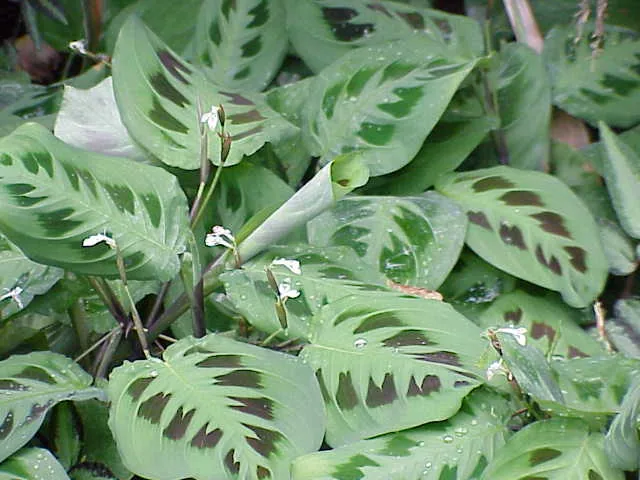
The real reason people fall for it is the leaves. Every one wears bold markings, whether that means red veins tracing a herringbone across deep green or soft dark blotches that look like little footprints. Best of all for a smaller home, it never climbs past 18 inches (46 cm) tall, so a shelf, a hanging pot, or a free corner of the desk suits it just fine.
You may have heard it called fussy, but that is not really fair. It simply knows what it likes: gentle water, moisture that never runs dry, and air on the humid side. Slip up with hard tap water or a dry room and the leaf edges brown, yet even that is easy to put right. Keep those few things in mind and you end up with a forgiving, pet-safe houseplant that closes its leaves for you like clockwork after dark.
Care
The short version: set it in bright light kept off direct sun, water with rainwater or filtered water so the soil stays evenly damp, and give it a warm, humid spot that stays above 60°F (15.6°C), and the two of you will get along just fine.
Light
Set the prayer plant somewhere with bright, indirect light and shield it from direct sun, which fades the lovely markings and scorches the leaves. It will cope in medium or even low light, though you will see the richest color when the spot is bright and the harsh rays are softened.
Water
Let the soil stay evenly moist all through spring and summer, then ease back from autumn into late winter and allow it to dry a touch. What matters even more is what fills the watering can, since this plant is sensitive to the fluoride, chlorine, and salts in tap water that scorch the tips. Rainwater, distilled, or filtered water keeps the foliage clean and green.
Soil
Pot it up in a moist, humusy, well-drained mix with a soil base. You want something that holds water without ever going soggy, because a waterlogged root ball is what leads to rot, and that is the one thing worth guarding against.
Temperature
Keep it cozy and above 60°F (15.6°C). Cold drafts and chilly windowsills are its weak spot, so in winter move it well clear of doors and vents where the air turns sharp.
Humidity
This one loves high humidity and lets you know it is unhappy with brown, crisp edges whenever the air dries out. Stand the pot on a tray of wet pebbles or run a small humidifier, and grouping it with a few leafy neighbors helps hold that moisture close.
Feeding
Offer a balanced houseplant fertilizer once a month through the spring and summer growing season, then pull right back from autumn to late winter. A light hand is kindest, since overfeeding burns the leaves the same way hard water does.
Pruning
It asks for very little pruning. Trim away any damaged, faded, or brown-tipped leaves to keep it looking neat, and that really is the whole job.
Repotting
Repot in spring whenever the roots begin to crowd the pot or peek out of the drainage holes. That same moment is perfect for dividing the plant if you would like more, since the clump comes apart gently while it is already in your hands.
Size & spacing
It keeps a tidy shape, standing 6 to 18 inches (15 to 46 cm) tall and reaching 6 to 24 inches (15 to 61 cm) across. That low, spreading habit makes it a lovely pick for a hanging basket or the front edge of a shelf, where the leaves can tumble over the side.
Troubleshooting
Nearly every worry with a prayer plant shows up in its leaves, and the reassuring part is that most come down to water, light, or humidity rather than any disease. Catch the early hints and you can usually set things right before they spread. Find your symptom below and make one small change at a time.
Wilting, yellowing leaves and soft, mushy stems
Soil that stays wet for too long invites root rot, and the giveaway is roots that have gone brown and soft instead of firm and pale. Slide the plant out, trim away the ruined roots, and settle it into fresh, well-drained mix. After that, water only when it truly needs a drink and never leave the pot standing in a saucer of water.
Fix:
- Remove from soggy soil and trim rotted roots
- Repot into fresh well-drained mix
- Water only when appropriate and ensure drainage
Fine webbing and tiny yellow speckles across the leaves
Warm, dry air rolls out the welcome mat for spider mites, which cluster on the undersides of the leaves and leave behind faint webbing and pinprick yellow dots. Rinse the foliage well, raise the humidity, and treat with insecticidal soap or horticultural oil. Keep the plant apart from your others until every last mite is gone.
Fix:
- Rinse foliage and raise humidity
- Treat with insecticidal soap or horticultural oil
- Isolate affected plant
Brown, crackly tips creeping along the leaf edges
Those dry brown edges are leaf burn, and more often than not the fault lies in your tap water rather than in anything you did. Fluoride, chlorine, and salt slowly gather at the leaf margins, and heavy feeding in dry air only deepens the harm. Switch to rainwater, distilled, or filtered water, go gentler with the fertilizer, and lift the humidity, and fresh growth will come in clean.
Fix:
- Use rainwater, distilled or filtered/dechlorinated water
- Reduce fertilizer frequency and strength
- Raise humidity (humidified room or pot on a tray of wet pebbles)
- Trim damaged tips for appearance
Faded color and pale, sun-bleached spots
When the red and green pattern washes pale and bleached patches turn up, too much direct sun is almost always behind it. Remember that this plant grew up shaded on the forest floor, so strong light simply overwhelms it. Move it into bright indirect light and draw a sheer curtain across any fierce window, and the color will steady.
Fix:
- Move to bright indirect light out of direct sun
- Filter strong window light
Leaves that stay flat after dark instead of folding
A content prayer plant lifts and folds its leaves each night like praying hands, so leaves that stay open usually mean weak light or a stressed plant rather than illness. The color often still looks perfectly fine. Give it bright indirect light by day and true darkness at night, then smooth out any watering, humidity, or temperature trouble that might be unsettling it.
Fix:
- Provide adequate bright indirect light during the day and natural darkness at night
- Correct watering, humidity and temperature to reduce stress
Toxicity
Here is a real comfort for pet owners: the prayer plant is completely safe to keep around your home. The ASPCA lists it as non-toxic to cats, dogs, and horses, and finds no harmful compounds in the leaves. If a curious pet eats a mouthful it might feel a little queasy for a while, but there is no genuine poisoning to fear.
Safe for
People · Cats · Dogs · Horses · Rabbits · Livestock · Birds
Cats None
Cats are safe here. The ASPCA finds nothing toxic, so the worst a leaf-chewing cat risks is a brief, mild bout of tummy upset.
Dogs None
Dogs are just as safe, with no poison anywhere in the foliage. A big mouthful might leave a dog a little off for a short spell, and nothing more.
Horses Safe
Horses get the all-clear from the ASPCA too. Since there is no toxin to worry about, a curious taste does them no harm at all.
Rabbits Safe
With no toxic compounds present, a rabbit can share space with the plant safely, though it should never stand in for the rabbit's usual hay and greens.
Livestock Safe
Nothing in the leaves threatens grazing animals with poisoning. Being a tender tropical houseplant, it rarely ends up within their reach anyway.
Birds Safe
Pet birds have nothing to fear from this plant. The leaves hold no toxins, so a little perching or nibbling will not trouble them.
People Safe
It is safe to keep around children. There is no poison in any part of it, even though it is grown for its looks rather than for eating.
Although non-toxic, ingestion of plant material can still cause mild gastrointestinal upset in pets
Varieties
A handful of named forms come up again and again, told apart mostly by the pattern on their leaves. These are the ones worth getting to know.
var. erythroneura (Herringbone / red-veined prayer plant)
This is the eye-catching one, showing a bright red midrib with red veins that fan out in a herringbone across its dark green leaves.
var. kerchoveana (Rabbit's-foot / rabbit tracks)
A softer, paler green form carrying two rows of dark blotches down each leaf, the very marks that gardeners say look like little rabbit tracks.
How to propagate
Making more prayer plants is easier than you might expect, and spring is your window, whether you gently split a full clump or coax a cutting to root.
DivisionEasy
Spring, at repotting · Several weeks
The gentlest way to get more plants is to divide the clump in spring while you have it out for repotting. Ease the root ball apart into a few sections, checking that each keeps its own roots and shoots, then pot them up on their own. Give each division several weeks to settle in before new growth appears.
Stem cuttingsModerate
Spring to summer · Several weeks to root
Prayer plants will also grow from stem cuttings snipped just below a node in spring or summer. Tuck the cutting into moist mix and keep it warm and humid. Look for it to take several weeks to form roots.
Myths
The prayer plant will poison your cats and dogs.
The ASPCA places the prayer plant and the wider Maranta group on its non-toxic list for cats, dogs, and horses, with no toxic principles recorded. You can welcome it into a home full of pets with a clear mind, even if a greedy nibble might leave a tummy briefly unsettled.
The leaves fold up at night for religious reasons.
That nightly folding is nyctinasty, a simple day and night sleep movement, and nothing mystical at all. After dark the leaves swing up and close in a pose that recalls praying hands, and that resemblance is exactly what gave the plant its name.