Ornamental · Geraniaceae
Rozanne Cranesbill
Geranium 'Rozanne'
One of the most forgiving flowering perennials a nervous gardener can plant, and it gives back far more than it asks.
Full sun
Every 5–10 days
USDA 5–8
12–18 in · 30–46 cm
Overview
If you're new to gardening and want a plant that won't let you down, hardy geranium 'Rozanne' is a wonderful place to start. It's part of the true cranesbill family, named for the slender beak-shaped seed pods that follow the flowers, and it's a different plant entirely from the tender scented Pelargonium that people often just call geranium. Best of all, it's a cold-hardy perennial that returns on its own year after year across zones 5 to 8, so your effort keeps paying off.
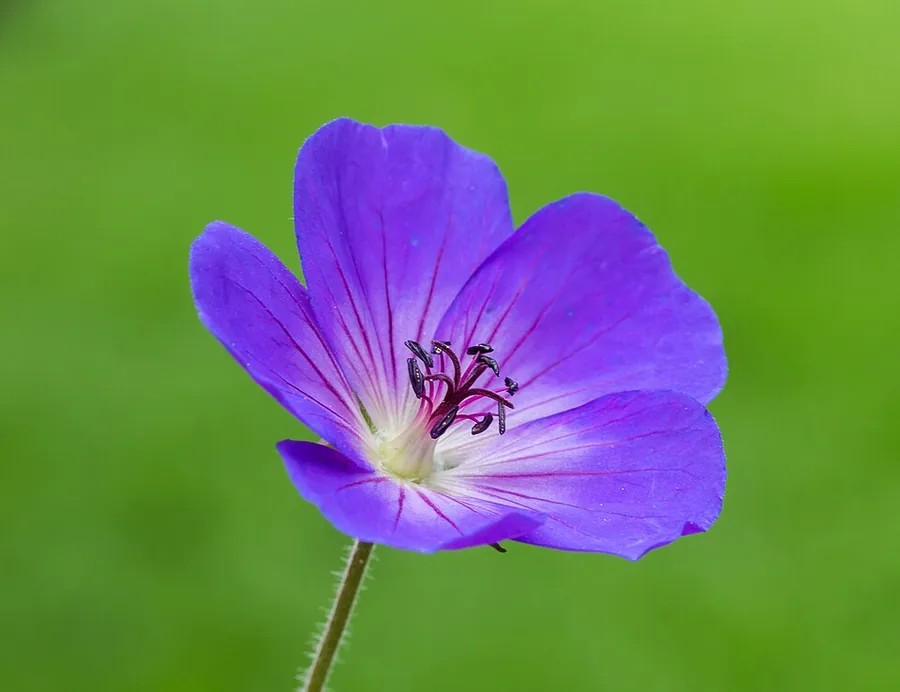
The flowers are where it wins hearts. From late spring all the way to fall it keeps offering up violet-blue blooms with soft white centers, often with barely a break, spilling across a low mound that knits through the bed and quietly hides bare soil. That steady, generous show is exactly why it was named Perennial Plant of the Year in 2008.
You'll also be glad to know it copes with heat better than most cranesbills and usually gets passed over by deer and rabbits. Offer it sun, soil that drains, and one friendly midseason trim, and 'Rozanne' will thank you with months of color for very little effort. Mistakes here are easy to recover from, so plant it with confidence.
Care
The short version: settle it into full sun to part shade in average, well-drained soil, water it through dry spells, and shear it back after the first flush, and you'll keep the flowers coming into fall.
Light
'Rozanne' gives you the most flowers in full sun, though it settles happily into partial shade and partial sun too. In hot regions a bit of afternoon shade is genuinely kind to it, softening the heat stress that can make the plant droop in midsummer.
Water
Offer it average, medium moisture and let the top inch or so of soil dry out between drinks, which usually lands around every 5 to 10 days. Established plants shrug off some drought, but try not to let them go bone-dry, and be sure to water through dry spells so the flowers keep coming.
Soil
You don't need perfect soil, because it grows in loam, clay, or sand as long as the ground drains well. It's happiest in moist, organic-rich earth, so mix in a little compost wherever you can. Don't fret over pH, as it has no particular preference.
Temperature
This tough perennial takes winters down to -20°F (-29°C) and summer heat up to about 90°F (32°C) in stride. That wide comfort range is exactly what lets it thrive across zones 5 to 8 without any special fuss.
Humidity
Everyday outdoor humidity suits it, so there's nothing here for you to measure or worry about. Airflow matters far more than humidity, because still, damp air around crowded leaves is what invites leaf spot and rust.
Feeding
It's a light eater, so you can keep this simple. Work some compost or organic matter into the soil as the growing season begins, or give it a balanced general-purpose feed in spring, and that's plenty. There's no need to keep feeding all summer long.
Pruning
This is the one task that truly pays you back. Once the first flush of flowers fades, cut the whole plant back hard to tidy it up and coax a fresh late-summer or early-fall rebloom. You can snip any wandering side stems whenever you like to keep the spread in check.
Repotting
Plants growing in the ground rarely need lifting and divide on their own gentle schedule. In a container, repot when you notice roots circling the pot, the flowering easing off, or the soil drying out unusually fast.
Size & spacing
Look forward to a low mound about 12 to 18 inches (30 to 46 cm) tall that spreads 12 to 24 inches (30 to 61 cm) wide. Give plants room toward the wider end of that range so air can move freely and the foliage stays clean and healthy.
When to plant
There's no need to feel rushed with 'Rozanne', because as a hardy perennial the goal is simply helping it settle in rather than beating the frost. Set new plants out in spring once the last frost has passed, or in early fall while the soil still holds some warmth, and you can look forward to flowers from late spring right through to early autumn.
Northern hemisphere
Southern hemisphere
Typical months for a temperate climate: start earlier in warm zones, later where spring frosts linger.
- Plant: Spring after the last frost, or early fall
- Harvest: Late spring (May) through summer to early fall, often nearly continuous
Hardiness
USDA hardiness zones: 5–8
Temperature: down to -29°C
Troubleshooting
'Rozanne' is famously easygoing, so please don't expect much trouble, and know that the little that does appear tends to show on the leaves in wet, crowded spots. Get familiar with the few signs below and you'll be able to step in early, while the fix is still quick and painless. Good airflow and watering at the base head off nearly all of it for you.
The plant has suddenly wilted and flopped even though the soil is moist
This one is more serious, and it helps to name it: a clump that collapses in hot weather while the ground is still wet is likely southern bacterial wilt, which settles into warm, soggy soil and can't be cured. The kindest move is to lift the plant, destroy it, and give that spot a rest from susceptible perennials for a while. Take heart, because in hot areas a touch of afternoon shade and freely draining soil keep your plants well clear of this trouble.
Fix:
- Remove and destroy affected plants
- Avoid replanting susceptible species in the same soil
- Reduce afternoon heat stress by providing some afternoon shade in hot climates
A few brown or tan spots have appeared on the leaves
Take a breath, because this is only fungal leaf spot and your plant will be just fine. It tends to arrive when wet weather or overhead watering leaves the foliage sitting damp, so pinch off the marked leaves, open the clump up a little so air can pass through, and water at the soil from here on. The spots look worse than they are, and Rozanne bounces back once the leaves dry out.
Fix:
- Remove and discard affected leaves
- Improve air circulation by thinning or spacing plants
- Water at the base rather than overhead
Little rusty orange bumps are dotting the undersides of the leaves
Turn a leaf over and those raised orange specks are rust fungus, another harmless visitor that likes crowded, damp foliage. Don't worry, just gently remove the affected leaves and throw them away, give the plant a bit more elbow room for airflow, and keep water off the leaves when you can. Your Rozanne keeps flowering happily right through it, since the trouble is only skin deep.
Fix:
- Remove and destroy infected foliage
- Increase spacing and air circulation
- Avoid overhead irrigation
Toxicity
Here's some reassuring news for pet owners: true hardy geranium is safe. Cranesbills carry no toxin that would harm cats, dogs, horses, or other animals, and they hold no poison rating for people either. The only plant worth keeping an eye out for is the unrelated scented Pelargonium, which is sometimes sold under this same common name.
Safe for
People · Cats · Dogs · Horses · Rabbits · Livestock · Birds
Cats None
You can relax about the cat, because true hardy geranium is safe for cats. If a curious one chews a leaf or bloom it won't be poisoned, though as with any plant a very large mouthful might leave it briefly queasy.
Dogs None
Your dog is welcome to sniff and nose around cranesbill. There's no toxin in it, so even a stem or flower that gets chewed brings nothing worse than the passing tummy grumble any greenery can stir up.
Horses None
Horses can graze nearby with nothing to fear, since the plant holds no compounds that would harm them. Grazers usually pass over the aromatic leaves anyway, so it rarely tempts them.
Rabbits None
Rabbits stay perfectly safe around it, and happily this is one of the plants rabbits tend to leave alone. That makes Rozanne a comforting pick for a garden they wander through.
Livestock None
Cattle, goats, and sheep are in no danger at all from true geranium. Nothing in it troubles farm animals, so a nibbled clump costs you a plant rather than their health.
Birds None
Both garden and pet birds are safe near Rozanne. The leaves and flowers carry no toxin, so a peck or two does them no harm.
People None
True cranesbill has no poison rating for people, little ones included. It's a good habit to wash your hands after gardening, but you'll find no special hazard waiting in this plant.
Wash hands after handling as a general gardening practice; no specific toxicity hazard is reported for true Geranium.
Varieties
'Rozanne' is the star of the show, but a couple of close relatives are lovely to know about if you'd like a gentler shade or a different flower color.
Geranium 'Rozanne' (syn. 'Gerwat')
This is the patented sterile hybrid you came for, a clump-forming charmer that keeps sending up violet-blue, white-centered flowers from late spring to fall and takes summer heat in its stride, which is what earned it Perennial Plant of the Year in 2008.
Geranium 'Azure Rush'
If you'd like a softer look, this sport of 'Rozanne' blooms just as long but wears paler, lighter blue flowers on a neater, more compact mound.
Geranium sanguineum (Bloody Cranesbill)
This is a true cranesbill species instead of a hybrid, loved for its bright magenta-pink flowers and often planted next to 'Rozanne' so you can see the two side by side.
Companions
'Rozanne' shines as a long-blooming groundcover at the feet of taller plants, weaving between shrubs and upright perennials that enjoy the same sun and average moisture.
Plant near
Roses: Mounding hardy geranium foliage covers bare lower rose stems and provides a long-blooming groundcover at the base.
Ornamental grasses: Contrasting upright form pairs well with the sprawling mound and extends seasonal interest in borders.
Daylilies and other clumping perennials: Similar culture (full sun to part shade, average moisture) and complementary bloom times in mixed borders.
How to propagate
Since 'Rozanne' is a sterile hybrid, growing it from seed isn't on the table, and that's perfectly fine. Every new plant comes from dividing an existing clump or rooting a cutting, both of which copy the parent exactly and are gentle enough for a beginner to try.
DivisionEasy
Spring or early fall · One growing season
Dividing is the friendliest and surest way to make more of this sterile hybrid, and it's hard to get wrong. Lift a settled clump in spring or early fall, ease it into pieces that each keep some healthy roots, and get them back in the ground right away. Give each division a single growing season and it will settle in and fill out for you.
Stem cuttingsModerate
Spring to early summer · Several weeks to a few months to root and establish
You're also welcome to root basal or softwood cuttings taken from spring through early summer, and while it asks for a little more patience than dividing, it's still very doable. Allow them several weeks to a few months to root and find their feet. Seed simply isn't an option here, since the plant is sterile.
Myths
Hardy geranium 'Rozanne' is dangerous for cats and dogs.
It's an easy worry to carry, but it comes down to a shared name. The 'Geranium' on the ASPCA toxic list is actually Pelargonium, the tender scented bedding plant from a completely separate genus. True hardy Geranium, the cranesbill, including 'Rozanne', is not listed as toxic to pets, so you can plant it with your animals in mind and feel at ease.
You can raise more 'Rozanne' plants from saved seed.
It's a lovely idea, but 'Rozanne' is a sterile hybrid that sets little or no viable seed, and whatever it does drop won't grow up looking like the parent. The dependable way to make more is to propagate it vegetatively, either by dividing a clump or rooting basal cuttings, and both are well within reach.