Shrub · Rubiaceae
Gardenia
Gardenia jasminoides
Give it acidic soil, steady moisture, and humid air, and this shrub thanks you with sweetly scented white flowers.
Partial shade
Every 3–7 days
50–90°F · 10–32°C
USDA 8–11
Overview
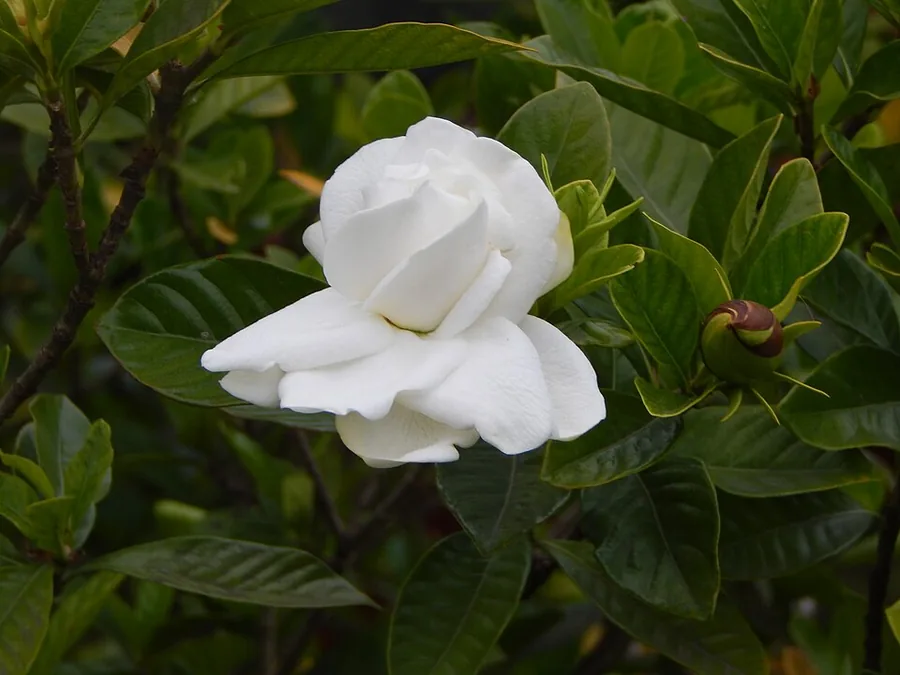
If you have ever leaned in to a creamy white gardenia flower and caught that rich perfume, you already know why people fall for this shrub. It is a broadleaf evergreen from the madder family, and even between flushes of bloom the glossy dark leaves keep it looking handsome. Whether it grows in the open ground down South or lives in a pot where winters bite, it simply asks for a little warmth and care, and pays you back in fragrance every late spring and summer.
Do not let the fussy reputation scare you off. What a gardenia truly wants is acidic soil, even moisture, and humid air, and once you learn to read it, keeping those three steady becomes second nature. The two hiccups you are most likely to meet are bud drop and yellowing leaves, and the good news is that both come from conditions you can adjust, not from anything you did wrong.
Settle the basics and this plant rewards your patience with a long life as a perennial shrub. Give it the soil and humidity it loves, forgive yourself the occasional dropped bud while you find the rhythm, and it will bloom for weeks with a scent that drifts clear across the garden.
Care
The short version: part shade with gentle morning sun, acidic soil held at a pH of 5.0 to 6.0, even moisture from rainwater, and humid air. Feed with an acid-forming fertilizer in spring, and try to keep night temperatures steady while the buds are setting.
Light
Your gardenia will be happiest in part shade, with soft morning sun and some shelter from harsh afternoon heat. In cooler climates it can take full sun, and indoors it copes with bright indirect light, but deep shade will quietly cost you flowers, so aim for that bright, gentle middle ground.
Water
Try to keep the soil consistently moist but never soggy, because swinging between wet and dry is what brings on bud drop. Watering every 3 to 7 days suits most weather, and reaching for rainwater or another non-alkaline source helps you avoid slowly nudging the soil pH upward.
Soil
Plant into well-drained, humus-rich, acidic soil with plenty of organic matter mixed in. Aim for a pH between 5.0 and 6.0, since letting it drift higher locks up iron and turns the leaves yellow, which is easy to prevent once you know to watch for it.
Temperature
Gardenias are comfortable anywhere from 50°F to 90°F (10°C to 32°C), so ordinary room warmth suits them well. Cool nights of 50°F to 55°F (10°C to 13°C) actually help the buds form, though sudden swings in either direction can make those same buds drop, so steadiness is your friend.
Humidity
These shrubs love humidity above 50% and quietly resent dry indoor air. Grouping plants together, setting the pot on a pebble tray, or running a humidifier all help where the air runs dry, and it is worth the effort since low humidity is a leading cause of bud drop.
Feeding
Reach for an acid-forming azalea or camellia fertilizer such as 10-8-8, applied lightly in spring after frost and again about 6 weeks later. Ease off by fall, because late feeding pushes soft growth that will not harden in time for the cold.
Pruning
The kindest time to prune is right after flowering in summer, when you can tidy straggly branches and spent blooms without worry. Wait too long and you risk cutting away the very wood that carries next season's buds, so a little timing goes a long way.
Repotting
Move a container gardenia up a pot size every 2 to 3 years, or sooner if roots start circling the base, water runs straight through, or growth stalls with yellowing leaves. Adding fresh acidic mix each time keeps the pH right where the roots want it.
Size & spacing
In time a gardenia grows to 4 to 8 feet (122 to 244 cm) tall and roughly as wide, so it becomes a real presence. Give it 4 to 8 feet (122 to 244 cm) of elbow room so air moves freely through the canopy, which keeps the plant healthier and gives pests less to settle on.
When to plant
Gardenias feel at home in the warm belt of zones 8 to 11, where they flower from late spring into early summer and even year-round in the mildest spots. Set new plants out in spring once the last frost has safely passed, and remember to prune soon after flowering so you never trim away next year's buds by accident.
Northern hemisphere
Southern hemisphere
Typical months for a temperate climate: start earlier in warm zones, later where spring frosts linger.
- Plant: spring after last frost
- Harvest: late spring to early summer (year-round in warm climates)
Hardiness
USDA hardiness zones: 8–11
Temperature: down to -12°C
Troubleshooting
When a gardenia is unhappy, it usually shows you on the buds and leaves first, and most of the time the cause is soil, water, or air rather than any disease. Catch those early signs and you can gently steer things back before you lose a single bloom. Look for what matches below, then make small adjustments.
Flower buds yellow and fall off before they open
Losing buds before they open is bud drop, the single most common gardenia worry, and it nearly always follows a sudden change the plant did not like. Cold nights below 50°F to 55°F (10°C to 13°C), uneven watering, and dry indoor air are the usual culprits. Keep the soil evenly moist, lift the humidity, and hold the temperature steady while buds are setting, and things soon settle.
Fix:
- Maintain consistent, even soil moisture with good drainage
- Provide cool night temperatures of 50-55 degrees F during bud set
- Raise humidity around the plant
- Provide adequate light and avoid over-fertilizing
New leaves go yellow while the veins stay green
When fresh leaves turn yellow but their veins stay green, you are looking at iron chlorosis, which shows up when the soil turns too alkaline for roots to draw up iron. Start by testing the soil pH, then lower it with sulfur and feed an acid-forming azalea or camellia fertilizer. A little chelated iron and a switch to rainwater usually bring the green right back.
Fix:
- Lower soil pH using water-soluble sulfur or aluminum sulfate
- Apply chelated iron to soil or as a foliar spray
- Use an acid-forming (azalea/camellia) fertilizer such as 10-8-8
- Irrigate with rainwater or non-alkaline water
Sticky leaves with a black sooty coating
Shiny, sticky leaves under a film of black sooty mold are a sign that sap-sucking pests are feeding up above. Whiteflies are the usual visitors on gardenia, with scale, aphids, and mealybugs not far behind. Spray insecticidal soap or horticultural oil under the leaves, repeat every 5 to 7 days, and gently wipe the mold away once the insects are gone.
Fix:
- Spray insecticidal soap or horticultural oil thoroughly on leaf undersides
- Repeat treatments at 5-7 day intervals
- Wipe sooty mold off with a moist cloth once insects are controlled
- Apply sprays when temperatures stay below 90 degrees F
Toxicity
Gardenia is only mildly toxic to pets and gentle on people, so there is no need to panic. Its leaves and flowers hold geniposide and genipin, which can give a cat, dog, or horse an upset stomach, loose stool, or hives. The reaction stays mild, but it is still kind to keep curious pets and grazing animals away from the shrub.
Toxic to
Cats · Dogs · Horses · Rabbits · Livestock · Birds
Safe for
People
Cats Mild
A cat that nibbles the leaves or flowers might vomit, get loose stools, or come out in hives. The compounds behind it, geniposide and genipin, are only mildly irritating, so most cats come through just fine on their own.
Dogs Mild
Dogs tend to chew more than cats do, and a mouthful can bring on vomiting, loose stools, and sometimes raised welts on the skin. The upset stays mild and usually passes, though it is worth a call to your vet if it lingers.
Horses Mild
A grazing horse may end up with a queasy stomach and loose droppings after eating the foliage. The trouble stays mild, but it is still kind to keep the shrub well away from paddocks.
Rabbits Caution
Rabbits are not named on the ASPCA list, yet the same gut-irritating compounds are present, so it is safest to treat gardenia as off the menu and watch for soft stools if a curious rabbit takes a bite.
Livestock Caution
There is no clear record of poisoning in cattle, goats, or sheep, but the iridoid glycosides could still unsettle their digestion. Fencing the shrub off is the gentle, worry-free choice.
Birds Caution
Pet birds have not been studied for gardenia, and their small size makes any irritant more of a concern. Keeping them away from the leaves and flowers is the safe and simple approach.
People Essentially safe
People are essentially safe around gardenia, and the same compounds even appear in foods colored with gardenia extract. It still is not a snacking plant, so gently steer children away from chewing the leaves.
Keep plants and fallen plant parts away from pets; ingestion causes mild gastrointestinal upset.
Helpline numbers

United States
ASPCA Animal Poison Control: (888) 426-4435 (fee applies)

United Kingdom
Animal PoisonLine: 01202 509000 (fee applies)

Australia
Animal Poisons Helpline: 1300 869 738
Varieties
Nearly all garden gardenias trace back to one species, yet a handful of named types are worth knowing for their hardiness, size, or bloom. If you are shopping, these are lovely ones to ask for by name.
Kleim's Hardy
Kleim's Hardy is a single-flowered cultivar bred for cold tolerance, and it is reportedly hardy down to about USDA zone 7.
Radicans
Radicans is a dwarf, low-spreading form with small leaves and flowers, and it makes a lovely creeping groundcover.
Veitchii
Veitchii is a compact everblooming type loved for its reliable, long flowering season.
How to propagate
Making more gardenias takes a little patience, but it is quite doable. You can root a summer cutting or simply pin a low branch down to layer it into a brand new plant.
Stem cuttingsModerate
Summer (June through August) · 6-12 weeks to root
Most gardeners begin new gardenias from cuttings taken in summer, between June and August. Snip semi-hardwood pieces where the green wood is just starting to turn brown, dip the ends in rooting hormone, and root them under intermittent mist or inside a covered pot. Give them 6 to 12 weeks to root, and know that softwood tip cuttings also do well in early to mid summer.
LayeringModerate
Growing season · Several weeks to months
Layering is a wonderfully reliable way to make new gardenias during the growing season. Pin a low branch down into the soil and let it root in place, which takes anywhere from several weeks to a few months before you can sever it and pot it up.
Myths
Gardenias are completely safe houseplants that pose no risk to pets.
The ASPCA does list gardenia as toxic to cats, dogs, and horses, though the reaction stays mild, bringing on some vomiting, diarrhea, or hives. It will not badly poison a pet, but it is not harmless either, so sweep up dropped buds and leaves and you have little to worry about.
Yellow gardenia leaves always mean you are overwatering.
Yellowing on new growth is far more often iron chlorosis from alkaline soil than too much water. Bring the pH back to 5.0 to 6.0 and offer a little iron, and the plant usually greens up again, so there is no need to assume the worst.