Ornamental · Onagraceae
Fuchsia
Fuchsia × hybrida
Offer it cool shade and steady moisture, and the fuchsia rewards you with dangling, two-tone flowers all season long.
Partial shade
Every 2–4 days
59–70°F · 15–21°C
USDA 10–11
Overview
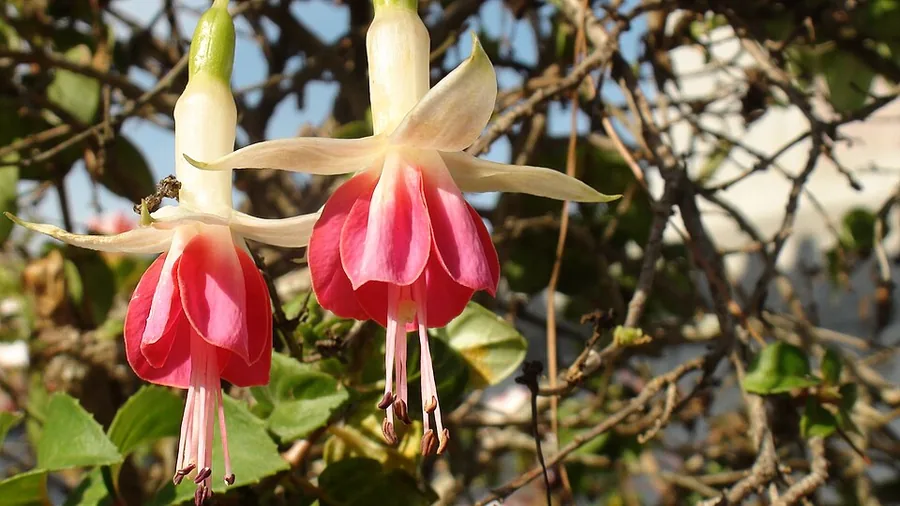
Little else in the garden puts on a show quite like a fuchsia at its peak. The pendant blooms, so often dressed in two contrasting colors, sway from the stems like tiny eardrops, which is precisely how the plant picked up its old country name of lady's eardrops. Most garden fuchsias you will meet are hybrids raised for that display, some trained upright and others left to pour out of a hanging basket.
At heart this is a shade lover, and that is good news for a shaded yard. Fuchsias truly settle into cool, part-shaded corners and grow sullen in heat, so they thank any gardener who can tuck them out of the fierce afternoon sun. Treat them kindly and they will keep flowering from spring all the way through fall.
Many growers keep fuchsia as an annual or bring it under cover for the cold months, yet the hardy types can stay in the ground wherever winters run mild. Whichever path you take, remember it drinks deeply and feeds hungrily, and it repays that little bit of extra care with months of blossom. You really cannot go far wrong here.
Care
The short version: cool part to full shade, soil kept evenly moist and never allowed to go bone dry, a balanced feed every two weeks all through the growing season, and a little shelter from hot afternoon sun and wind. Get those right and the rest falls into place.
Light
Offer a fuchsia part to full shade, and the cooler the spot, the happier it will be. It manages bright indirect light nicely too, but hot afternoon sun scorches the leaves and shuts the flowers down, so seek out a sheltered, shaded corner and the plant will thank you.
Water
Keep the soil consistently moist and never let it run dry, since a thirsty fuchsia wilts quickly. Plants in pots and hanging baskets lose moisture fast and need watering often, plus a bit of cover from drying wind. As fall comes on, gradually ease back on the water to help the plant drift toward its rest. A wilted fuchsia usually perks right up once you water it.
Soil
Set it in rich, moisture-retentive loam with a generous helping of organic matter mixed through. A gently acidic pH of 5.5 to 6.5 suits it well, and soil that stays damp without going soggy keeps the roots content and healthy.
Temperature
Fuchsias prefer things cool, ideally 59°F to 70°F (15°C to 21°C). Once the average daily temperature climbs past 76°F (24°C) the flowers pause, so summer heat is really the one factor to plan around, and it is nothing to fret over.
Humidity
This plant enjoys the air a little on the moist side, roughly 50% to 70% humidity. Dry air wears on it and can tempt spider mites, so a sheltered, slightly humid nook serves it far better than an open, sun-baked one.
Feeding
Fuchsias are hungry feeders, so keep them well fed. Offer a soluble, balanced complete fertilizer every two weeks straight through the growing season, and that steady nourishment keeps the flowers arriving one after another.
Pruning
Pinch off the new shoots once they have made two full sets of leaves, which nudges the plant to branch and fill out nicely, then set the pinching aside about a month before the first frost. For hardy types, cut them back in mid-March once the risk of a freeze has gone by. Do not worry about being too bold; fuchsias forgive a firm trim.
Repotting
Shift potted fuchsias into fresh mix each spring. When roots begin winding around the pot, when the soil dries almost the moment you finish watering, or when growth stalls, the plant is quietly telling you it wants a roomier home.
Size & spacing
Most plants grow to 1.5 to 3 feet (46 to 91 cm) tall and reach 12 to 24 inches (30 to 61 cm) across. Leave each one enough elbow room for air to drift freely among the leaves, and that simple bit of spacing keeps rust and mildew from taking hold.
When to plant
Fuchsias take their cues from cool weather rather than from what the calendar calls summer, so timing them is easy to get right. Root your cuttings indoors in early spring, set the plants outside after the last frost once nights hold above freezing, and look forward to flowers from spring through fall, with a gentle lull once midsummer heat arrives.
Northern hemisphere
Southern hemisphere
Typical months for a temperate climate: start earlier in warm zones, later where spring frosts linger.
- Sow: Cuttings rooted indoors in early spring; seed germinates in 21-28 days at 70-75°F
- Plant: After the last spring frost when nights stay above freezing
- Harvest: Spring through fall, slowing in summer heat
Hardiness
USDA hardiness zones: 10–11
Temperature: down to -1°C
Troubleshooting
Nearly every fuchsia hiccup comes down to heat or to a small cast of familiar pests and a fungus or two, and most are easy to turn around. Keep a friendly eye on the flowers and the underside of the leaves, since that is where the earliest clues appear. Find your symptom below and step in before it spreads.
Warped, swollen tips with lumpy growths and reddening leaves
What you are seeing is the fuchsia gall mite, a creature far too tiny to spot that bends the growing tips and flowers into thickened, misshapen lumps. Snip away every affected part and throw it out, then treat the plant with horticultural oil or insecticidal soap once every 2 to 3 weeks. Keep it apart from your other plants and wash your tools, hands, and clothes, since these mites travel easily. Caught early, most fuchsias push out healthy new growth again.
Fix:
- Remove and destroy all infested plant parts
- Apply horticultural oil or insecticidal soap at 2-3 week intervals
- Isolate infested plants and clean tools, hands, and clothing
Flowers pause and buds let go when the heat arrives
Take a breath, because your plant is fine. Fuchsias bloom when the air stays cool, and flowering simply switches off once the average daily temperature climbs past 76°F (24°C). Nothing is dying; it is only pausing until things ease. Slide the container into deeper shade where the air feels cooler, keep the soil evenly moist, and the flowers will return on their own as fall settles in.
Fix:
- Move containers to a cooler, shadier location
- Keep soil evenly moist
- Provide protection from hot afternoon sun and wind
Powdery orange spots hiding under the leaves
Those little dusty patches are fuchsia rust, a fungus that likes the shaded underside of a leaf while the top face may pale with yellow blotches. Pick off the marked leaves and get rid of them, thin the plant so fresh air can move between the stems, and aim your watering at the roots instead of the foliage. This one is very manageable once you open things up.
Fix:
- Remove and destroy affected leaves
- Improve air circulation
- Avoid wetting foliage when watering
Tacky leaves, black film, and a puff of small white flies
Whiteflies are almost always behind this, lifting off in a little cloud when you brush the foliage and leaving a sticky film that darkens into black sooty mold. Aphids and spider mites cause much the same mess, one curling the leaves and the other laying down faint stippling and fine webs. Give the plant a good rinse with water, follow up with insecticidal soap or horticultural oil, and repeat the treatment so you break the breeding cycle. It clears up with a little persistence.
Fix:
- Rinse foliage with water
- Apply insecticidal soap or horticultural oil
- Repeat applications to break the life cycle
Toxicity
Here is a reason to breathe easy: fuchsia is safe from every angle. The ASPCA records it as non-toxic to cats, dogs, and horses, no part of the plant hides a poison, and the small dark berries are even good for people to eat. You can grow it freely without a second thought for your pets, your livestock, or a curious child.
Safe for
People · Cats · Dogs · Horses · Rabbits · Livestock · Birds
Cats None
You can relax if your cat takes a nibble; fuchsia sits on the ASPCA's non-toxic list, so a chewed leaf or a batted-off flower holds no poison at all. As with any greenery, a very large helping might leave a sensitive stomach a touch queasy for a short while, and that is the whole of it.
Dogs None
Dogs are welcome around this plant. The ASPCA gives fuchsia a clean bill for them, the berries go down without harm, and the worst a berry-thief might face after a real feast is a soft stool for a day before bouncing right back.
Horses None
There is nothing here to trouble a horse. Fuchsia holds no compound that affects them, so if one reaches over the fence and grabs a mouthful from a low basket, it will come to no harm at all.
Rabbits None
A rabbit is free to graze on fuchsia with no worry on your part. The leaves and blooms are gentle on them, and even the little berries can be eaten safely.
Livestock None
Goats, sheep, and cattle can wander and nibble near fuchsia without any cause for alarm. Not one part of the plant carries a harmful compound that would upset a grazing animal.
Birds None
Birds treat the ripe berries as a treat, and the plant offers them nothing dangerous in return. Do not be surprised if the local wild birds clean the fruit off the stems before you ever reach it.
People None
The whole plant is friendly to people, and those small dark berries are truly edible, tasting mildly sweet with an occasional gentle peppery note. Wait until they are fully ripe and they reward you with their best flavor.
Varieties
Garden fuchsias arrive in hundreds of named hybrids, but they gather into just a few groups that are helpful to recognize before you pick one out.
Gartenmeister
A triphylla hybrid carrying coral-red tubular blooms above deep bronze-green foliage, and it shrugs off summer warmth more gracefully than most of its cousins.
Hardy fuchsia (Fuchsia magellanica types)
Sturdier, more shrub-like plants that are content to remain in the ground and ride out milder winters right where they stand.
Trailing or basket types
Cascading forms whose stems tumble down over the edge of a hanging basket, in contrast to the upright shrubs that hold themselves at 1 to 2 feet (30 to 60 cm) tall.
How to propagate
Fuchsias are refreshingly easy to multiply, and cuttings are the one dependable way to keep a hybrid exactly the way you love it.
Stem cuttingsEasy
Spring or late summer using softwood cuttings about 6 inches long · Roots typically form in 2-4 weeks
Snip softwood cuttings about 6 inches (15 cm) long in spring or late summer, and they will send out roots in 2 to 4 weeks, which is wonderfully forgiving for a first try. Go with cuttings rather than seed, because the hybrid cultivars don't come true from seed and only a cutting will hand you the very same flower and shape as the parent plant.
Myths
Fuchsia berries are poisonous to people and pets.
Happily, the reverse holds true. The ASPCA records fuchsia as non-toxic to cats, dogs, and horses, and those small dark berries are safe and edible for people, offering a soft peppery sweetness once they ripen fully.
Fuchsias grow best in full sun.
Fuchsias love the shade far more than the sun. They put on their best flowering in part to full shade with cool temperatures, and a hot, exposed afternoon spot only holds them back, because heat above 76°F (24°C) turns the blooms off completely.