Ornamental · Convolvulaceae
Cypress Vine
Ipomoea quamoclit
Offer it full sun and a string to climb, and cypress vine rewards you with feathery leaves and scarlet stars.
Full sun
Every 3–7 days
59–95°F · 15–35°C
65–90 days
Overview
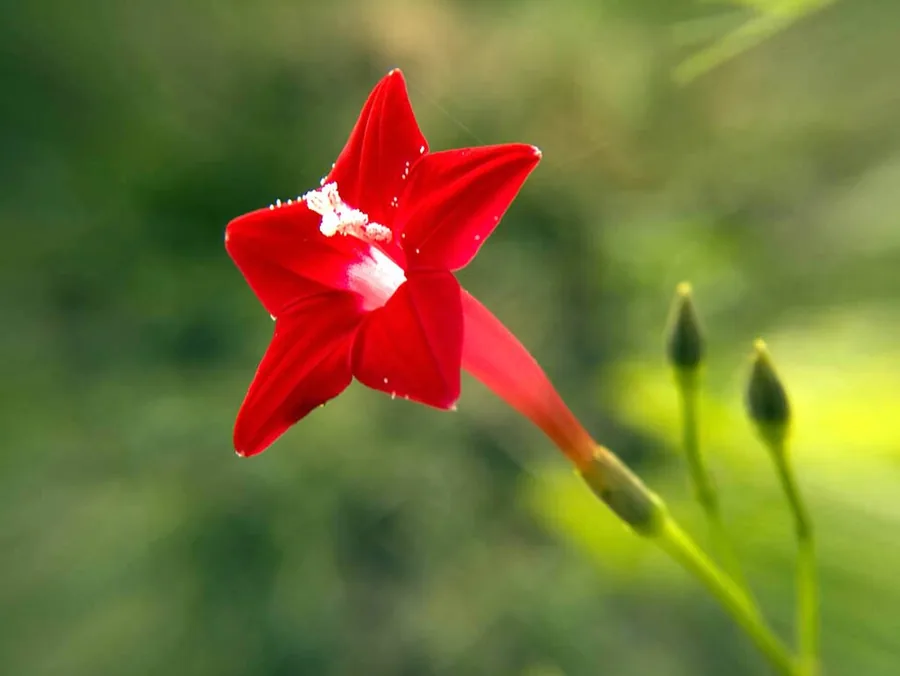
Cypress vine is a fast-growing annual in the morning-glory family, loved for its lacy, thread-fine foliage and dainty scarlet star-shaped flowers. The leaves are so finely cut they look nearly fern-like, and the blooms keep hummingbirds and butterflies coming back from early summer right up to frost. Let it climb and it can reach 6 to 20 feet (1.8 to 6 m) in a single season.
This is one of the most beginner-friendly vines you can plant, which is both its joy and the thing to keep an eye on. Hand it a sunny corner and a support to grab, and it practically grows itself. It also scatters seed freely, so in warm climates it can naturalize and surprise you in spots you never planted.
The hard seed is the one part to be mindful of. Those seeds hold LSA-type alkaloids and are toxic to pets and people if eaten, so place the vine and tuck away any saved seed somewhere out of reach. Grow it for the show it puts on, not for the seed pods.
Care
The short version: full sun, lean to average well-drained soil, and steady moisture while it finds its feet. Hold off on fertilizer, give it a trellis or string to grab, and snip the seedpods if you'd rather it not sow itself across the whole garden.
Light
Cypress vine blooms its best in full sun, which means 6 or more hours of direct light each day. It will still climb in part shade, but you'll notice the flowers thin out quickly as the light fades.
Water
Keep the soil evenly moist while the vine is getting established, then you can ease back, because it handles a bit of drought once its roots are settled. When dry weather comes, water deeply rather than offering frequent little sips.
Soil
Set it in average to poor, well-drained soil and try not to enrich it, even though the instinct is strong. Rich ground or extra nitrogen pushes leaves at the expense of flowers, so leaner really is better here. It's happy with a pH anywhere from 6.0 to 7.5.
Temperature
This one loves the heat, thriving through the warm months and dying back at frost. It grows comfortably across roughly 59°F to 95°F (15°C to 35°C) and won't really wake up until the soil has warmed.
Humidity
Ordinary outdoor humidity suits it just fine, so there's nothing here to fuss over. Good airflow matters far more than any number, keeping those fine leaves clear of pests and mildew.
Feeding
With this vine, feeding is usually a misstep. It needs almost none, and a high-nitrogen feed leaves you with a wall of foliage and barely any flowers, so at most give a light low-nitrogen feed at planting if your soil is truly poor.
Pruning
Pinch the young tips to coax the vine into branching, and trim any stray stems to keep it tidy where you'd like it. When the season winds down, clear away the spent vines and clip the seedpods to ease its heavy self-sowing.
Repotting
none
Size & spacing
With something to climb, the vine reaches 6 to 20 feet (1.8 to 6 m) tall and spreads 3 to 6 feet (91 to 183 cm) across. Plan for a strong trellis, fence, or string, since it blankets its support fast once the heat arrives.
When to plant
Cypress vine is a warm-season annual that simply won't tolerate cold soil. Start your seed indoors in late winter or sow it right outside once the frost has gone, and the vine will bloom from early summer until the first fall frost finally stops it.
Northern hemisphere
Southern hemisphere
Typical months for a temperate climate: start earlier in warm zones, later where spring frosts linger.
- Sow: 6-8 weeks before the last spring frost; nick and soak the hard seed coat 12-24 hours before sowing.
- Plant: After the last frost when soil has warmed; can be direct-sown at the last frost date.
- Harvest: Early summer through fall frost.
Hardiness
USDA hardiness zones: 11–12
Temperature: down to 4°C
Troubleshooting
Cypress vine is an easygoing plant, and the few hiccups that do crop up usually come down to too much food, too little sun, or a handful of common pests on those fine leaves. Find what matches below, then treat the cause and the plant will sort itself out.
Baby seedlings turning up everywhere come spring
Nothing has gone wrong here, your vine is simply a prolific self-seeder and can get a little weedy in warm areas, scattering seed that sprouts in cheerful drifts the next year. The easiest path is to pull those volunteers while they're tiny and lift out with a gentle tug. Want to stay ahead of it next time? Snip the forming seedpods before they ripen and let go.
Fix:
- Pull volunteer seedlings while young
- Remove seedpods before they ripen and shed seed
Lots of leaves, but the flowers just won't come
Take heart, this is one of the easiest fixes there is. When the soil is too rich or there's too much nitrogen around, your vine pours its energy into leaves and climbing instead of buds, and shade has the same effect because the plant wants at least 6 hours of direct sun to bloom freely. Stop feeding it, move it somewhere brighter, and let it settle into lean, well-drained soil. The flowers will follow.
Fix:
- Stop nitrogen feeding
- Move or sow in a full-sun site (6+ hours direct sun)
- Grow in average to lean, well-drained soil
Speckled, twisted leaves with webbing or a sticky film
Those delicate leaves can attract aphids, spider mites, and leaf miners, which leave behind speckling, yellowing, sticky residue, or pale winding trails. Don't worry, this is easy to catch. Turn a few leaves over and have a look: soft clustered bugs are aphids, fine webbing means mites, and squiggly tunnels point to miners. A firm rinse of water and some insecticidal soap early on usually settles it, and you can pinch off any leaf that's badly tunneled.
Fix:
- Rinse foliage with a strong spray of water to dislodge mites and aphids
- Apply insecticidal soap, treating early before populations expand
- Remove and destroy heavily mined or infested leaves
Toxicity
This isn't one to plant within easy reach of pets or little ones. The seeds contain LSA alkaloids and are toxic if eaten, bringing on stomach upset and, in larger amounts, hallucinations and other nervous-system effects. The leaves are a gentler caution, but the seedpods are the real concern, so keep them and any seed you save well out of reach.
Toxic to
Cats · Dogs · Horses · Rabbits · Livestock · Birds · People
Cats Mild
If a cat samples a leaf, you might see some drooling or a little vomiting. The seeds are where the real risk lies, since they carry LSA alkaloids that can cause agitation, tremors, disorientation, or hallucinations when a cat eats more than a nibble.
Dogs Mild
A few chewed leaves tend to bring on vomiting and an upset stomach. The seeds are the larger concern, because the alkaloids can leave a dog restless, shaky, and unsteady on its feet.
Horses Caution
Horses seldom bother with the wispy foliage, but it's wise to keep these morning-glory seeds out of their reach. A mouthful could upset the gut and, in larger amounts, touch the nervous system.
Rabbits Caution
Rabbits should not be browsing this plant. Think of the seedpods as the thing to watch, since the alkaloid-rich seeds can cause tummy trouble and, in bigger amounts, neurologic effects.
Livestock Caution
Grazing animals usually walk right past the vine, but it pays to be careful with seed-bearing plants in a pasture. Eating the seeds can bring on stomach upset and, with enough, signs of nervous-system distress.
Birds Caution
Wild birds happily sip nectar from the flowers without any harm, but the seeds are a different story. Keep saved seed away from pet birds, where even a small taste could cause problems.
People Caution
No part of this vine is grown for the table. The seeds are the worry: swallowing them can bring nausea and stomach pain, and a larger dose of the LSA-type alkaloids can cause hallucinations. Keep seeds and pods well out of children's reach.
Keep seeds and seedpods away from pets; the seeds are the main concern.
Helpline numbers

United States
ASPCA Animal Poison Control: (888) 426-4435 (fee applies)
Poison Control: (800) 222-1222



Canada
Poison Centres: 1-844-764-7669
Varieties
Cypress vine itself is the classic scarlet-flowered form, but a couple of close cousins show up beside it and are easy to confuse with it.
'Alba'
A lovely white-flowered version that trades the familiar scarlet stars for soft white ones.
Cardinal Climber (Ipomoea × multifida)
A cross between I. coccinea and cypress vine, this one shows wider, deeply lobed leaves and red trumpet blooms with pale centers, quite unlike cypress vine's threadlike foliage.
How to propagate
Cypress vine grows only from seed, and the single trick worth learning is gently softening that tough seed coat before sowing.
SeedEasy
Sow indoors 6-8 weeks before last frost, or direct-sow after the last frost when soil is warm. · Germinates in about 1-3 weeks after scarifying; establishes and climbs quickly through the warm season.
Growing this vine from seed is wonderfully forgiving, you just need to soften that tough seed coat first. Nick or scarify each seed and let it soak for 12 to 24 hours, then start it indoors 6 to 8 weeks before your last frost or pop it straight into warm ground afterward. Sprouts appear in 1 to 3 weeks, and once the heat arrives the vine takes off and climbs.
Myths
Cypress vine and cardinal climber are just two names for one plant.
They really are separate vines. Cypress vine wears very fine, feathery, thread-like leaves cut nearly to the midrib, while cardinal climber, the hybrid born from crossing I. coccinea and I. quamoclit, shows wider, deeply lobed palmate leaves. Just look at the foliage and you'll know which is which.