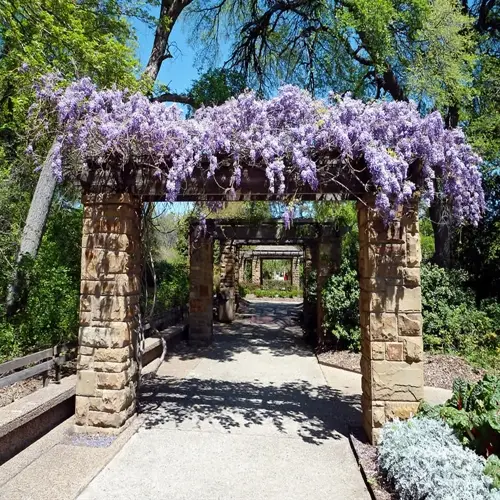

The lifespan of a wisteria goes far beyond what most people expect. Healthy plants live over 50 years with basic care. Many push past the 100-year mark and still bloom strong. When you plant a wisteria, you are adding a feature that will likely outlast you and your house.
I visited the Ashikaga Flower Park in Japan and stood under a wisteria planted in 1870. That plant is over 150 years old and still puts out a massive canopy of purple blooms every spring. The trunk grew so thick it needs a steel frame to hold up its branches. Seeing how long wisteria lives in person changed how I think about this plant. It's not a shrub you replace in ten years. It's a legacy feature.
Wisteria plant longevity comes from two things: its woody trunk and its tough root system. The vine builds permanent woody tissue that gets thicker year after year. Mature stems can reach 15 inches (38 cm) across. The roots spread wide and dig deep into the soil. They store huge amounts of energy. This lets the plant bounce back from drought, frost, and even hard pruning that would kill weaker species.
USDA Forest Service data confirms that wisteria can live more than 100 years in good growing spots. UF/IFAS notes that plants living past 50 years adds to the invasion risk. One Chinese wisteria planted in the early 1900s can still send out new growth today. It keeps covering more ground each year without any help from people.
Several things affect how long your plant will last. Full sun keeps the vine strong and builds dense wood. Good soil drainage stops root rot, which is the top killer of mature wisteria. Regular pruning removes dead wood and opens up air flow through the canopy. Plants that get ignored can still live for decades. But they bloom less and grow into tangled messes that invite disease.
In my experience, the oldest and healthiest wisteria plants are the ones with devoted owners. A gardener in my local club has a Japanese wisteria that her grandmother planted in 1958. That vine covers a 40-foot (12 m) pergola and still delivers hundreds of bloom clusters each May. She prunes it twice a year just like her grandmother taught her. Three generations of care show in the health of that plant.
Plan your wisteria as a permanent part of your property. Choose the spot as if you are placing a tree that will stand for a century. Pick the right species for your zone and your management style. American wisteria gives you the same long life with less spreading. Make sure your support can handle decades of growing weight on top of it.
A wisteria planted today could bloom for your grandkids and their children after them. That kind of lasting beauty is rare in the garden world. Put the thought and effort in up front and you create something that pays you back with flowers for a lifetime and beyond.
Read the full article: Wisteria Tree Care and Growing Guide