
Conifer is the word you want. It covers pine, spruce, fir and the rest of the needled crowd. If you are looking for another name for evergreens in a plant database, or asking for one at a nursery, that single word gets you there fast. It only covers half the story though. Evergreens fall into two groups, and just one of them makes cones.
Walk a garden center and you will see the same juniper tagged two ways. The pot label says conifer and the shelf sign hanging above it says evergreen. Neither one is wrong. One word names the cone the plant makes, and the other names its habit of holding live foliage from one season into the next. They describe different parts of the same shrub.
The conifer meaning comes straight from that cone. Penn State Extension sorts evergreens by how each plant carries its seed, and the line between the two sides is clean. Needled types ripen their seed inside a cone that opens on the branch. The other side carries seed in an ovary that swells into fruit, which is why a holly finishes the year covered in red berries instead of woody cones.
Narrowleaf evergreens are the ones most people picture when the word comes up. Pine, fir, spruce, juniper, hemlock and cypress all sit in this group. Their leaves are needles or small scales, and that shape is where the narrowleaf half of the name comes from. Every one of them sets seed in a cone, so you can call any of them a conifer and be right.
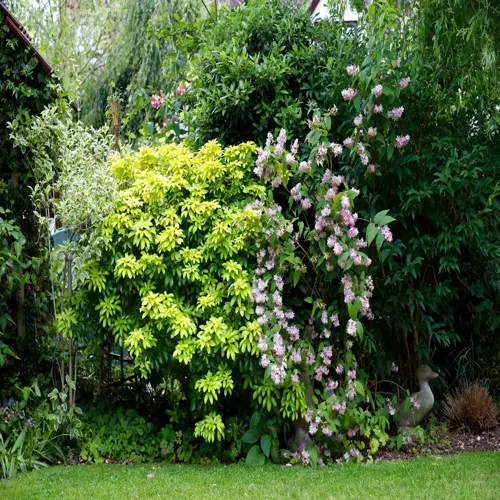
Broadleaf evergreens hold wide, flat leaves through winter and never make a cone at all. Holly, boxwood, rhododendron, pieris, mountain laurel and mahonia belong here. They stay just as green in midwinter as a spruce does. But they are not conifers, and a nursery worker who hears the word conifer will walk you right past them on the way to the needled tables.
- Pine, fir, spruce, juniper, hemlock and cypress.
- Seed ripens in a woody cone on the branch.
- Leaves are needles or flat scales pressed to the twig.
- Gives year-round color and texture to a yard.
- Holly, boxwood, rhododendron, pieris, mountain laurel and mahonia.
- Seed sits in an ovary that ripens into fruit.
- Leaves are wide and flat, often glossy.
- Many carry flowers or berries on top of the winter green.
Both names sit under one bigger word, and that word is the one doing the real work. An evergreen is any plant that stays in leaf year round, cone or no cone. Deciduous plants strip down to bare wood every fall and start over in spring. Evergreens never go through that empty stretch, which is the whole reason people plant them along a driveway or against a blank wall.
The name does hide one thing. Evergreen leaves do fall, they just hang on for more than a year before they let go. Old growth drops while new growth is already open, so the plant never looks bare the way a maple looks bare in winter. That is true on both sides of the split, and it is why you still end up raking under a pine.
So pick your word by what you actually want in the ground. Say conifer when you are after needles and cones, and that one term pulls up the whole needled shelf at once. Say broadleaf when you want wide leaves and spring flowers, or berries the birds will strip by February. Either word cuts the nursery list roughly in half before you start comparing sizes and prices.
Read the full article: Evergreen Trees: 8 Types and How to Choose