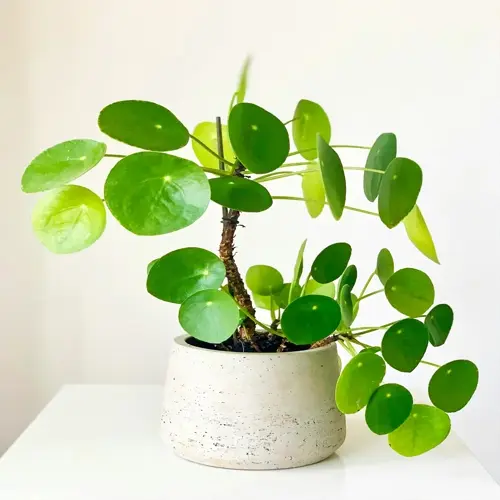

Your pilea is happy when you see flat, round, dark green leaves sitting on firm upright stems. New growth at the top and baby plants popping up from the soil are the clearest signals. If your plant shows all of these, your care routine is working.
I tested this by comparing two of my own plants side by side. On my healthiest pilea, the stems feel firm and spring back when I tap them. The leaves sit flat like little green pancakes with a nice shine. On the one I neglected, the stems went soft and the leaves curled down. Once I fixed the watering and light on that second plant, the change took about three weeks to show. You can feel the difference in your stems before you see it in the leaves.
A healthy pilea grows what botanists call peltate leaves. The stem attaches to the center of a round, flat leaf blade. When your conditions are right, these leaves turn dark green and glossy with no spots or curling. The stems stay upright and close together in a dense rosette shape.
The NYBG notes that your indoor pilea stays in a juvenile state. The compact pot keeps it from reaching full size. This means your healthy pilea should look dense and bushy rather than tall and stretched. If your plant gets leggy with long bare stems, it's reaching for more light and needs a brighter spot.
Here are the healthy pilea signs you want to check for on a regular basis. A thriving pilea plant will hit all of these markers month after month.
Leaf Color and Texture
- Color check: Leaves should be a consistent dark green without yellow patches, brown edges, or pale spots anywhere.
- Surface quality: A light natural sheen on the leaf surface means the plant is well-hydrated and getting enough light.
- Shape: Flat, round leaves signal proper water balance. Curling or cupping means something is off with moisture or temperature.
Stem Strength and Spacing
- Firmness test: Gently press a stem. It should feel rigid and snap back into place without bending or staying limp.
- Node spacing: Short gaps between leaf nodes mean your light levels are correct and the plant is growing compact.
- Upright posture: Stems should point up or slightly outward, not drooping toward the soil or leaning hard to one side.
New Growth and Pup Production
- Top growth: Look for small, tightly curled new leaves appearing at the crown of the plant every 2 to 4 weeks in growing season.
- Pup count: A happy pilea pushes out baby plants from the base or through the soil. Expect 1 to 3 pups per season.
- Root health: If pups and new leaves show up on schedule, the root system below is healthy and doing its job right.
Absence of Pests and Disease
- Leaf undersides: Check beneath the leaves for tiny webs, white fuzz, or sticky residue that signals spider mites or mealybugs.
- Soil surface: No fungus gnats hovering near the pot means your watering schedule keeps the top layer dry enough.
- Stem base: The main stem should be firm and green at the soil line with no dark mushy spots that indicate rot.
Run through this checklist once a month and you'll catch small problems before they turn into big ones. A thriving pilea plant gives you all these positive signals at the same time. If one area slips, adjust that specific part of your care routine and watch for improvement over the next two to three weeks. Pilea responds fast to corrections, which is one of the best things about growing this plant.
Read the full article: Pilea Plant Care and Growing Guide