Shrub · Rosaceae
Japanese Spirea
Spiraea japonica
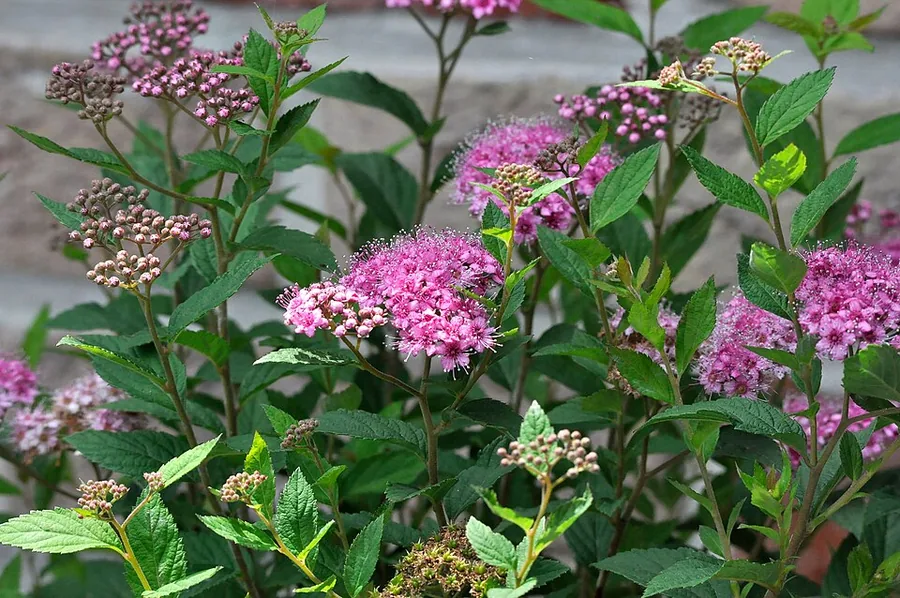
Forgiving, quick to grow, and generous, Japanese spirea rewards you with flat pink flower clusters and foliage that shifts color from spring to fall.
Full sun
Every 5–10 days
USDA 3–8
4–6 ft · 1.2–1.8 m
Overview
If you have never grown a shrub before, Japanese spirea is a kind place to start, because it asks for so little and gives back a lot. It belongs to the rose family, drops its leaves each winter, and settles into a low, rounded mound of about 4 to 6 feet (122 to 183 cm) tall. It grows quickly, so it can fill an empty corner in only a season or two, and by early summer it is topped with flat clusters of pink flowers. Many kinds add another gift on top of that, with leaves in gold, lime, bronze, or red.
Part of what makes this shrub so reassuring is how much it forgives. It takes the cold all the way down to zone 3, settles happily into clay or rocky ground, and because it blooms on new wood, pruning is hard to get wrong. Butterflies come to visit while it flowers, and the leaves warm to a reddish tone before they fall. For all that beauty, it asks for very little in return.
There is one thing worth knowing before you plant, and it is easy to plan around. Spiraea japonica self-seeds and suckers with real determination, and across much of the eastern and southeastern US it has slipped out of gardens and turned invasive, pushing native plants aside. If you live where that matters, a sterile cultivar or a native shrub will give you the same charm without the worry.
Care
The short version: give it a sunny spot with soil that drains well, keep it watered through its first season and whenever things turn dry after that, feed it lightly each spring, and prune in late winter so it can flower on the fresh new growth.
Light
For the most flowers and the richest leaf color, give spirea a spot in full sun, where it truly shines. It will still grow in partial shade, but be ready for fewer blooms and a looser, leggier shape when the light is low.
Water
While your young shrub is finding its feet, keep the soil evenly moist and water it about every 5 to 10 days. Once it is settled it copes well with short dry spells, so there is no need to fuss. The one thing to steer clear of is ground that stays soaking wet, since that is what rots the roots.
Soil
One of the joys of this shrub is that it accepts almost any soil, from heavy clay to thin rocky ground. It is happiest in rich, well-drained loam full of organic matter, and it stays easygoing about pH anywhere from 6.0 to 8.0.
Temperature
Spirea is a genuinely cold-hardy friend, coming through winters as low as -35°F (-37°C) and shrugging off summer heat up to 95°F (35°C). That wide comfort range is exactly why it settles in across so much of the country.
Humidity
You can relax about humidity outdoors, since it makes no difference to this plant and there is no number to keep an eye on. What matters far more is good air movement, because crowded, damp leaves are what invite leaf spot.
Feeding
A gentle touch is all this shrub asks for. Mix in a balanced shrub fertilizer or a little compost in early spring and leave it there, since this is a light feeder that struggles when the diet is too rich.
Pruning
Because spirea flowers on new wood, make your main cut in late winter to early spring before growth wakes up. Trim away the spent flower clusters after the first bloom and you will often be rewarded with a second flush that same year. Bumalda types like a softer touch than the bigger species do.
Repotting
Planted in the ground, spirea never needs repotting at all. A container specimen is happy to be potted up or root-pruned every 2 to 3 years, and roots circling the pot or water running straight through are your friendly signal that it is time.
Size & spacing
Picture a rounded shrub that reaches 4 to 6 feet (122 to 183 cm) tall and spreads a little wider at 5 to 7 feet (152 to 213 cm) across. Give it that space so air can move freely and leaf spot stays away.
When to plant
This shrub is happiest out in the open garden, and it is tough enough to thrive across USDA zones 3 to 8. Plant container or balled-and-burlapped shrubs in spring or fall, and look for those flat pink flower clusters from June to July, with a gentle scattering of rebloom that may follow.
Northern hemisphere
Southern hemisphere
Typical months for a temperate climate: start earlier in warm zones, later where spring frosts linger.
- Sow: Seed is rarely used by home gardeners; if started, sow indoors in late winter, though cultivars do not come true from seed.
- Plant: Plant container or balled-and-burlapped shrubs in spring or fall.
- Harvest: Showy pink (or white to red in some cultivars) flat-topped flower clusters from June to July, with sparse intermittent rebloom possible.
Hardiness
USDA hardiness zones: 3–8
Temperature: down to -40°C
Troubleshooting
Take heart, because Japanese spirea is very hard to lose, and nearly all of its problems are small and simple to spot. A pest or two shows up in spring, wet spells can bring a little leaf spotting, and only soggy ground causes serious harm. Look through what follows, find the match, and step in early while it is still easy to fix.
Wilting and dieback in a shrub standing in wet ground
When a spirea wilts and fades while its soil stays soggy, it is struggling with root rot, where waterlogged ground starves the roots of air until they turn brown and soft. Help the drainage or lift the shrub to a drier home, and gently cut back on watering. Roots that are lost cannot come back, so prevention really is where your care matters most.
Fix:
- Improve drainage or relocate the shrub to a better-drained site
- Reduce watering and avoid wet, compacted soil
- Remove severely affected plants
Tiny insects and sticky, curling new growth
Those little soft-bodied bugs clustering on the freshest shoots are aphids, and they love tender spring growth, but they are nothing to fear. A firm spray of water knocks most of them off, and insecticidal soap is there for the rare colony that settles in. Lady beetles and lacewings will happily finish the job if you let them.
Fix:
- Knock aphids off with a strong jet of water
- Treat heavier infestations with insecticidal soap or horticultural oil
- Encourage and preserve natural predators such as lady beetles and lacewings
Bordered leaf spots with a touch of early yellowing
Neat round spots with dark, tidy edges are the sign of fungal leaf spot, which takes hold when leaves stay wet and the air sits still. Gather up the fallen leaves, thin out any crowded stems so the plant can breathe, and water low at the base so foliage dries quickly. It tends to look far worse than it is and seldom puts the shrub in any danger.
Fix:
- Remove and dispose of fallen and heavily spotted leaves
- Improve air circulation by thinning crowded stems
- Water at the base to keep foliage dry
Toxicity
Here is some comfort for pet owners: Japanese spirea is not toxic. It does not appear on the ASPCA poison list, and no harmful compound has been recorded, so cats, dogs, and livestock can share the garden with it safely. Like any plant that is not food, a big mouthful might bring a short bout of stomach upset, but nothing more serious than that.
Safe for
People · Cats · Dogs · Horses · Rabbits · Livestock · Birds
Cats None
Spirea is safe for cats, with no toxic compound on record, so a curious nibble is nothing to worry about. A big mouthful of any plant can bring on a little drooling or a brief upset tummy, and that is the worst of it.
Dogs None
Dogs can live happily alongside this shrub. The most a determined chewer might get is some mild, passing stomach upset from the roughage, never poisoning.
Horses Safe
No toxicity is on record for horses, so a planting near a paddock is no cause for concern. As with any shrub that is not forage, a horse that strips off a large amount could feel a touch of digestive upset.
Rabbits Safe
Rabbits are quite safe around spirea, since it carries no known toxin. It is not a food plant, though, so let it be an occasional nibble rather than a steady browse.
Livestock Safe
Cattle, goats, and sheep can graze near spirea without harm, as the plant holds no recognized poison. Heavy feeding on any woody shrub might unsettle the gut a little, but that is as far as it goes.
Birds Safe
Spirea is gentle on birds, and its summer flowers actually invite butterflies and other pollinators. Backyard hens can forage beneath it with no concern at all.
People Safe
There is no toxic principle here to trouble people, so the shrub is perfectly safe to have around children. It still is not grown for eating, so enjoy it as an ornamental rather than a snack.
As with any non-food plant, ingestion of large amounts of plant material may cause mild, transient stomach upset; no specific toxic principle is documented.
Varieties
Most of the spirea you will find at a garden center are named cultivars, picked for their leaf color just as much as their flowers. These are the ones that are lovely to get to know.
Goldmound
A neat, mounding little shrub whose bright golden-yellow leaves sit beautifully alongside soft pink flowers.
Limemound
Its lime-green to golden leaves cover a low mound and warm to reddish tones in fall above pink blooms.
Goldflame
New leaves arrive in bronze-red to orange before they calm down, glowing against deep pink flowers.
Froebelii
A vigorous Bumalda type loved for its deep carmine-pink flowers and reddish young foliage.
Double Play Candy Corn
Its leaves open candy-apple-red, mellow to pineapple-yellow and then green, all crowned by purple-red flowers.
How to propagate
Japanese spirea is wonderfully easy to make more of, which is also part of why it spreads so readily on its own. You can root cuttings, divide the suckering clumps, or sow seed, though seed rarely holds onto a cultivar's good looks.
Stem cuttingsEasy
Take softwood stem cuttings in late spring to early summer. · 4 to 8 weeks to root under suitable conditions.
Take softwood cuttings in late spring to early summer and they root with almost no trouble, settling in within 4 to 8 weeks when conditions suit them. That same eagerness to root is part of why the plant spreads so freely in the wild.
DivisionEasy
Divide established clumps or rooted suckers in early spring or fall. · One growing season to become established.
Since spirea throws up suckers, you can gently lift and separate rooted offshoots from an established clump in early spring or fall. Replant them and let them have a full growing season to find their feet.
SeedModerate
Sow seed in late winter to early spring. · Several months to a full season; seedlings of named cultivars do not come true to type.
Spirea self-seeds with great enthusiasm, which is exactly what drives its invasive streak, so seed you sow yourself needs several months to a full season to become a plant. Named cultivars will not come true from seed, so it is best to propagate those from cuttings or division instead.
Myths
Japanese spirea is a harmless ornamental that is fine to plant anywhere in the eastern United States.
It really is safe for pets, but that is only half the story. Spiraea japonica seeds itself with abandon and has escaped gardens all across the eastern and southeastern US, where it is treated as invasive and crowds native plants out. In those areas, a native shrub is the kinder choice for the land around you.
Prune Japanese spirea in fall or just after it blooms to get more flowers the following year.
Since this shrub sets its flowers on new wood, the main pruning belongs in late winter to early spring before growth begins. Shearing off only the faded flower heads after bloom is the trick that brings a second flush. Cut hard at the wrong moment and you give away next year's display.