Houseplant · Bromeliaceae
Earth Star
Cryptanthus bivittatus
Offer it bright indirect light and steady humidity, and the earth star will reward you with color all year long.
Bright indirect
Every 5–7 days
61–84°F · 16–29°C
USDA 10–12
Overview
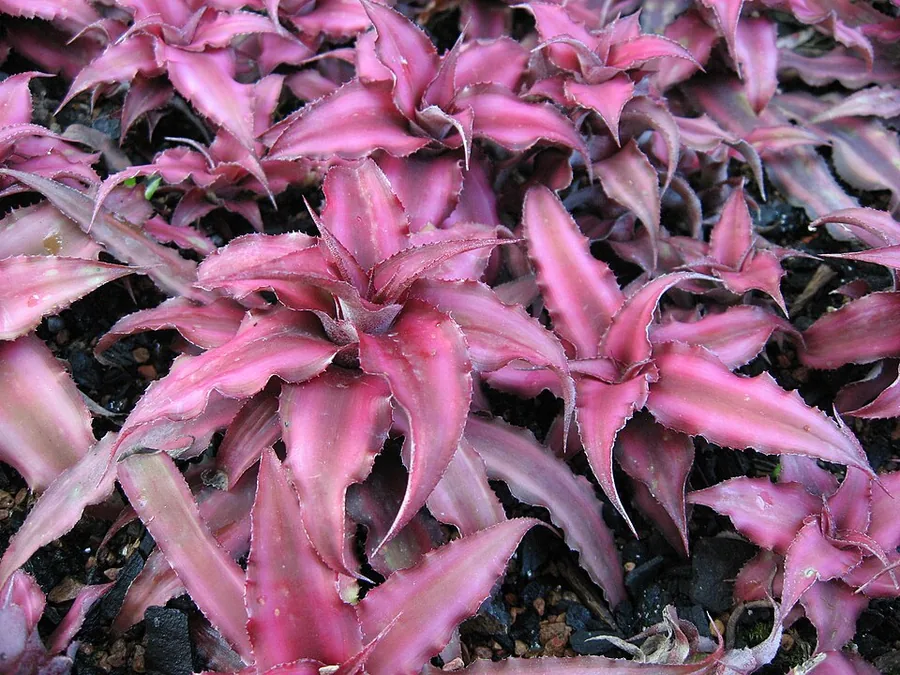
If you have ever felt unsure about bromeliads, the earth star is a kind place to begin. It grows low and flat, opening into a star-shaped rosette of stiff, wavy leaves that you will quickly grow fond of. Unlike the tank-forming kinds, this one lives in soil, which is exactly why it is called a terrestrial bromeliad, and its bands of green, pink, and red stay lovely indoors right through the year.
It keeps things small and undemanding, rising only 3 to 6 inches (8 to 15 cm) tall and spreading a little wider, so it settles happily into a small pot, a dish garden, or a terrarium without ever taking over. Growth is slow and gentle, and the rosette flowers a single time, lifting up small white blooms at its heart before it eases into decline and quietly passes the baton to its pups.
You really can do this. Give it warmth, humidity, and bright but filtered light, and it will forgive the occasional slip. Too much direct sun will bleach the leaves and too little will drain their color, but once you find that comfortable middle, those bright stripes are your thank-you.
Care
The short version: bright indirect light, a rich organic mix kept lightly moist but never soggy, gentle warmth, and high humidity. A monthly feed through the growing season is plenty, and the plant will happily raise its own pups for you.
Light
Settle your earth star where it gets bright, indirect light, and it will be content. It will cope with medium light or partial shade, though the color softens there, and strong direct sun will bleach the leaves, so steer clear of that. A window dressed with a sheer curtain is just about perfect.
Water
Keep the rich organic mix lightly moist but well drained, watering about every 5 to 7 days once the surface has dried a touch. Try not to let it dry out completely, and skip pouring water into the center, since a wet crown can rot. There is no cup to fill on this terrestrial bromeliad, so the roots are where your attention belongs.
Soil
Pot it up in a rich, organic, well-drained mix, something peat- or sphagnum-based rather than a heavy standard soil. The roots are happiest with a little acidity, a pH of 5.0 to 6.0, and they will struggle in dense ground that holds too much water.
Temperature
Comfortable room warmth is all it asks, anywhere from 61°F to 84°F (16°C to 29°C). Keep it clear of cold drafts and chilly winter windowsills, because it simply has no patience for the cold.
Humidity
This is a moisture lover, most at ease between 50% to 70%. Indoor air often runs a bit drier, so a pebble tray, a cluster of plants together, or a terrarium will help it stay steady. When the air near a vent turns dry, the leaf tips are the first to brown, so a little extra humidity goes a long way.
Feeding
A light hand is best. Feed monthly from mid-spring through early fall with a balanced water-soluble fertilizer cut to about half strength. Since it grows slowly and needs very little, you can stop feeding altogether once growth winds down in the cooler months.
Pruning
There is barely any pruning to worry about. Simply remove any dead or damaged outer leaves as you notice them, and once the rosette has flowered and begun to fade, cut away the spent mother plant after its pups have come along.
Repotting
You only need to repot every 2 to 3 years, or a little sooner if pups crowd the pot, the mix dries fast, or the rosette starts lifting up out of the soil. Thanks to that slow growth, it is in no rush for a roomier home, so there is no pressure here.
Size & spacing
It stays charmingly small, reaching just 3 to 6 inches (8 to 15 cm) tall and spreading 6 to 12 inches (15 to 30 cm) across. That tidy size makes it a natural companion for shallow dishes, terrariums, and those snug little windowsill corners.
Troubleshooting
Take heart, because nearly every earth star hiccup traces back to light, water, or air that has gone too dry, and the leaves will let you know early. Find the closest match below, make one small change, and you will usually have things back on track before any harm is done. Pests are rare, so a relaxed glance now and then is all you need.
White fluff, firm lumps, or a sticky film on the foliage
Cottony tufts, hard bumps, or a sticky film are the calling cards of mealybugs or scale, while fine webbing in dry air usually means spider mites. Have a look at the leaf bases and undersides, then lift the pests away with a cotton swab dipped in isopropyl alcohol. A follow-up with insecticidal soap or horticultural oil clears the rest, and keeping the plant on its own until it is clean keeps your others safe.
Fix:
- Wipe off pests with a cotton swab dipped in isopropyl alcohol
- Treat with insecticidal soap or horticultural oil and repeat as needed
- Isolate the plant until the infestation clears
Pale, sun-washed spots showing up on your sunniest leaves
When the brightest leaves look bleached or scorched, the cause is almost always too much light, and harsh midday sun is the real troublemaker. Direct rays overheat the rosette and fade the most exposed leaves until the edges shrivel. Don't worry, just move it into bright but diffused light and let it enjoy only gentle morning or evening sun.
Fix:
- Move to bright but diffused/indirect light
- Provide only gentle morning or evening sun and shield from intense midday sun
The bright colors dimming and pink striping going pale
If an earth star sits too long in deep shade, its bright pink and red striping slips into something muted and flat. The remedy could not be simpler: move it somewhere brighter with bright indirect light, and the next flush of growth will come back vivid and cheerful.
Fix:
- Move to a brighter spot with bright indirect light
Browned, crisp tips while the rest of the leaf stays fine
Dry air is the usual reason behind brown, crispy tips, especially when the plant sits near a heat or air vent. The tips crisp up while the rest of the rosette looks perfectly fine. Move it away from those drafts, lift the humidity with a pebble tray or by grouping plants, and keep the mix evenly moist, and the new leaves will come in clean.
Fix:
- Move away from heating/cooling vents
- Raise humidity with a pebble tray or grouping plants and keep the mix evenly moist
Toxicity
Here is something to put your mind at ease: the earth star is non-toxic. The ASPCA lists Cryptanthus as safe for cats and dogs, with no harmful compounds in any part of the plant. The only thing to keep in mind is the stiff, wavy leaf edges, which can give a light scratch but carry no chemical worry at all.
Safe for
People · Cats · Dogs · Horses · Rabbits · Livestock · Birds
Cats None
Safe to be around. The ASPCA finds no toxic principles, so a curious cat that pats at or chews a leaf is in no danger, though a big mouthful might bring a touch of stomach upset.
Dogs None
Nothing to worry about. There is nothing poisonous here for dogs, and the most a determined chewer faces is a brief, mild tummy ache from the fibrous leaves.
Horses None
Harmless to horses. The plant holds no toxins, so a nibble does no harm beyond the mild upset any unfamiliar greenery might cause.
Rabbits None
Perfectly fine around rabbits. There is no poison in it, and the leaves carry no chemical risk if one decides to have a taste.
Livestock None
No threat to grazing animals. Being a non-toxic bromeliad, it holds nothing that would harm cattle, goats, or sheep.
Birds None
Safe for pet birds. The plant carries no toxic compounds, so a bird that pecks at the rosette comes to no harm.
People None
Not poisonous to people. The only thing to watch is the stiff, wavy leaf edges, which can lightly scratch small hands, but in every other respect this is a non-toxic plant.
Leaves are stiff with wavy, sometimes finely toothed edges that can lightly scratch; no chemical hazard. As with any plant, nibbling may cause mild stomach upset.
Varieties
Earth stars arrive in a friendly spread of colors and sizes, and a handful of forms show up most often in homes and garden centers. These are the ones it helps to recognize by name.
Cryptanthus bivittatus var. atropurpureus
A deeper-colored form of the species, dressed in rich reddish to purple-bronze foliage and recognized as a variety in Kew's Plants of the World Online.
'Minor' (Dwarf Rose-Stripe Star)
A compact dwarf form that carries pretty rose-pink stripes down its leaves, and it is listed by the ASPCA among the non-toxic earth stars.
'Pink Starlite'
A much-loved cultivar with broad creamy-pink and green banded leaves that blush to a deeper pink when the light is bright.
How to propagate
One of the loveliest things about earth stars is how readily they renew themselves, offering you a fresh crop of pups each time the mother rosette finishes blooming.
Offsets & pupsEasy
After the mother rosette flowers and produces pups, typically anytime in the warm growing season · 4 to 8 weeks
Earth stars renew themselves through offsets, or pups, that gather at the center and base of the parent once it has flowered, usually during the warm growing season. Gently ease a pup away, press it into a moist organic potting mix, and keep it watered and humid. Give it a little time and it will root and settle in within 4 to 8 weeks.
SeedDemanding
Warm season under controlled humidity · Several months
Growing from seed is possible, but it is slow and rarely done at home, so don't feel you have to try it. Sown in the warm season under controlled humidity, seedlings need several months to amount to much, which is why offsets stay the easy and reliable way to go.
Myths
Like the rest of the bromeliads, earth stars are supposed to be filled at a central cup.
Cryptanthus are terrestrial bromeliads with a flat rosette and no water-holding tank, so there is no cup to fill. You water them at the roots instead, growing them in soil and keeping the organic mix lightly moist rather than pouring water into the center.
Bromeliads such as the earth star will poison your pets.
You can relax on this one, because the ASPCA classifies earth star (Cryptanthus) as non-toxic to cats and dogs, with no toxic principles identified. It makes a safe and easygoing choice for a home with curious animals.