Shrub · Celastraceae
Burning Bush
Euonymus alatus
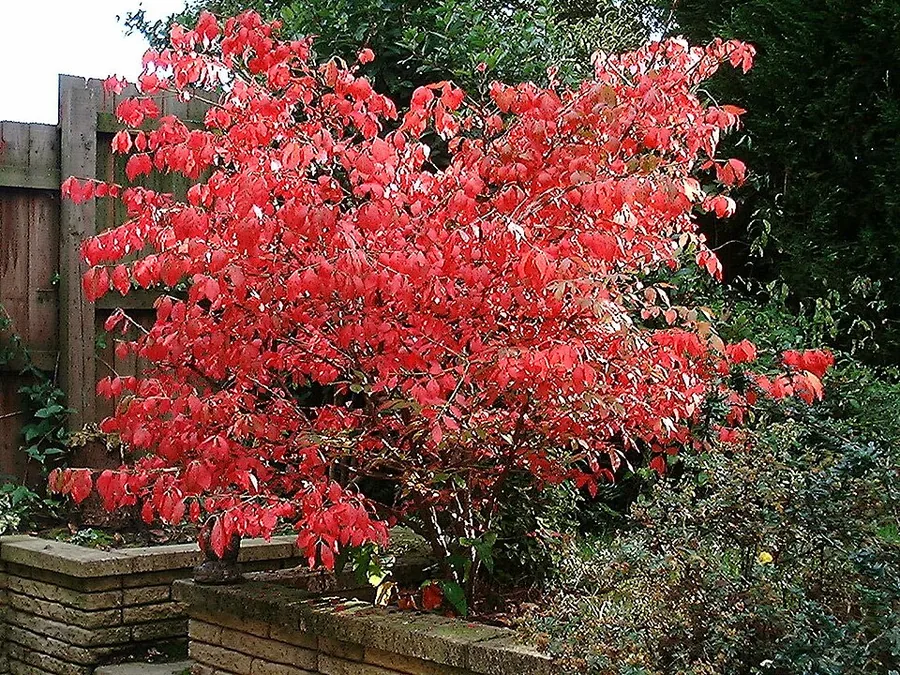
Settle it in full sun and come autumn the leaves flare a deep scarlet you'll catch from clear across the yard.
Full sun
Every 7–14 days
USDA 4–8
15–20 ft · 4.6–6.1 m
Overview
Burning bush is a forgiving, easygoing shrub, and gardeners grow it for one thing above all: the fall color. Through summer the leaves are a calm, reliable green, but as the days grow short they shift to a fierce scarlet-red that brightened yards and parking lots for decades. Look closely and you'll find corky, winged ridges running along the stems, the very feature behind names like winged euonymus.
This is a plant that asks very little of you. Once its roots have taken hold it shrugs off dry spells, settles into clay, loam, or sand without fuss, and rides out winters as cold as -29°F (-34°C). That very toughness, though, is the snag. Birds eat the orange-red fruit and drop the seed in woods and along fencerows, where it builds dense thickets that push out native plants.
For that reason, burning bush is now invasive across much of the eastern and central United States and banned outright in several states. If you're after the same fall blaze without the spread, gentle natives like chokeberry, serviceberry, or ninebark will give you the color with an easier conscience.
Care
The short version: set it in full sun for the brightest fall color, offer it well-drained soil of nearly any kind, keep it watered until it's settled in and then mostly let it be, and prune in late winter to keep its shape. It's a hard plant to get wrong.
Light
Offer burning bush full sun for the richest fall color. It will get along in partial shade and grow perfectly well, but a shaded plant simply leafs out green in autumn and skips the scarlet display that makes it worth planting in the first place.
Water
Water a young plant steadily through its first year, then you can ease off. Once it's settled it is truly drought tolerant and asks for water only every 7 to 14 days during a dry stretch. Keep it out of constantly wet soil, which opens the door to twig blight.
Soil
This shrub is happy in almost any well-drained soil, whether clay, loam, or sand, across a generous pH of 5.5 to 8.0. The one thing it really needs is good drainage, since soggy ground is behind most of the trouble it ever runs into.
Temperature
Burning bush handles cold beautifully, from about -29°F to 95°F (-34°C to 35°C), which spans USDA zones 4 through 8. Harsh winters don't trouble it, and that same hardiness is part of why it slips so easily into the wild.
Humidity
Everyday outdoor humidity suits it just fine, so there's no level for you to fuss over. Good airflow counts for more than moisture in the air, because crowded, stagnant growth is what gives fungal twig blight a chance to take hold.
Feeding
This shrub seldom needs feeding at all. One balanced slow-release fertilizer in spring is plenty, and only if growth looks weak. Pile on the nitrogen and you'll get leafy green growth in place of the fall color you wanted, so a light touch serves you best.
Pruning
Prune in late winter or early spring before fresh growth begins, whether you're tidying its shape or cutting it back hard, which it takes in good stride. Trimming away the spent fruit also cuts down on the seedlings that make this plant a problem.
Repotting
Burning bush is a landscape shrub and rarely lives in a pot, so repotting is hardly ever something to think about. If you do raise a young one in a container, move it up a size when roots circle the bottom, water rushes straight through, or the top growth stalls.
Size & spacing
Given its head, it grows into a large shrub reaching 15 to 20 feet (4.5 to 6 m) tall and 8 to 12 feet (2.4 to 3.7 m) wide. Give it room to fill that out, or plan on steady pruning to hold it to the size you want.
When to plant
Burning bush is a hardy deciduous shrub, which keeps the calendar refreshingly simple. Plant it in spring or fall while the weather stays mild, look for its quiet green flowers around May, and then wait for the main act when the foliage flames red in autumn beside its orange-red fruit.
Northern hemisphere
Southern hemisphere
Typical months for a temperate climate: start earlier in warm zones, later where spring frosts linger.
- Plant: Spring or fall
- Harvest: Inconspicuous yellow-green flowers in spring (about May), followed by red-purple fall foliage and orange-red fruit
Hardiness
USDA hardiness zones: 4–8
Temperature: down to -34°C
Troubleshooting
Burning bush rarely causes a grower much worry, and the few troubles it has are easy to read once you know the signs. Weak fall color is usually about where it sits, while spots, webbing, or dieback point to a pest or a soggy root zone. Find your match below and act early, and things come right.
Speckled, dusty leaves and faint webs during heat
Leaves that look pale and dusty, with delicate webbing tucked under them, are usually the work of spider mites, which thrive when the weather turns hot, dry, and dusty. Here is a gentle way to be sure: hold a leaf over a sheet of white paper and tap it, and you'll spot tiny specks creeping along. A strong spray of water knocks them off, and a follow-up with horticultural oil or insecticidal soap, repeated once more, takes care of the next batch. The plant recovers well.
Fix:
- Spray foliage forcefully with water to dislodge mites
- Apply horticultural oil or insecticidal soap
- Repeat treatments to break the mite life cycle
Twigs and small branches dying back
A few dead twigs and some sunken cankers usually trace back to twig blight, a fungus that settles in when the ground stays too wet. You'll see it most often where drainage is poor or the soil never gets a chance to dry. The remedy is simple and the plant bounces back: prune well below each damaged spot, wipe your tools clean between cuts so you don't spread it, and sort out the drainage that gave it a foothold.
Fix:
- Prune out and dispose of affected twigs well below the damage
- Improve drainage and avoid overwatering
- Clean pruning tools between cuts
Crusty white bumps on stems, leaves going yellow
Those crusty white and brown bumps gripping the stems are euonymus scale, a sap-sipping insect that yellows the leaves and slowly tires the plant out. Take heart, you can turn this around: snip out the most heavily coated stems and coat what remains in horticultural oil to smother the rest. The trick is timing, since sprays only reach the young crawlers as they move in late spring and summer, so aim for that window.
Fix:
- Prune out heavily infested stems
- Apply horticultural oil to smother scale
- Treat crawlers when active in late spring to summer
Fall leaves stay green rather than red
If autumn arrives and the leaves stay flat and greenish, don't worry, this is one of the easiest fixes there is. The blazing color is the whole point of the plant, and a muted display almost always means the spot is too shady. A shrub set in shade will still leaf out happily, it just won't blush red, and a heavy hand with nitrogen pushes the same green growth. Give it a sunnier home and lighten up on the feeding, and the scarlet will return.
Fix:
- Relocate or transplant to a full-sun site
- Reduce or stop nitrogen fertilizing
- Thin overhanging vegetation to increase light
Toxicity
It's safest to think of this entire shrub as poisonous. The leaves, bark, and fruit carry alkaloids and cardiac glycosides that bring on vomiting and diarrhea and, in larger amounts, upset the heartbeat. It isn't safe for dogs, cats, horses, livestock, or people, so tuck the fallen berries and prunings well out of reach.
Toxic to
Cats · Dogs · Horses · Rabbits · Livestock · Birds · People
Cats Moderate
A cat that nibbles the leaves or berries will usually drool and bring it back up, with diarrhea and a sore belly close behind. If it eats a real amount, the cardiac glycosides can start to unsettle the heartbeat, which is the point a quiet evening becomes a trip to the vet.
Dogs Moderate
Dogs that sample any part of the shrub tend to vomit and pass loose, uncomfortable stools within a few hours. A large mouthful can bring on weakness and an uneven heartbeat, so calling the vet is the wise and kind choice.
Horses Moderate
A horse cannot vomit, so whatever it eats stays in and surfaces as colic, diarrhea, and a heavy, weak stride. Browsing a sizable amount can throw off the heartbeat, so reach for the vet without delay.
Rabbits Toxic
Those same alkaloids and glycosides land hard on a rabbit's tiny frame, bringing gut stasis, diarrhea, and a quick downhill turn. No part of this plant should sit anywhere a rabbit might reach.
Livestock Toxic
Cattle, sheep, and goats that graze the foliage or fallen fruit suffer serious digestive upset, and with bigger amounts, worrying heart-rhythm trouble. Fence grazing animals away from any hedge or windbreak that holds it.
Birds Caution
Birds gulp the bright fruit and pass the seed along unharmed, which is precisely how this shrub finds its way into wild land. The arils don't bother them, yet the seeds and foliage still pose a risk to caged or ground-feeding species.
People Caution
Nothing on this shrub is food. The fruit and seeds can trigger vomiting and diarrhea, and a large dose carries that same heart-rhythm risk, so it's best to keep curious children away from the eye-catching berries.
Keep fallen fruit and prunings away from pets and small children; ingestion of several leaves or seeds commonly causes gastrointestinal upset.
Helpline numbers

United States
ASPCA Animal Poison Control: (888) 426-4435 (fee applies)
Poison Control: (800) 222-1222



Canada
Poison Centres: 1-844-764-7669
Varieties
A handful of named selections show up at garden centers, mostly more compact versions of the same shrub. It's good to know going in that none of them gets around the invasive problem.
Compactus
A dwarf winged form that reaches about 10 feet and fills in denser than the species, yet it still produces heavy seed and spreads every bit as invasively.
Rudy Haag
A very compact, slow-growing pick that holds at roughly 3 to 5 feet tall and produces far less fruit than most.
How to propagate
Burning bush is easy to multiply, which is part of why it travels so freely in the wild. You can root cuttings on purpose, or, all too often, find seedlings springing up on their own.
Stem cuttingsModerate
Softwood cuttings in early summer or semi-hardwood cuttings in mid to late summer · Several weeks to root, then grown on for a season or more
Take softwood cuttings in early summer, or semi-hardwood ones a bit later, dip the cut ends in rooting hormone, and keep them humid while they settle. Rooting takes several weeks, after which they want a full season or more of growing on before they're ready for the garden.
SeedEasy
Seed sown after cleaning and cold stratification · Germinates readily; note that prolific self-seeding is the main reason this plant is invasive
Cleaned and cold-stratified seed comes up easily, and that ease is the trouble. Birds feast on the fruit and scatter the seed far afield, which is how the shrub leaps the garden boundary and goes invasive. Raising it from seed on purpose is something to avoid.
Myths
It is perfectly fine to plant the little compact burning bush types, since those smaller ones stay put and won't spread.
Compact picks like Compactus still produce plenty of bird-carried seed, so they slip into the wild just as readily as the full-size shrub does. Burning bush is banned or regulated in several states regardless of the cultivar, dwarf forms included.