
Introduction
The staghorn fern breaks every rule you know about growing a tropical houseplant. It doesn't need a pot or soil. You hang it on your wall like living art, and it thrives up there. These wild plants have taken over social media feeds and plant shops for good reason.
I grew my first one about 6 years ago after seeing a mounted specimen at a local nursery. The genus Platycerium gets its name from Greek words meaning "flat horn." That name clicks once you see the forked fronds that fan out like antlers. There are 18 known species across tropical Africa, Australia, and Southeast Asia.
Think of this epiphytic fern as a tree dwelling organism that built its own composting system. It clings to tree trunks and traps falling leaves in its shield fronds for food. Some species now grow wild in Florida and Hawaii. Others like P. wallichii are vanishing from forests due to habitat loss.
This guide covers 8 species, mounting methods, watering tips, and steps to grow your own. Whether you want a single mounted piece or a full living wall, you'll find your answers right here.
8 Popular Staghorn Fern Species
Most guides lump all staghorn fern species into one care sheet, but that misses the huge range in this genus. I've grown 4 of these types of staghorn fern over the years, and each one taught me something new about what these plants can do.
You'll find easy beginner picks like Platycerium bifurcatum and rare staghorn fern finds that need expert hands. Some handle frost while others die below 60°F (15.5°C). A few sell as elkhorn fern at garden centers, so check the species name tags before you buy.
Platycerium bifurcatum
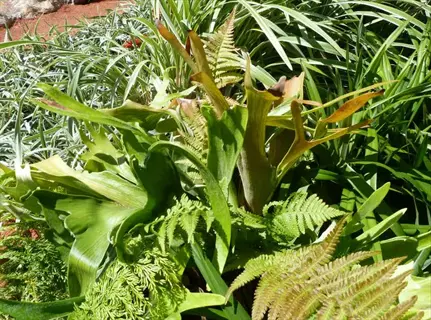
- Common Names: Known as the common staghorn fern or elkhorn fern, this is the most available and beginner safe species in the entire genus.
- Native Range: Found in the rainforests of Java, New Guinea, and southeastern Australia, and now growing wild in parts of Florida and Hawaii.
- Size: Mature plants reach up to 3 feet (90 centimeters) across with fertile fronds up to 18 inches (45 centimeters) indoors and 4 feet (1.2 meters) in nature.
- Cold Tolerance: One of the hardiest species, surviving brief freezes down to 30°F (-1°C) and growing outdoors in USDA Zones 9a through 13b all year.
- Care Level: Low maintenance with slow growth, making it the ideal starter species for anyone new to growing epiphytic ferns indoors or outdoors.
- Recognition: Received the Royal Horticultural Society Award of Garden Merit in 1993 for its reliable performance and ornamental value.
Platycerium superbum
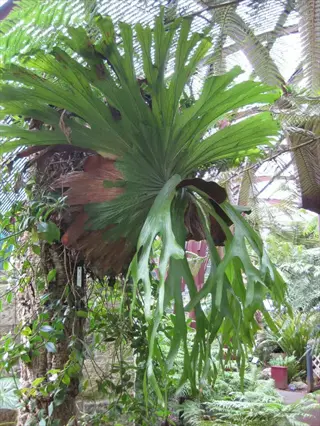
- Common Names: Often called the giant staghorn, this Australian native produces some of the most impressive shield fronds you will ever see in the genus.
- Native Range: Found only in the rainforests of eastern Australia, growing high in the canopy in Queensland and New South Wales.
- Size: Shield fronds can reach over 4 feet (1.2 meters) wide. Fertile fronds hang down in forked shapes that look stunning on a wall.
- Key Difference: This species does not produce pups or offsets. You can only grow new plants from spores, which makes it much harder to propagate.
- Care Level: Moderate challenge that needs steady humidity above 50% and protection from temps below 50°F (10°C) in colder months.
- Display: Best on large boards or in oversized hanging baskets where the massive shield fronds can spread out without restriction.
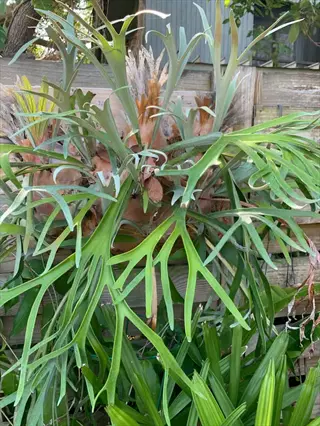
Platycerium veitchii
- Common Names: Known as the silver elkhorn or French staghorn, this species stands out with striking silver blue fronds unlike any other green species.
- Native Range: Found in the drier forests of northeastern Australia, where it handles more sun and less humidity than most other species.
- Size: A compact grower reaching about 2 feet (60 centimeters) across, which makes it great for smaller spaces, apartments, and tabletop setups.
- Cold Tolerance: Very hardy for the genus, handling temps as low as 30°F (-1°C) right alongside P. bifurcatum as one of the toughest options.
- Care Level: Beginner safe thanks to its tolerance of drier air, brighter light, and temperature swings that would stress more sensitive species.
- Unique Feature: Silver trichomes on the fronds act as natural sun shields, so this species can handle more direct light than its tropical cousins.
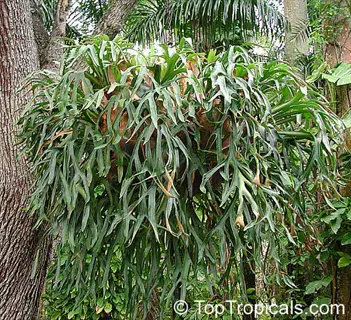
Platycerium coronarium
- Common Names: Called the crown staghorn or disc staghorn, this is one of the most dramatic and largest species in the whole Platycerium genus.
- Native Range: Grows across tropical forests in Thailand, Malaysia, Indonesia, and the Philippines in humid lowland rainforests.
- Size: Fertile fronds can reach a stunning 15 feet (4.5 meters) long, making it far too large for indoor growing but amazing in tropical gardens.
- Shield Fronds: Creates upright, crown shaped shield fronds that form a large basket to catch falling leaves and organic debris for nutrients.
- Care Level: For advanced growers only, needing steady warmth above 60°F (15.5°C), humidity above 70%, and lots of growing space.
- Display: Best grown outdoors in tropical climates on large trees, where the massive hanging fronds can reach their full size.
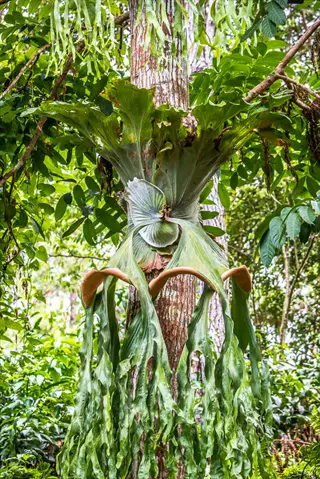
Platycerium grande
- Common Names: Known as the moosehorn fern or regal elkhorn, this massive species is one of the most striking and endangered members of the genus.
- Native Range: Found only in the Philippines, where wild numbers have dropped to about 242 documented plants in recent surveys.
- Size: A large species with broad, fan shaped fertile fronds that spread upward, creating a look quite different from the typical antler shape.
- Conservation Status: Listed as Critically Endangered due to deforestation, habitat loss, and illegal collection for the plant trade.
- Care Level: Hard to grow, needing warm temps above 60°F (15.5°C), high humidity, steady moisture, and full shade at all times.
- Distinction: Often confused with P. superbum but has broader, more upright fertile fronds with less forking in the structure.
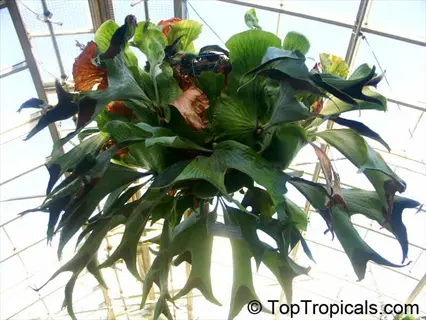
Platycerium hillii
- Common Names: Called the stiff staghorn or green staghorn, this Australian species grows more rigid and upright fronds compared to others.
- Native Range: Found in the tropical rainforests of northeastern Australia, growing on tree trunks and branches in humid, sheltered spots.
- Size: A medium species reaching about 2 to 3 feet (60 to 90 centimeters) across, with fertile fronds that branch less than P. bifurcatum.
- Key Feature: Stiffer and more erect fronds give this plant a tidier, more compact look that works well in smaller indoor spaces.
- Care Level: Moderate challenge with needs close to P. bifurcatum but a bit less cold tolerant, preferring temps above 50°F (10°C).
- Hybridization: Often crossed with P. bifurcatum to create popular cultivars that blend the best traits of both parents for your collection.
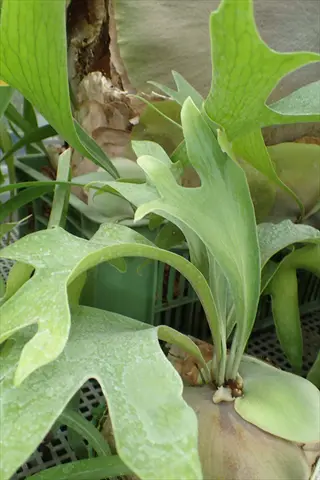
Platycerium wallichii
- Common Names: Known as Wallich's staghorn fern, this rare species is one of the most endangered ferns on the planet and sought after by collectors.
- Native Range: Found in tropical lowland rainforests of China, India, Malaysia, Myanmar, and Thailand, where numbers keep dropping.
- Conservation Status: Listed as Critically Endangered on the IUCN Red List and protected as a national second class wild plant in China.
- Size: A medium to large species with fertile fronds that hang down in long, narrow, forked patterns unlike most other species you will find.
- Care Level: Expert care is a must, with strict temps above 60°F (15.5°C), very high humidity, and no tolerance for stress.
- Ethical Note: Due to its endangered status, you should only buy nursery grown specimens and verify the source to avoid supporting wild collection.
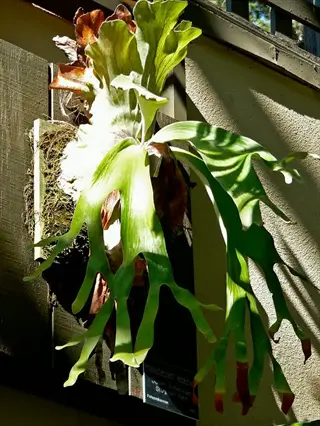
Platycerium andinum
- Common Names: Called the American staghorn fern or Andean staghorn, this is the only Platycerium species native to the Americas.
- Native Range: Found in Peru and Bolivia, growing in cloud forests at moderate elevations far from the typical Asian and Australian habitats.
- Size: A medium species reaching about 2 to 3 feet (60 to 90 centimeters) with broad, less forked fertile fronds that create a rounder look.
- Unique Position: Its isolated South American range suggests the genus was once more widespread before continental drift split the populations apart.
- Care Level: Hard to grow because it prefers cool, misty cloud forest conditions with temps between 50°F (10°C) and 75°F (24°C).
- Availability: Almost never found in plant shops, making it a prized find for advanced collectors willing to match its specific growing needs.
Mounting and Display Methods
A mounted staghorn fern on your wall becomes a piece of living sculpture that grows more stunning every year. The New York Botanical Garden says boards and baskets work much better than pots. I've tried every method below, and each one gives you a different visual effect for your space.
Before you start your staghorn fern wall mount project, know that copper wire is toxic to all ferns and should never touch your plant. Use fishing line or jute twine instead. Cedar and cork bark boards resist rot on their own, so they last for years without any treatment. Sphagnum moss goes between the board and the root ball to keep your fern moist and happy. The kokedama method skips the board and wraps the whole root ball in a moss sphere for a clean, floating look.
Board Mounting
- Materials Needed: A wooden board made of cedar, oak, or untreated hardwood, sphagnum moss, fishing line or jute twine, and a picture-hanging bracket for the back.
- Best For: Creating a living wall art display that showcases the natural growth habit of staghorn ferns with shield fronds pressed flat against the backing surface.
- Installation: Layer damp sphagnum moss on the board, place the fern's root ball against the moss, and secure with fishing line wrapped in a criss-cross pattern around the board.
Wire Basket Display
- Materials Needed: A wire hanging basket lined with sphagnum moss or coconut coir, additional moss for filling, and a sturdy hook or chain rated for the mature weight.
- Best For: Allowing 360-degree growth so the fern can develop shield fronds and pups around the entire basket, eventually creating a spectacular sphere-shaped colony.
- Installation: Line the basket with a thick layer of damp sphagnum moss, nestle the fern into the center, and pack additional moss around the root ball to hold it securely.
Kokedama Style
- Materials Needed: Sphagnum moss, peat-based soil mix, cotton string or jute twine, and a hanging hook or decorative branch for suspension in a bright location.
- Best For: A minimalist, Japanese-inspired display that wraps the root ball in a moss sphere, creating an elegant floating appearance without any pot or mounting board.
- Installation: Wrap damp sphagnum moss around the root ball, shape into a firm sphere, and bind tightly with cotton string or twine before suspending from a hook.
Tree Attachment (Outdoor)
- Materials Needed: A mature tree with textured bark (oak, palm, or similar), sphagnum moss, jute twine or nylon stockings, and a sheltered spot with dappled light.
- Best For: Recreating the natural growing environment in USDA Zones 9 through 13, where the fern can establish itself on the host tree and grow without any human-made mounting.
- Installation: Secure the fern against the tree trunk using biodegradable material, pack sphagnum moss around the root ball, and keep moist until new shield fronds grip the bark.
I recommend board mounting if you're just starting out with your first hanging basket or wall display. It gives you the easiest access for watering and lets you check the root ball without any guesswork.
Watering and Humidity
Getting your staghorn fern watering right is the single most important part of care. Overwatering kills more of these ferns than anything else. I learned this the hard way when my first staghorn turned to mush in about 3 weeks. UF/IFAS Extension says you should wait until the fern wilts just a bit before you soak it again.
Two simple rules guide everything about how to water staghorn fern plants. More humidity means less watering, and more light means more watering. Keep these formulas in your head and you'll avoid most mistakes. Your sphagnum moss should feel damp like a wrung out sponge after you water it. Never let it drip wet or sit soaked for long periods.
The soaking method works best for mounted ferns. Take your board off the wall and dunk the root ball in a basin of room temp water for 15 to 20 minutes. This immersion watering lets the moss absorb water deep into the core. For in between soaks, misting once a day keeps the humidity up around the fronds. The NYBG recommends this daily misting for anyone growing in warm, dry rooms.
Now I always check the moss with my finger before reaching for the watering can. If the center still feels damp to the touch, I wait another day or two. This one habit keeps your fern safe from the root rot that catches so many new growers off guard.
Light and Temperature Needs
Staghorn fern light requirements come down to one rule. Give your plant bright indirect light and keep it away from harsh afternoon sun. An east facing window works best because it delivers gentle morning rays without the scorching heat. South facing windows also work if you hang a sheer curtain to filter the strong beams.
In my experience, a spot about 4 feet from a south window works great for most staghorns. Too much direct sun creates bleached, blotchy marks on the fronds that won't heal. Too little light causes pale, leggy growth that looks stretched and weak. When I first started growing these ferns, I put one in a dark corner and it stretched out fast. You can also use artificial light grow bulbs on a timer for 10 or more hours a day during dark winter months.
The ideal summer temperature range sits around 70°F (21°C) with a max of about 75°F (24°C) according to the NYBG. Your fern grows best when night temps dip about 10°F (5.5°C) below daytime readings. This drop mimics the natural forest cycle. Cold tolerance varies a lot between species. P. bifurcatum and P. veitchii handle temps as low as 30°F (-1°C) in USDA hardiness zones 9a and up. Most other species can't go below 55°F (13°C) without damage.
Propagation Techniques
If you want to know how to propagate staghorn fern plants, start with pups. These small offsets sprout from the parent's rhizome at the base. When I first divided a pup about 3 years ago, I was nervous I'd kill it. Now that baby plant is almost as big as the mother. Pup division works much faster than spore propagation, which takes years.
You need patience for staghorn fern propagation no matter which method you pick. Pup division takes about 3 to 6 months before the new plant settles in and starts growing on its own. Spore growing can take over 2 years before you see a plant that even looks like a fern. P. superbum doesn't produce pups at all, so spores are your only option with that species. Most hobbyists should start with P. bifurcatum offsets because they root fast and forgive mistakes.
Pup Division Method
- When to Divide: Wait until pups are at least 4 inches (10 centimeters) across with their own small shield frond and several developing roots visible at the base.
- Tools Required: A clean, sharp knife sterilized with rubbing alcohol, damp sphagnum moss, a new mounting board or basket, and fishing line or twine for securing.
- Process: Cut the pup away from the parent plant's rhizome with care, keeping as many roots attached as possible, and mount right away on damp sphagnum moss.
Spore Propagation
- Difficulty Level: Expert level technique that takes several months to show visible growth and up to 2 years or more before you get a young staghorn fern.
- Collecting Spores: Wait for brown spore patches to appear on the undersides of mature fertile fronds, then scrape them onto clean paper and store in a dry envelope.
- Growing Medium: Sow spores on a sterile, damp peat moss surface in a covered container to keep near 100% humidity and steady temps around 70°F (21°C).
Tissue Culture (Laboratory)
- Overview: A commercial method used by nurseries to produce large numbers of identical plants from small tissue samples in sterile lab settings.
- Advantages: Allows rapid multiplication of rare or endangered species without harming wild populations, and produces disease free starter plants.
- Limitations: Not practical for home growers due to the need for sterile equipment, special growth media, and controlled lab conditions.
Post-Propagation Care
- First Two Weeks: Keep new pups in a humid spot with bright indirect light, misting daily and avoiding direct sun until new root growth takes hold.
- Watering Adjustment: Water more often than mature plants during the first month, keeping the sphagnum moss damp but never soaked to prevent rot.
- Growth Expectations: Expect slow initial growth for the first 3 to 6 months as the young plant builds its root system and starts producing new fronds.
Troubleshooting Common Issues
A staghorn fern turning brown doesn't always mean trouble. Brown fronds can mean several things depending on where the color shows up. I've seen growers rip out healthy shield fronds because they thought the natural browning was a sign of disease. Brown shield fronds are normal as they age and trap debris for nutrients.
The most common pests you'll run into are scale insects and mealybugs according to NC State Extension data. Spider mites and aphids also show up but less often. Check the undersides of your fronds for tiny bumps or sticky residue. A cotton swab dipped in rubbing alcohol takes care of small outbreaks. For bigger problems, neem oil or insecticidal soap sprayed once a week will clean things up.
Root rot from overwatering causes brown tips and a mushy base that smells bad. Black spots on the fronds point to a fungal issue from too much moisture sitting on the leaves. If you see random browning you can't explain, check whether copper wire is touching your fern. UF/IFAS warns that copper is toxic to all fern species and will cause damage over time.
5 Common Myths
Staghorn ferns need to be planted in regular potting soil like other houseplants to grow properly and stay healthy.
Staghorn ferns are epiphytes that naturally grow on tree bark, not in soil. They thrive best when mounted on boards or placed in baskets with sphagnum moss.
The brown shield fronds at the base of a staghorn fern are dead and should be removed immediately to keep the plant clean.
Brown shield fronds are a natural part of the plant's life cycle. They trap organic debris that decomposes into nutrients the fern absorbs, so removing them can starve the plant.
Staghorn ferns are tropical plants that cannot survive any cold weather and must always be kept above 70 F (21 C).
While most species prefer warmth, Platycerium bifurcatum and P. veitchii can tolerate temperatures as low as 30 F (-1 C), and P. bifurcatum is hardy in USDA Zone 9 and above.
You should water staghorn ferns every day because they come from humid rainforests and constantly need moisture on their roots.
Overwatering is the primary cause of staghorn fern death. These plants prefer to dry out slightly between waterings, and soaking once a week is usually sufficient for most environments.
All staghorn fern species look the same and produce the identical antler-shaped fronds regardless of variety or growing conditions.
The 18 Platycerium species vary dramatically in size, frond shape, and growth habit. P. coronarium produces fertile fronds up to 15 feet (4.5 meters) long, while P. veitchii stays compact with silvery blue fronds.
Conclusion
Good staghorn fern care starts with one simple truth. These plants aren't regular houseplants and they don't want to be treated like one. Platycerium species live on trees, and that fact shapes every care choice you make. Mount them instead of potting them. Let them dry out between soaks. Give them bright light without direct sun.
This staghorn fern growing guide walked you through 18 species in the genus, and each one has its own needs. Hardy picks like P. bifurcatum handle temps as low as 30°F (-1°C) and forgive most mistakes you'll make as a new grower. The biggest killer is still overwatering, so check your moss before you soak. That one habit will save you more plants than any other tip in this guide.
When I started growing these epiphytic fern plants years ago, I had no idea how many doors they'd open. Success with your first staghorn often leads you to try orchids, bromeliads, and other mounted tropicals. The skills transfer across all these plant groups.
Keep in mind that some Platycerium species are vanishing from the wild. Buying nursery grown plants instead of wild collected ones helps protect endangered species like P. wallichii and P. grande. Your next staghorn fern is waiting for a spot on your wall, and now you know how to keep it alive for decades.
External Sources
Frequently Asked Questions
How do you care for staghorn ferns?
Staghorn ferns need bright indirect light, weekly watering by soaking, high humidity, and balanced monthly fertilizer during the growing season.
What is special about staghorn ferns?
Staghorn ferns are unique epiphytes with two distinct frond types: shield fronds that collect nutrients and antler-shaped fertile fronds for reproduction.
How fast does a staghorn fern grow?
Staghorn ferns are slow growers, typically adding a few new fronds per year under optimal conditions.
How do you care for an elephant ear staghorn fern?
Elephant ear staghorn ferns (Platycerium elephantotis) need warmer temperatures above 60 F (15.5 C), high humidity, and consistent moisture.
Are staghorn ferns hard to keep alive?
Staghorn ferns are moderate in difficulty once you understand their epiphytic nature and avoid overwatering.
How old can a staghorn fern get?
Staghorn ferns can live 20 to 30 years or more with proper care, and some wild specimens are estimated at over 50 years old.
Why is the staghorn fern so expensive?
Staghorn ferns are expensive due to their slow growth rate, difficulty of propagation, and high demand among collectors.
How do you care for a staghorn fern indoors?
Indoor staghorn ferns need bright indirect light near east or north-facing windows, weekly soaking, daily misting, and monthly fertilizer.
Is the staghorn fern toxic?
Staghorn ferns are non-toxic to dogs, cats, and horses according to NC State Extension, making them safe for pet households.
What is the difference between a staghorn fern and an elkhorn fern?
Staghorn ferns (Platycerium bifurcatum) produce single plants while elkhorn ferns (Platycerium alcicorne) form dense colonies with narrower fronds and different shield frond patterns.