
Introduction
A raised garden bed is a growing area held above the soil around it, framed or not, and the fill inside decides whether it works. Lumber sells the idea. The frame is optional, and the fill never is. A bed shaped with sloped sides and no boards at all grows the same crops, so your money belongs in the soil rather than the siding.
University of Maryland Extension puts a standard bed at 2 to 4 feet (60 to 120 cm) wide and 2 to 12 inches (5 to 30 cm) high, with the length left to you. The University of Delaware fact sheet asks for at least 12 inches (30 cm) of raised bed soil depth. It also likes 4-foot beds, because you can reach the middle from either side and never step on the growing area.
Every number below carries the name of the extension service that published it, which is not how most raised garden bed guides work. The usual page hands you one width, one depth and one soil recipe with nothing behind them. The universities behind those numbers do not agree with each other, and you get both figures here instead of one quiet average.
That disagreement is the useful part of raised bed gardening. Maryland's height range starts at 2 inches (5 cm) while Delaware wants 12 inches under your plants. The gap is real, because a shallow bed with an open bottom lets roots run down into the ground below and a bed sealed off from that ground does not. Read the extension recommendations as a range with reasons attached, then pick from your own ground. Rock, pavement or lead-risk soil pushes you deeper. Decent native dirt lets you build low and cheap.
Raised Garden Bed Specs That Matter
Height comes first, and the published raised garden bed dimensions do not line up. University of Maryland Extension puts a bed at 2 to 12 inches (5 to 30 cm) high and 2 to 4 feet (60 to 120 cm) wide, at any length you want. Utah State asks for at least 6 to 12 inches (15 to 30 cm) on a framed bed, or 8 to 12 inches (20 to 30 cm) above grade with no frame at all. Delaware wants at least 12 inches (30 cm) of soil in a bed 4 feet (120 cm) wide.
Width is the number they nearly agree on, and the reason is your arm. Delaware ties 4 feet to reaching the middle from either side and to lumber that already sells in that length. The best width for raised beds also protects the thing you paid for. You stand in the paths instead of on the soil, so footsteps never pack it down.
Run one 4x8 raised bed through that table and the spread shows up fast. At 4 by 8 feet (120 by 240 cm) the footprint clears every source, since Delaware names those exact lengths. Give it 12 inches (30 cm) of fill and all three are satisfied. Build the same box 6 inches (15 cm) tall and Utah State still counts it as framed, Maryland still has it inside the range, but Delaware would want deeper soil under your tomatoes.
Raised bed soil depth is only half the question anyway. A bed shallower than 12 inches (30 cm) should have no bottom, so roots can push into the ground underneath. That single rule splits a shallow bed on open ground from the same box on a patio, where the fill is every bit of root room the plant will ever get. Build much taller if bending hurts or you garden from a chair, and leave paths of at least 4 feet (120 cm) wide.
You Do Not Always Need a Frame
The builder's crew scraped the topsoil off the flat strip beside my driveway and left orange clay that shed water like a tarp. I spread 4 inches (10 cm) of compost down the length of it, scattered blood meal over that, and turned the whole strip with a digging fork until the clay and the compost came up one color. Then I raked it into a low mound and planted bush beans. That mound was an unframed raised bed. It cost me one afternoon and a pile of compost, with no boards and no corner screws.
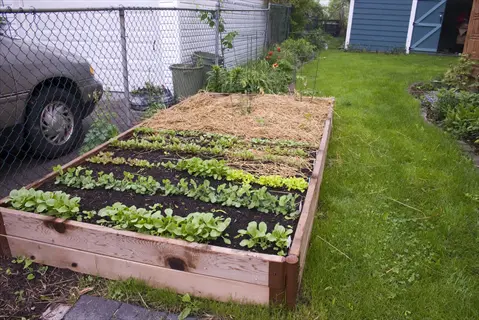
Oregon State University Extension calls framing optional in FS 270, and the frameless version runs on the short list I used beside that driveway. You add organic material and nitrogen to the native soil, mix it in, then shape the soil into beds. That is the entire method. University of Maryland Extension goes as far as listing the sloped side bed as a straight substitute for an enclosure, sitting in the same lineup as stone, brick, concrete block and cedar boards. So how to build a raised garden bed with no lumber at all? You shape the soil instead of boxing it in, and the five steps below cover the whole build.
Choose ground with at least 6 hours of direct sun, good drainage and easy water access, per University of Delaware.
Spread organic material over the native soil and add nitrogen with it, per Oregon State University Extension.
Work the organic material into the native soil rather than layering it on top, so the amendment is incorporated instead of sitting on the surface.
Rake the soil into a bed 8 to 12 inches (20 to 30 cm) above grade and 3 to 4 feet (90 to 120 cm) wide, per Utah State University Extension.
Mulch the areas between beds to hold down weeds and give yourself somewhere to walk, per Oregon State University Extension FS 270.
Skip the boards on flat ground with soil you can still dig. Put the money into compost instead. A DIY raised garden bed built from lumber earns its price on a slope, along a lawn edge that creeps in, or when you want the sides holding the same shape in five years. If you do build the box, drive 4 inch (10 cm) decking screws at each corner and back the joint with a wooden block or a metal plate. Make the top ledge wide enough to sit on and one side of the bed doubles as a bench for weeding.
Siting, Timing, and Access
Where to place a raised garden bed? Start by counting hours of sun. University of Delaware Extension asks for at least 6 hours of direct sun a day, and Utah State University Extension puts the number at 6 to 8 hours for the most fruit and leaf growth. Raised bed sun requirements come first for a plain reason. You can change everything inside the frame later, but you cannot move the sun.
Two site conditions decide the rest. The spot needs good drainage and easy access to water, since a bed dries out fast in hot, dry weather and you will be dragging a hose out to it. Run the bed north to south where the yard allows it. On contaminated soil, asphalt or concrete, lay geotextile barrier fabric between the bed soil and the ground.
Height and paths belong in the same decision as sun. Beds can be built much taller for gardeners who have trouble bending or who work from a chair. Oregon State University Extension publishes a wheelchair accessible raised bed design. Pathway width between beds is the other half of it, so leave at least 4 feet (120 cm) and a wheelbarrow, a garden cart, or a gardener who needs more room can get through.
So when should you build? Fall or early winter is the best time to begin, and that comes straight from the University of Delaware fact sheet with no caveat attached. Mark the sunny corner now. Build it when the growing season is over.
Raised Bed Materials and Safety
Is pressure treated lumber safe to build a vegetable bed with? University of Maryland Extension points to Oregon State University research on that question. Soil copper rose by a small amount only within 1 inch (2.5 cm) of the bed edge, and the plants grown in those beds showed no increase in copper at all. The arsenic treatment behind most of the worry is chromated copper arsenate. It has not been sold for home use since 2004, so the boards you buy today are not the boards your parents built with.
Ask three extension services and you get three answers. The Maryland guidance rates micronized copper azole low in toxicity for a home garden. University of Delaware calls new pressure-treated pine safe, but rules it out for organic gardening. University of Maine keeps the focus on your own skin and lungs in contact with the bed soil and its dust, where the risk is certainly not zero. So the best material for raised garden beds comes down to which of those three positions you want to live with.
Cedar or redwood boards
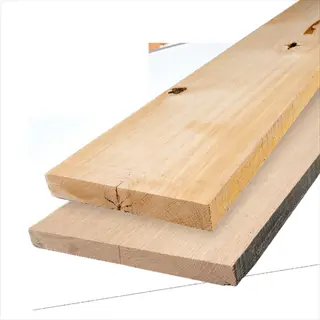
- Rot resistance: Utah State University Extension lists cedar and redwood as rot-resistant woods suited to framed raised beds.
- Wider species list: University of Maryland Extension cites the USDA Forest Products Lab, which adds black cherry, oak, black locust and Osage orange.
- No preservative question: Untreated decay-resistant wood removes the preservative debate, which is why University of Maine recommends it first.
- Cost caution: No extension source located publishes a price or a lifespan in years, so treat vendor cost-per-year claims as marketing rather than data.
- Build detail: Utah State University Extension specifies 4 inch (10 cm) decking screws at the corners, reinforced with a wooden block or metal plate.
- Compared with fir: Utah State University Extension warns untreated fir rots within a few years, while cedar and redwood resist rot on their own.

Untreated hemlock
- Extension recommendation: Jonathan Foster of University of Maine Cooperative Extension names untreated hemlock alongside cedar as his first choice for bed walls.
- Documented durability: His own hemlock beds are at least 6 to 7 years old, with no boards replaced and the frames still sound.
- Failure pattern: He notes raised beds degrade board by board rather than all at once, so repairs stay small and local instead of total.
- Structural margin: Once a bed is full of settled soil, he says the loss of a whole board seldom threatens the structure.
- No contamination question: Untreated wood removes the leaching question, which is his stated reason for choosing it over treated lumber.
- Framed as a choice: He presents this as a personal risk-tolerance call, not as a finding that treated lumber is unsafe for food crops.
Modern pressure-treated pine
- Current chemistry: University of Maryland Extension says micronized copper azole is the most common residential wood preservative, with copper and no arsenic.
- Toxicity rating: That same publication describes micronized copper azole as low in toxicity for residential use around a home garden.
- Research finding: University of Maryland Extension reports Oregon State research finding soil copper rose only within 1 inch (2.5 cm) of the bed edge, not in the plants.
- Organic caveat: University of Delaware calls new pressure-treated pine safe, but says it should not be considered for organic gardening at all.
- Remaining concern: University of Maine stresses the gardener's own contact through skin, dust and hands, and says that risk is certainly not zero.
- Mitigation options: Exterior latex paint, semi-transparent oil-based stain, or a heavy plastic liner that still lets the bed drain.
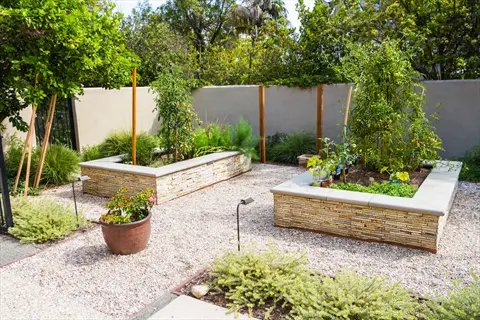
Stone, brick and concrete block
- Listed as suitable: University of Maryland Extension names stone, brick and concrete block among acceptable enclosure materials for a raised bed.
- Fly ash caution: The same source notes concrete and cinder blocks often contain fly ash, a byproduct of burning coal that contains heavy metals.
- Label problem: Block labels do not disclose which aggregate was used, so a gardener cannot check what is inside any particular product.
- Thin evidence: University of Maryland Extension states that there is little research data on the topic, which is why it stops short of a verdict.
- Practical note: Masonry walls do not rot, so the decay-resistance question that governs every wood choice does not apply to them.
- Retaining wall option: Oregon State University Extension documents beds built with retaining wall materials as a legitimate raised bed format.

Recycled plastic lumber
- Listed by extension: University of Maryland Extension names rigid recycled plastic boards among suitable raised bed enclosure materials for vegetable gardening.
- Also a mitigation: It appears again as a non-wood alternative for gardeners uneasy about any wood preservative sitting against food-growing soil.
- Comparable option: University of Delaware notes recycled lumber lasts about as long as the naturally resistant cedar and cypress it competes with.
- No decay cycle: Synthetic boards are not subject to the fungal decay that governs how long untreated fir or pine survives in soil contact.
- Sourced limits: No extension source located publishes a price, a lifespan in years or a strength rating for synthetic raised bed walls.
- Structural note: Long walls of any material benefit from corner reinforcement, which Utah State University Extension specifies as a wooden block or metal plate.
Cedar raised beds and untreated hemlock skip the whole argument, which is why they head most extension lists. Rot resistant wood still gives out plank by plank, so a repair means one board and an hour of your time, not a new frame. Masonry never rots, but the Maryland fact sheet notes concrete and cinder blocks often contain fly ash from burning coal, a byproduct that carries heavy metals. Labels do not tell you which aggregate went in, and there is little research data either way.
Two lines are not comfort calls. The Delaware fact sheet says never build with recycled tires, creosote or pentachlorophenol, which rules out old railroad ties. Utah State University Extension is softer on the ties and asks for a plastic barrier between that wood and the soil mix. Own a bed made of them already? The barrier is your fix. Shopping for wood this weekend? Buy something else.
My recommendation is that you use naturally water- and rot-resistant woods such as untreated hemlock or cedar, which last significantly longer than other woods and avoid the contamination risk (my own beds are made of hemlock).
Soil Mixes Experts Disagree On
What to fill a raised garden bed with, exactly? The confident answers online flatly disagree. One garden blog prints a 7:3:2 recipe, another prints 60/30/10 and treats it as settled, and neither shows a source. No extension source located publishes 60/30/10, and the four university ratios that do exist run from 30% compost up to half the bed by volume.
Pick your raised bed soil mix by answering one question first. Are you amending native topsoil that already sits under the bed, or filling an empty frame from scratch? The published figures differ because they answer different versions of that job. The right topsoil compost ratio for workable ground is not the one for a box of bought material. The best soil for raised beds is the mix that fits where you start.
Amend native topsoil in place
- Source: Utah State University Extension, for beds built directly on workable native soil rather than filled from scratch.
- Ratio: 30% to 50% well-composted organic matter by volume, mixed into the topsoil that is already there.
- Context: The figure applies where the bed is built on native topsoil that is being amended rather than replaced.
Compost plus soil or topsoil
- Source: University of Maryland Extension, which pairs compost with garden soil or with purchased topsoil.
- Ratio: 1:2 or 1:1 compost to soil, so compost makes up between a third and a half of the volume.
- Also from this source: The same publication says to have existing garden soil tested by a laboratory, and to test for lead when growing food.
Soil and compost at 70/30
- Source: Penn State Extension, which asks that both the soil and the compost come from reputable sources.
- Ratio: 70% soil to 30% compost, the most conservative compost share of the four approaches here.
- Also from this source: Penn State Extension applies four soil health principles to raised beds, beginning with minimizing soil disturbance.
Equal parts with a drainage material
- Source: Utah State University Extension, offered as a custom blend alongside its native-topsoil amendment figure.
- Ratio: Equal parts by volume of composted organic matter, a drainage material, and native soil or topsoil.
- Drainage material: Coarse sand, vermiculite, pumice or perlite, each named by Utah State University Extension as an option.
Pale, stalled seedlings in one bed and dark green ones in the other, same seed packet, same week. I built the slow one over 6 inches (15 cm) of chipped branches, the second of two untreated cedar beds, each 4 by 8 feet (120 by 240 cm). Wood pulls nitrogen out of the soil while it rots. Utah State University Extension budgets 1/4 pound (0.11 kg) of actual nitrogen per 100 square feet (9.3 sq m) for each 1 inch (2.5 cm) of woody material added, and I had budgeted none.
Utah State University Extension budgets 1/4 pound (0.11 kg) of actual nitrogen per 100 square feet (9.3 sq m) for every inch of woody organic material added, which works out to 5 pounds (2.3 kg) of ammonium sulfate 21-0-0, 2 pounds (0.9 kg) of urea 46-0-0, or 8 pounds (3.6 kg) of blood meal 12-2-1.
Have existing garden soil tested by a laboratory before it goes into a food bed, and ask for lead by name. That test is cheap next to the alternative. And the reason any of these ratios matter is that you choose the texture and the organic matter here instead of inheriting whatever the yard handed you.
Where Raised Beds Fall Short
The disadvantages of raised garden beds are the same traits that sell them, read from the other side. University of Maryland Extension publishes the honest list. You pay up-front labor and expense. The bed dries out fast in hot, dry weather. A bed is also relatively permanent, so you plan the garden around its size and layout. And it is no good on a slope unless you terrace first.
The tomatoes in my first bed wilted flat by mid afternoon in July, a week after I had picked the first ripe fruit off them. That bed warmed faster in spring because it was not insulated by the surrounding soil, and the same exposure pulled the water back out of it once the heat set in. The kitchen window over the sink looks straight down the bed, so I caught the wilt while rinsing a pan. Raised beds dry out faster than the ground beside them, and the watering that kept my in ground row happy was nowhere near enough for the frame.
Higher soil temperatures increase evaporative moisture loss, so the bed that let you plant early asks for more water through the hot summer months. Sort out raised bed irrigation before you fill the frame. A raised bed garden has to be watered one way or another, and drip or trickle is the most efficient method. Raised bed maintenance also means keeping that surface covered, since mulch and cover crops cut evaporation and let more water soak in.
- The ground is contaminated, rocky, paved over or otherwise unworkable.
- You want earlier planting, since the bed is not insulated by surrounding soil.
- Bending is hard, and University of Delaware allows much taller beds for that reason.
- The growing area needs to stay off-limits to feet so the soil never compacts.
- The ground slopes and you are not prepared to terrace it first.
- Summers are hot and dry, and watering more often is not realistic.
- You want to keep changing the layout, since a bed is relatively permanent.
- Up-front labor and expense are the deciding factor this season.
If two or three of the in ground items describe your yard, put the money and the labor into the ground instead. The slope settles it fastest, because terracing turns a weekend project into a build. The rest of that column is a cost you can choose to pay.
Common Myths
A raised garden bed has to be a box you build or buy, so the project starts with lumber and screws.
Oregon State University Extension states beds can be framed or unframed, and University of Maryland Extension allows skipping the enclosure entirely by shaping a bed with sloped sides.
There is one correct raised bed soil recipe, and the popular 60/30/10 blend circulating online is that recipe.
No extension source located endorses 60/30/10. Maryland publishes 1:1 or 1:2 compost to soil, Penn State 70% soil to 30% compost, and Utah State 30% to 50% organic matter.
Pressure-treated lumber poisons the vegetables grown beside it, so treated wood can never touch a food bed.
University of Maryland Extension reports Oregon State research finding soil copper rose only within 1 inch (2.5 cm) of the bed edge, not in the plants; Maine still flags gardener contact risk.
Twelve inches is the universal minimum height for a raised bed, and anything shallower is a waste of effort.
University of Maryland publishes beds 2 to 12 inches (5 to 30 cm) high, and real depth needs depend on whether open soil sits beneath the bed.
Raised beds are the low-maintenance option, because the good soil inside does most of the work for you.
Utah State University Extension warns that higher soil temperatures increase evaporative moisture loss and require more frequent summer irrigation, and University of Maryland lists drying out among the drawbacks.
Conclusion
Test the soil before you buy a single board. A laboratory test tells you what you are starting with, and it is the only way to rule out lead in ground that will grow food. Then mark the site. University of Delaware asks for at least 6 hours of direct sun and at least 12 inches (30 cm) of soil depth. Utah State University Extension gives 6 to 8 hours as the range for maximum fruit and foliage production. Paths run at least 4 feet (120 cm) so you can kneel and still push a wheelbarrow past.
The frame is the next call, and you want to make it before you shop, because an unframed bed needs no boards at all. Your raised bed soil mix follows from that same choice. Amending native topsoil takes 30% to 50% composted organic matter by volume. A mix built from scratch means you pick one published ratio and stay with it. Do not average the extension numbers into a figure that nobody recommends.
When to build a raised bed is a settled question. University of Delaware puts the best time to begin building in fall or early winter. Water comes next. A raised bed garden has to be irrigated, and raised bed irrigation works best through drip or trickle lines, which the Utah State fact sheet calls the most efficient method.
There are two cases where a raised garden bed is the wrong answer. University of Maryland Extension lists slopes on its own drawback set, so an un-terraced hillside needs terracing first or it needs an in-ground plot instead. The second case is water. If more frequent irrigation through a hot, dry summer is not realistic for you, the ground bed will hold moisture better and you should plant there.
The soil inside the bed decides how the season goes, and the frame around it is optional.
Glossary
- actual nitrogen
- The weight of pure nitrogen in a fertilizer rather than the weight of the product itself, which is why the same rate needs different amounts of each product.
- chromated copper arsenate
- An older wood preservative containing arsenic, copper and chromium that has not been sold for residential use since 2004.
- fly ash
- A powdery byproduct of burning coal that can contain heavy metals and is sometimes used as an ingredient in concrete and cinder block.
- geotextile barrier fabric
- A woven or spun landscape fabric laid between bed soil and the ground to block contact with pavement or contaminated soil while still letting water through.
- hugelkultur
- The common name for a raised bed built over a layer of buried wood.
- intensive garden
- A planting style that grows crops close together in a small area of high-fertility soil to get more harvest per square foot.
- micronized copper azole
- The copper-based wood preservative used in most residential pressure-treated lumber sold today; it contains no arsenic.
- unframed raised bed
- A bed raised by mounding and shaping amended soil with sloped sides, using no boards, blocks or fasteners at all.
External Sources
Frequently Asked Questions
How deep should a raised garden bed be?
University of Delaware asks for at least 12 inches (30 cm) of soil. Other extension sources publish shallower figures:
- University of Maryland Extension: beds 2 to 12 inches (5 to 30 cm) high
- Utah State University Extension: framed beds at least 6 to 12 inches (15 to 30 cm) high
- Utah State University Extension: unframed beds 8 to 12 inches (20 to 30 cm) above grade
What do you put on the bottom of a raised garden bed?
Usually nothing at all. Utah State University Extension says beds shallower than 12 inches (30 cm) deep should have no bottom, and University of Delaware adds geotextile barrier fabric only over contaminated soil, asphalt or concrete.
Is pressure-treated lumber safe for a raised garden bed?
Extension sources split three ways. University of Maryland Extension reports Oregon State research finding soil copper rose only within 1 inch (2.5 cm) of the bed edge, with no rise in the plants, University of Delaware calls modern treated pine safe but unsuitable for organic gardening, and University of Maine says the gardener's own contact risk is not zero.
What is the cheapest way to build a raised garden bed?
An unframed bed skips frame materials entirely. Oregon State University Extension documents unframed beds, and Utah State University Extension amends native topsoil with 30% to 50% composted organic matter by volume rather than starting from a purchased mix.
What should you not put in a raised garden bed?
Four things carry sourced warnings:
- Soil that has never been tested, especially for lead, when the bed will grow food
- Raw woody material without added nitrogen, which Utah State budgets per inch (2.5 cm) added
- Recycled tires, or lumber treated with creosote or pentachlorophenol such as railroad ties
- Concrete or cinder block with undisclosed fly ash, which University of Maryland flags as under-researched
Do raised garden beds need bottoms?
No. Utah State University Extension says beds shallower than 12 inches (30 cm) deep should have no bottom, so roots can reach the soil underneath. A barrier belongs there only over pavement or contaminated ground.
Why do raised garden beds dry out so fast?
Because the bed is not insulated by the surrounding soil. Penn State Extension credits that for the faster spring warm-up, and Utah State University Extension adds that the higher soil temperatures increase evaporative moisture loss and demand more frequent irrigation in hot summer months.
How long do raised garden beds last?
No extension source located publishes a lifespan figure. What is documented is that untreated fir rots within a few years, cedar and redwood are naturally rot-resistant, and one extension educator reports his own untreated hemlock beds at least 6 to 7 years old, sound with no boards replaced.
What vegetables grow best in a raised garden bed?
Extension sources rank no crops. They set the conditions instead: University of Delaware asks for at least 6 hours of direct sun and at least 12 inches (30 cm) of soil depth, Utah State University Extension gives 6 to 8 hours as the range for maximum fruit and foliage production, and Oregon State University Extension adds regular compost and adequate irrigation.
What is a German raised garden bed called?
Hugelkultur, the common name for a bed built over buried wood. No extension source located evaluates the method's results. What is documented is that woody material ties up nitrogen as it decomposes: Utah State University Extension budgets 1/4 pound (0.11 kg) of actual nitrogen per 100 square feet (9.3 sq m) for every 1 inch (2.5 cm) of woody organic material mixed into a bed's soil.