
Introduction
The oakleaf hydrangea is one of just two hydrangea species native to North America. William Bartram first wrote about this native shrub in 1791 during his travels through the Southeast. Alabama named it the official state wildflower in 1999. If you want a plant that thrives in your yard and helps local wildlife, this one belongs on your short list.
I've grown Hydrangea quercifolia for over 10 years now. It still surprises me every season with how much it gives back. The University of Florida calls it an outstanding plant worth growing. It reaches 6 to 10 feet tall and handles USDA zones 5B through 9. Few shrubs reward you this much for so little care.
What makes this plant special is its four-season interest that keeps your garden looking great all year long. Summer brings white cone shaped flower panicles that glow against dark green foliage. Fall lights up with fiery red and purple leaves that stop people in their tracks. Winter reveals beautiful cinnamon brown peeling bark on the stems while bold oak shaped leaves hold their form through spring.
Wild oakleaf hydrangea populations need our help right now. Research shows that 23% of recorded wild stands no longer exist in their native range. Growing this native shrub in your garden does more than boost your curb appeal. It helps preserve a species that pollinators and songbirds depend on for food and shelter across the Southeast.
8 Best Oakleaf Hydrangea Varieties
NC State Extension lists 13 named cultivars of oakleaf hydrangea for you to consider. Heights range from 2 to 12 feet and flower panicles span 4 to 12 inches long. I've tested most of these oakleaf hydrangea varieties in my own garden over the years. The 8 picks below cover every size so you can find your best fit for your yard.
A 2021 HortScience study found that wild plants show better disease resistance than many store bought cultivars. Dr. Sandra Reed's breeding program has tapped into this wild strength since 1996. Your compact oakleaf hydrangea choices like Ruby Slippers and Pee Wee came from careful selection work like hers. Need a tall Alice for screening or a dwarf oakleaf hydrangea like Munchkin for your patio? One of these 8 varieties will match your garden goals.
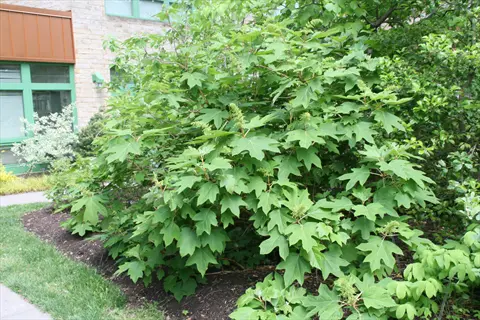
Alice Oakleaf Hydrangea
- Mature Size: Alice is one of the largest oakleaf hydrangea cultivars, reaching 10 to 12 feet (3 to 3.7 meters) tall with a similar spread, making it ideal for large landscapes and screening.
- Flower Display: Produces massive flower panicles up to 12 inches (30 centimeters) long that open creamy white and turn deep pink as they age through summer and fall.
- Fall Color: Delivers striking burgundy-red fall foliage that rivals any native deciduous shrub, creating a bold seasonal statement in the garden border or woodland edge.
- Growth Habit: Develops a broad, upright, multi-stemmed form with strong branching that holds heavy flower panicles upright without flopping or breaking under their weight.
- Best Use: Perfect for large properties where you need a tall privacy screen, windbreak, or dramatic specimen plant that provides year-round structural interest.
- Care Note: Blooms on old wood, so avoid pruning in late winter or early spring; instead, remove only dead or damaged branches right after flowering ends in midsummer.
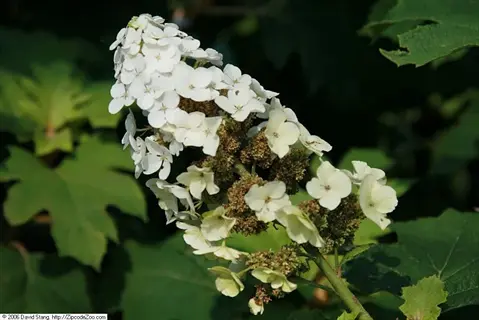
Snow Queen Oakleaf Hydrangea
- Mature Size: Snow Queen reaches 6 to 8 feet (1.8 to 2.4 meters) tall and wide, fitting well in medium to large garden spaces as a focal point or hedge element.
- Flower Display: Known for holding its flower panicles upright rather than drooping, with dense 8 to 10 inch (20 to 25 centimeter) blooms that appear in late spring to early summer.
- Fall Color: Produces some of the most vivid mahogany-red fall color among all oakleaf hydrangea cultivars, making it a standout choice for autumn garden interest.
- Award Recognition: Received the Royal Horticultural Society Award of Garden Merit, confirming its reliable performance and outstanding ornamental qualities across multiple growing conditions.
- Best Use: Excellent as a specimen plant, foundation planting, or mixed shrub border where its upright flower form and bold fall color create a strong visual anchor.
- Care Note: More sun tolerant than many oakleaf varieties, performing well in six or more hours of direct sunlight while still thriving in partial shade conditions.
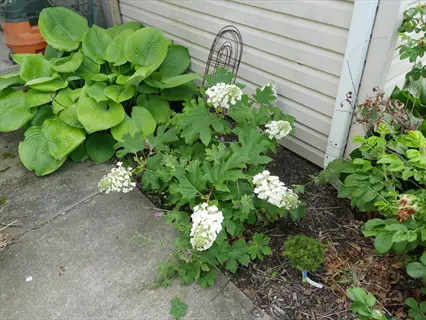
Ruby Slippers Oakleaf Hydrangea
- Mature Size: A compact cultivar growing 3.5 to 4.5 feet (1 to 1.4 meters) tall and 4 to 5 feet (1.2 to 1.5 meters) wide, suitable for smaller gardens and foundation beds.
- Flower Display: Flowers open white and quickly transition to deep rose-pink, providing the most dramatic color change of any oakleaf hydrangea cultivar throughout the blooming season.
- Fall Color: Foliage turns a rich mahogany-red in autumn, complementing the aging flower panicles that remain on the plant well into winter for extended seasonal interest.
- Growth Habit: Maintains a dense, rounded form that requires minimal pruning, with sturdy stems that hold flower clusters upright even during heavy summer rainstorms.
- Best Use: Ideal for small gardens, container plantings, or front-of-border positions where its compact size and vivid flower color transitions create maximum impact in limited space.
- Care Note: Performs well in USDA zones 5 through 9 and shows good cold hardiness, making it a reliable choice for northern gardeners who want oakleaf hydrangea blooms.

Gatsby Gal Oakleaf Hydrangea
- Mature Size: Reaches 5 to 6 feet (1.5 to 1.8 meters) tall and 4 to 6 feet (1.2 to 1.8 meters) wide, placing it in the medium size range for versatile garden applications.
- Flower Display: Produces large, showy flower panicles that open pure white and age to a soft blush pink, held upright on strong stems for clean visual presentation.
- Fall Color: Offers reliable deep red to burgundy fall foliage color that lasts several weeks before leaves drop, extending the ornamental season well into late autumn.
- Growth Habit: Develops a tidy, well-branched form with a slightly more compact habit than older cultivars like Alice, requiring less maintenance pruning to look its best.
- Best Use: Works well as a foundation shrub, hedge element, or mixed border plant where its medium size fills space without overwhelming neighboring perennials and smaller shrubs.
- Care Note: Bred for improved garden performance by Proven Winners, this cultivar shows strong disease resistance and adapts well to both sun and partial shade conditions.
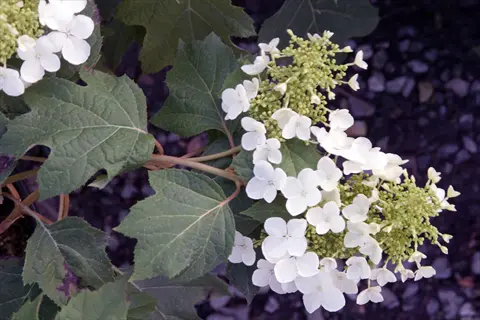
Pee Wee Oakleaf Hydrangea
- Mature Size: A popular compact selection growing 3 to 4 feet (0.9 to 1.2 meters) tall and 3 to 4 feet wide, making it one of the most common dwarf oakleaf options on the market.
- Flower Display: Bears smaller but abundant flower panicles about 4 to 6 inches (10 to 15 centimeters) long that open white and shift through pink to tan over the season.
- Fall Color: Delivers dependable orange-red to burgundy fall foliage that looks especially attractive when planted in groups or mass plantings along walkways and garden borders.
- Growth Habit: Forms a dense, mounding shape with proportionally smaller leaves than full-size varieties, creating a more refined texture in the landscape that suits formal settings.
- Best Use: Perfect for small yards, foundation plantings near low windows, borders, and mass plantings where uniform compact size creates a neat, low maintenance hedge or edging.
- Care Note: Just as drought tolerant as larger varieties once rooted in, and performs well across USDA zones 5 through 9 with minimal pest or disease pressure.
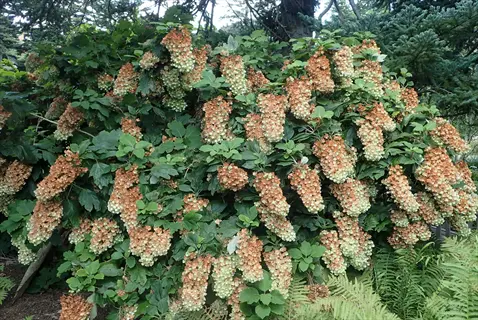
Snowflake Oakleaf Hydrangea
- Mature Size: Grows 6 to 8 feet (1.8 to 2.4 meters) tall and wide with a broad, upright habit, fitting well in medium to large landscape settings with adequate room to spread.
- Flower Display: Features unique double flowers with layered petals that create a fuller, lacecap-like appearance, with panicles reaching 12 to 15 inches (30 to 38 centimeters) long.
- Fall Color: Produces rich burgundy-red fall color that persists for weeks, while the double flower panicles remain decorative on the plant through early winter months.
- Growth Habit: Develops a slightly open, arching form that showcases the heavy double flowers, though stems may droop under bloom weight in very wet seasons or shaded positions.
- Best Use: Outstanding as a specimen plant where its unique double blooms can be appreciated up close, or in a cutting garden where the large flower panicles make excellent arrangements.
- Care Note: Blooms slightly later than single-flowered varieties, extending the oakleaf hydrangea season by one to two weeks when planted alongside earlier cultivars in the same garden.
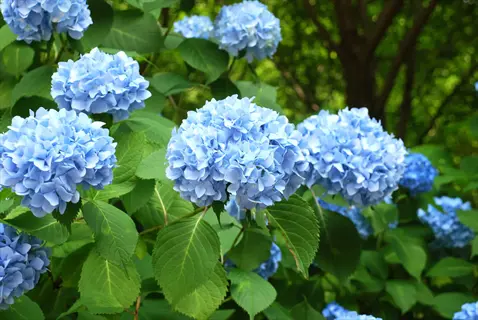
Munchkin Oakleaf Hydrangea
- Mature Size: One of the most compact cultivars at 2 to 3.5 feet (0.6 to 1 meter) tall and 2.5 to 3.5 feet wide, ideal for tight spaces and container growing situations.
- Flower Display: Produces proportionally sized flower panicles about 4 to 6 inches (10 to 15 centimeters) long that open white and turn pink then deep rose as they age through summer.
- Fall Color: Foliage turns attractive shades of red, orange, and burgundy in autumn, providing fall color on a miniature scale that works in patio containers and small garden beds.
- Growth Habit: Maintains a very dense, rounded form with proportionally smaller leaves, creating an almost topiary-like appearance without any pruning needed to keep its tidy shape.
- Best Use: Excellent for container gardening on patios and decks, small urban gardens, rock garden edges, and areas where a full-size oakleaf hydrangea would overwhelm the space.
- Care Note: Despite its small size, Munchkin is fully hardy in zones 5 through 9 and shows the same drought tolerance and disease resistance as its full-size relatives.
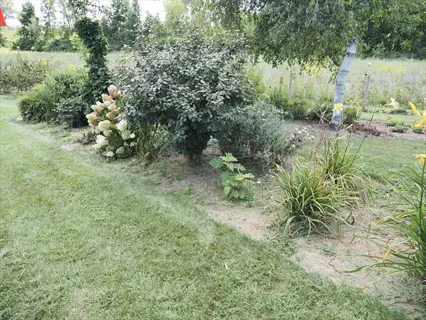
Little Honey Oakleaf Hydrangea
- Mature Size: Reaches 3 to 4 feet (0.9 to 1.2 meters) tall and 3 to 4 feet wide, offering a compact form similar to Pee Wee but with a distinct foliage color.
- Flower Display: Bears white flower panicles typical of oakleaf hydrangeas, but the real show comes from its golden-yellow spring foliage that shifts to green in summer heat.
- Fall Color: Foliage transitions from summer green to shades of red and burgundy in autumn, providing three distinct foliage color phases throughout the growing season for extended interest.
- Growth Habit: Forms a dense, mounding shrub with chartreuse to golden leaves that brighten shaded garden corners where darker foliage plants might create a heavy, somber feel.
- Best Use: Perfect for adding bright foliage contrast in woodland gardens, shade borders, and mixed plantings where its golden leaves pair well with blue and purple companions.
- Care Note: Requires more shade protection than green-leaved varieties because the golden foliage can scorch in hot afternoon sun, especially in zones 7 through 9.
Planting and Soil Needs
Planting oakleaf hydrangea the right way starts with thinking about where this shrub grows in the wild. You'll find it along shaded stream banks and moist forest floors across the Southeast. Your goal is to match those conditions as close as you can in your own yard. Pick a spot that gets morning sun and afternoon shade for the best flower production and leaf color.
This partial shade shrub handles a wider range of oakleaf hydrangea soil requirements than you might expect. Clemson University notes it grows in moist areas with a soil pH between 6.8 and 7.2. UF/IFAS adds that it tolerates clay, sand, acidic, and loam soils too. The key factor is drainage. Your soil can be almost any type as long as water doesn't sit around the roots after rain.
Your planting time depends on which USDA hardiness zones you garden in. If you grow in zone 5, plant in late spring after the last frost so roots have a full season to get strong before winter. Zone 9 gardeners do best planting in early fall when cooler temps ease transplant stress. Winter rains give you free irrigation too. Zones 6 through 8 can plant in either spring or fall with good results.
Dig a hole twice as wide as the root ball but only as deep. Set the plant so the top of the root ball sits level with the ground surface or just above it. Backfill with your native soil and skip the amendments unless your ground is pure clay. Spread 2 to 3 inches of mulch around the base but keep it a few inches from the trunk to prevent rot.
I've had the best luck with foundation planting spots along the north or east side of my house. These spots give the natural shade pattern that oakleaf hydrangeas love while still letting in morning light. Space your plants 36 to 60 inches apart based on your chosen cultivar's mature size. Compact types like Pee Wee need less room while Alice demands the full 5 feet.
Watering, Feeding, and Pruning
Good oakleaf hydrangea care starts with smart watering during the first growing season. Clemson University says to give your new plant 2 gallons per inch of trunk width each day for the first 2 weeks. After that, cut back to every other day for 2 months, then settle into a weekly schedule. Once your shrub puts out strong new growth, UF/IFAS rates it as moderate on drought tolerance so you can relax the watering a bit.
Watering hydrangea plants gets easier after the first year in the ground. I water mine deep once a week during dry summer spells and skip the hose when rain takes care of things. Stick your finger 2 inches into the soil near the base to check moisture before you water. Wet soil means you can wait another day or two. Dry soil means it's time to give your plant a good long drink.
Fertilizing hydrangea plants of this type doesn't require a heavy hand. Apply a balanced slow release fertilizer with an NPK ratio around 5:3:3 in early spring as new growth starts. One feeding per year is all most oakleaf hydrangeas need in decent garden soil. Too much fertilizer pushes leafy growth at the expense of flowers, so resist the urge to feed more than once.
Pruning oakleaf hydrangea is the one task where timing matters more than technique. This shrub blooms on old wood, which means flower buds form on the stems during summer and fall for the following year's show. If you cut those stems in winter or early spring, you remove every bud and get zero flowers that season. I learned this the hard way my first year and had a green but bloomless shrub all summer.
The safe window for pruning falls right after flowers fade in July or August. Remove dead or crossing branches first, then shape the plant if needed. You can cut back up to a third of the oldest stems at ground level to encourage fresh growth from the base. Deadheading spent blooms is optional since the dried flower heads add winter texture, but removing them gives the plant a cleaner look through fall.
Here's my month by month guide for oakleaf hydrangea care. March and April bring new leaf growth, so apply fertilizer and check for winter damage. May through June is peak bloom time when you should just enjoy the flowers. July and August offer your pruning window right after blooms fade. September through February is hands off time while next year's buds develop on the old wood stems.
Propagation Methods
Oakleaf hydrangea propagation saves you money and fills your garden with plants you love. UF/IFAS notes that this shrub sends out oakleaf hydrangea suckers from its roots and lower trunk. That natural habit makes it one of the easier shrubs to spread around your yard. I've used all 4 methods below and each one works great with the right timing.
You want to propagate your own plants to preserve the traits of a cultivar you love. NC State Extension lists 13 named cultivars with unique features worth keeping. Hydrangea stem cuttings and division give you exact copies of the parent plant. Seeds won't match the parent but they can produce fun new variations. Grab some rooting hormone and a few pots to start with hydrangea layering or cuttings from your best shrubs.
Stem Cuttings in Late Summer
- Timing: Take semi-hardwood cuttings in late June through August when current season growth has begun to firm up but is not yet fully woody and rigid.
- Method: Cut 4 to 6 inch (10 to 15 centimeter) sections with at least two leaf nodes, remove lower leaves, dip the cut end in rooting hormone powder, and insert into moist perlite and peat moss.
- Success Rate: Stem cuttings are the most reliable home propagation method with typical success rates of 70% to 90% when rooting hormone and bottom heat are used consistently.
Ground Layering in Spring
- Timing: Begin ground layering in early spring when flexible low branches are available, allowing the entire growing season for roots to develop before separating the new plant.
- Method: Bend a low branch to the ground, wound the bark on the underside where it contacts soil, pin it in place with a landscape staple, and cover the wounded section with 2 to 3 inches (5 to 8 centimeters) of soil.
- Success Rate: Ground layering is the easiest method for beginners because the branch stays attached to the parent plant and continues receiving water and nutrients while roots form.
Root Sucker Division
- Timing: Divide root suckers in late fall or early spring while the plant is dormant, giving the separated section time to establish roots before summer heat arrives.
- Method: Dig carefully around a sucker that has developed its own root system, sever it from the parent plant with a sharp spade, and replant immediately at the same depth in prepared soil.
- Success Rate: Division produces the fastest results since you are transplanting an already-rooted plant, though success depends on the sucker having enough independent roots to survive on its own.
Growing from Seed
- Timing: Collect seeds from dried flower panicles in late fall, then cold stratify them for 60 to 90 days in the refrigerator before sowing indoors in late winter under grow lights.
- Method: Press tiny seeds onto the surface of moist seed-starting mix without covering them, as they need light to germinate, and maintain consistent moisture with a humidity dome for 4 to 6 weeks.
- Success Rate: Seed propagation takes the most patience as plants may need 3 to 5 years to reach flowering size, and seedlings will not be identical to the parent cultivar due to genetic variation.
Landscape Design Ideas
Your oakleaf hydrangea landscape uses go far beyond sticking one plant in a corner and calling it done. This shrub fits into a woodland garden, rain garden, pollinator spot, or cutting garden with ease. NC State Extension backs up all of those uses. I've tried it in 4 different design roles and it shines in every single one.
Your companion plants make all the difference in how your oakleaf hydrangea looks. Hostas, heuchera, and native azaleas create a layered shade garden that stays fresh from spring through fall. Space your hydrangeas 36 to 60 inches apart and fill the gaps with these partners. A hydrangea hedge of Snow Queen or Alice along your property line brings seasonal privacy and bold fall color.
Woodland Garden Border
- Setting: Plant oakleaf hydrangeas beneath tall deciduous trees where they receive dappled light, pairing them with ferns, hostas, and native azaleas for a layered woodland garden border.
- Spacing: Place plants 3 to 5 feet (0.9 to 1.5 meters) apart to allow mature spread, and mulch with shredded bark to mimic the natural forest floor where wild populations thrive.
- Seasonal Flow: This combination provides spring azalea blooms, summer hydrangea flowers, fall foliage color from both shrubs, and winter bark interest from the hydrangeas' cinnamon-brown stems.
Foundation Planting Anchor
- Setting: Use compact varieties like Ruby Slippers or Pee Wee along the house foundation where they soften architectural lines without blocking windows or growing into roof eaves.
- Spacing: Plant 3 to 4 feet (0.9 to 1.2 meters) from the foundation wall and 3 feet apart for a continuous hedge effect, choosing the north or east side for ideal light conditions.
- Seasonal Flow: Foundation plantings gain year-round appeal with summer white blooms aging to pink, bold fall foliage, exfoliating winter bark, and fresh green spring growth.
Privacy Screen Hedge
- Setting: Line up full-size varieties like Alice or Snow Queen along property boundaries where their 8 to 12 foot (2.4 to 3.7 meter) height creates a dense seasonal privacy screen.
- Spacing: Space plants 5 to 6 feet (1.5 to 1.8 meters) apart for a continuous hedge, keeping in mind that the screen gets thinner in winter when the deciduous leaves drop.
- Seasonal Flow: The hedge provides maximum privacy from late spring through fall, with summer flowers, dense green foliage, and a dramatic autumn color display before winter dormancy.
Slope Erosion Control
- Setting: Plant oakleaf hydrangeas on shaded slopes or stream banks where their suckering root habit naturally spreads to stabilize soil and prevent erosion over time.
- Spacing: Place plants 4 to 5 feet (1.2 to 1.5 meters) apart on slopes, allowing the natural colonizing habit to fill gaps as root suckers emerge and establish between the original plants.
- Seasonal Flow: Once established, the dense root network holds soil year-round while the aboveground growth provides seasonal ornamental interest on otherwise difficult-to-landscape slopes.
Container Patio Focal Point
- Setting: Grow compact cultivars like Munchkin or Ruby Slippers in large containers at least 18 to 24 inches (45 to 60 centimeters) wide on shaded patios and decks.
- Spacing: Use one plant per container and group containers with other shade-loving plants like heuchera and Japanese forest grass for a complete patio garden composition.
- Seasonal Flow: Container specimens deliver the same four-season interest as in-ground plants, with the added benefit of repositioning the pot to showcase each seasonal change.
The suckering roots that make this shrub great for erosion control also fill in bare spots on shaded slopes. I planted 3 shrubs on a problem hillside in my yard. They spread into a solid mass within 4 growing seasons. That slope used to wash out every hard rain. Now the roots hold the soil tight while the flowers give me something nice to enjoy from the deck.
Wildlife and Ecological Value
Most guides skip the oakleaf hydrangea ecological value, and that's a shame. One shrub in your yard feeds a whole food web from pollinators up to songbirds. No other garden hydrangea does this much for wildlife. This one grew alongside native insects and birds for thousands of years, so they depend on it.
NC State Extension says this shrub pulls in butterflies, pollinators, and songbirds that eat seeds from dried blooms. Your pollinator garden gets a boost from the big flower panicles full of nectar in early summer. Butterflies rest on the broad leaves between feeding trips. The butterfly garden value alone makes this shrub worth your time even if you don't care about the blooms.
I found ladybugs and lacewings tucked into the peeling bark on my oldest plants last winter. These helpful bugs emerge in spring and eat aphids and pests in your garden beds. Your wildlife garden gets a free pest control station that works all on its own. Most people never think about the bark as a home for good insects, but it's one of the best perks of this shrub.
Native plant gardening with this species also matters for conservation in a real way. A 2021 HortScience study tracked 55 wild groups. They found that 23% of known stands have vanished from their native range. Wild plants carry genetics that differ from store bought cultivars. Every oakleaf hydrangea you grow helps save traits that could vanish from the wild.
You get the biggest conservation boost by picking straight species or seed grown plants for your wildlife garden. These hold more of the natural genetic range than named cultivars. Put them near other native shrubs to build a habitat that gives wildlife food and shelter all year. Your garden joins a bigger conservation effort with very little extra work on your part.
5 Common Myths
Oakleaf hydrangeas need full sun to bloom well, and any shade will prevent flowers from forming on the plant.
Oakleaf hydrangeas actually prefer partial shade and bloom reliably with four to six hours of morning sun followed by afternoon shade.
You can change oakleaf hydrangea flower color from white to blue or pink by adjusting the soil pH like mophead types.
Oakleaf hydrangea flowers are always white turning to pink and then tan as they age, regardless of soil pH, because they lack the pigment affected by aluminum.
Oakleaf hydrangeas are not native plants and were imported from Asia like most other hydrangea species grown in gardens.
Oakleaf hydrangea is one of only two hydrangea species native to North America, found naturally across the southeastern United States from North Carolina to Louisiana.
Pruning oakleaf hydrangeas in late winter or early spring is the best time to shape them before the growing season starts.
Pruning in late winter removes the old wood where flower buds already formed the previous summer, which eliminates that year's blooms entirely.
Oakleaf hydrangeas are highly susceptible to deer damage and need fencing or repellent to survive in rural landscapes.
Oakleaf hydrangeas are generally deer resistant due to their coarse-textured foliage and mild toxicity, though hungry deer may occasionally browse young plants.
Conclusion
The oakleaf hydrangea earns its spot as one of the best native shrubs you can grow in your yard. UF/IFAS calls it an outstanding plant for good reason. You get four-season interest, honest drought tolerance, and wildlife value that imported species just can't match. Few low maintenance flowering shrub options give you this much return on such a small investment of time and care.
Hydrangea quercifolia thrives in the shaded spots where most flowering shrubs fail. That tough north side of your house or the area under tall trees becomes a highlight. In my experience, the oldest plants grow rich cinnamon bark and strong multi-stemmed forms that look better each year. This shrub rewards your patience as it matures.
Your most important decision comes down to picking the right cultivar for your available space. A compact Pee Wee fits a small foundation bed while an Alice needs room to spread 10 feet wide. Get this choice right from the start and you'll avoid years of fighting with a plant that's too big or too small for its spot. Check the variety guide above and match the mature size to your garden dimensions.
Every oakleaf hydrangea you plant also helps a native shrub species under real pressure in the wild. With 23% of wild stands gone, garden plants serve as a backup for the species. You get stunning blooms, fiery fall color, and winter bark that catches your eye on gray mornings. Plant one this season and watch it become the anchor of your garden for years to come.
External Sources
Frequently Asked Questions
Where does oakleaf hydrangea grow best?
Oakleaf hydrangea grows best in partial shade with moist, well-drained, acidic soil in USDA hardiness zones 5 through 9.
Can oakleaf hydrangea take full shade?
Oakleaf hydrangea tolerates full shade but produces fewer flowers and may develop a leggy growth habit compared to plants in partial shade.
What are common problems with oakleaf hydrangeas?
Common problems include powdery mildew, leaf spot, spider mites, root rot from poor drainage, and failure to bloom from improper pruning.
Are oakleaf hydrangeas easy to grow?
Yes, oakleaf hydrangeas are considered low maintenance, drought tolerant, and pest resistant when planted in suitable conditions.
What not to plant next to hydrangeas?
Avoid planting aggressive root competitors, sun-loving plants, or shallow-rooted trees that steal moisture near hydrangeas.
Do oak leaf hydrangeas lose their leaves in winter?
Yes, oakleaf hydrangeas are deciduous and drop their leaves in winter, but they offer cinnamon-brown exfoliating bark for winter interest.
What does baking soda do to hydrangeas?
Baking soda can raise soil pH and is sometimes used as a homemade fungicide spray for powdery mildew on hydrangeas.
Do oakleaf hydrangeas like coffee grounds?
Coffee grounds can slightly acidify soil over time and add organic matter, but they should be composted first to avoid nitrogen lock-up.
Do hydrangeas do better in pots or in the ground?
Hydrangeas generally perform better in the ground where roots can spread freely, but they can thrive in large containers with proper care.
Should I cut blooms off oakleaf hydrangea?
Removing spent blooms is optional since dried flowers add winter interest, but deadheading can improve plant appearance.