Introduction
Bald cypress, red maple, lacebark elm and Japanese zelkova are the fast growing trees that university extension services put on their shade lists. If you want raw speed instead, hybrid poplar adds 5 feet (1.5 m) or more a year, and that is the only per-year figure here an extension service will stand behind. Treat the rest of the feet-per-year numbers online as sales copy. Weeping willow alone is published at anywhere from 3 to 10 feet (0.9 to 3 m) a year.
Speed is bought from lifespan. A 2020 study in Nature Communications found that tree lifespan drops about 23% for every 50% jump in early growth rate. They read tree rings from forests in cold, mild and tropical zones. The growth-lifespan trade-off held for almost every species they looked at. So the species you plant matters more than the tree growth rate printed on the nursery tag.
Getting the pick right still pays. Three well-placed trees, two on the west side of the house and one on the east, cut annual cooling energy 10 to 50% in USDA Forest Service modeling. That worked out to 200 to 600 kWh and $30 to $110 a year, though the dollars come from California climate zones, so read the percentage as the part that travels. West-facing shade beat every other exposure in the model.
The tree to skip is the one nurseries sold hardest. Bradford pear puts on 12 to 15 feet (3.7 to 4.6 m) in 8 to 10 years, then splits apart after year 15, and the whole tree runs 15 to 25 years. Plenty of fast growing shade trees work the same way. You buy a decade of canopy and inherit a removal bill. Pick for structure and lifespan first, and let growth rate break the tie.
Fast Growing Trees Worth Planting
The University of Kentucky Extension publishes a short list of fast growing shade trees. Every name on it carries a mature height and a mature spread. The second number is the one buyers skip. A crown 40 feet (12 m) across on your 25 foot (7.6 m) side yard turns into a removal bill you pay for, and no growth rate on the nursery tag warns you about it.
The bald cypress on the west side of my lot shades the back wall of the house all afternoon now. I planted it in 2012, roughly 24 feet (7.3 m) out from the wall. A mature one runs 60 to 100 feet (18 to 30 m) tall and 40 to 50 feet (12 to 15 m) wide. My overhead wires run along the street side. If yours cross the yard, that decides which side of the lot you can plant on before you pick a species.
The spacing rule is two numbers. Keep half the mature spread between the trunk and any structure or overhead obstruction. Between one large tree and the next, that gap grows to the whole mature width. Red maple has the smallest footprint here at 25 to 40 feet (8 to 12 m) across, so half of its narrow end puts the trunk 12.5 feet (3.8 m) from your wall. Every other tree below asks for more room than that.
Bald cypress
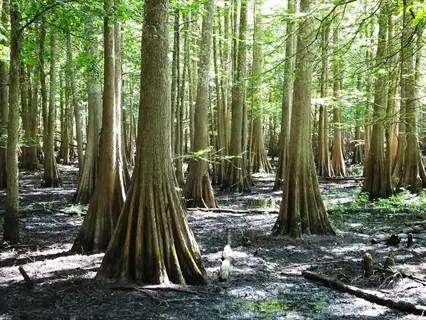
- Mature size: Kentucky Extension lists bald cypress at 60 to 100 feet (18 to 30 m) tall and 40 to 50 feet (12 to 15 m) wide.
- Clearance: Half that mature spread is about 20 to 25 feet (6 to 7.6 m) from any structure or overhead obstruction.
- Between trees: Kentucky Extension asks for the full mature width between large trees, so 40 to 50 feet (12 to 15 m) here.
- Why it is here: The University of Kentucky Extension names it among fast-growing shade trees, with mature dimensions attached.
- Check the unions: Purdue Extension calls codominant stems and included bark the most failure-prone parts of any tree.
- Placement: Its width suits the open west side of a large lot, the exposure the USDA modeling favored for cooling.

Tulip tree
- Mature size: Kentucky Extension gives tulip tree 80 to 100 feet (24 to 30 m) tall and 30 to 40 feet (9 to 12 m) wide.
- Clearance: Half the spread means roughly 15 to 20 feet (4.6 to 6 m) between the trunk and any wall or wire.
- Between trees: Leave the full mature width, 30 to 40 feet (9 to 12 m), before the next large tree goes in.
- Why it is here: It is the tallest tree on the Kentucky Extension fast-growing list, which makes height the first decision.
- Utilities: Kentucky Extension advises avoiding overhead and underground lines, and 100 feet (30 m) of eventual height makes that advice load-bearing.
- Trade-off: Early speed is bought against lifespan, at roughly 23% shorter life for every 50% faster early growth.

Japanese zelkova
- Mature size: Kentucky Extension puts Japanese zelkova at 60 to 80 feet (18 to 24 m) tall and 30 to 40 feet (9 to 12 m) wide.
- Clearance: Half the spread gives roughly 15 to 20 feet (4.6 to 6 m) of setback from a wall, drive or fence line.
- Between trees: The full mature width between large trees puts the next canopy tree 30 to 40 feet (9 to 12 m) away.
- Why it is here: Kentucky Extension carries it on the fast-growing shade tree list alongside bald cypress and lacebark elm.
- Check the unions: Look for included bark where two stems of similar size meet, the junction Purdue Extension says fails first.
- Site first: Kentucky Extension starts with temperature, sunlight, soil texture, drainage and fertility before any species goes on a shortlist.
Sawtooth oak
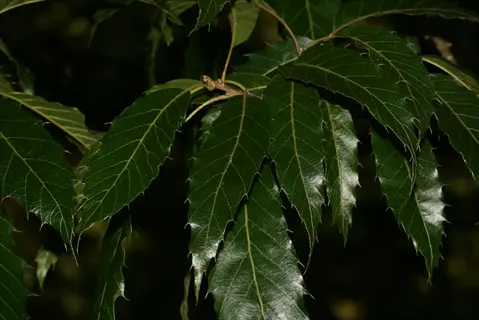
- Mature size: Kentucky Extension lists sawtooth oak at 50 to 60 feet (15 to 18 m) tall and 30 to 60 feet (9 to 18 m) wide.
- Clearance: The spread can match the height, so half of it can mean up to 30 feet (9 m) from the house.
- Between trees: At the top of its range the full mature width is 60 feet (18 m) to the next large tree.
- Why it is here: It is the oak that appears on an extension fast-growing shade tree list, which is unusual for the genus.
- Width is the variable: The 30 foot (9 m) swing between the narrow and wide end of its spread is the largest here.
- Contested company: Kentucky Extension puts pin oak on its weak-limb list even though Arbor Day recommends it, so name the oak you buy.
River birch
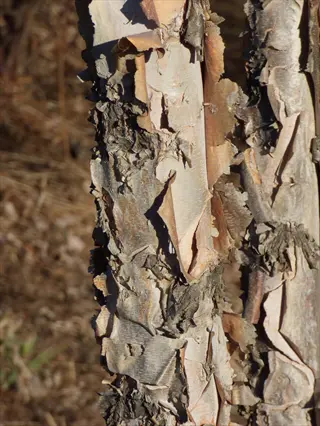
- Mature size: Kentucky Extension gives river birch 50 to 60 feet (15 to 18 m) tall and 40 to 50 feet (12 to 15 m) wide.
- Clearance: Half that spread is about 20 to 25 feet (6 to 7.6 m), more room than most people leave a birch.
- Between trees: The full mature width between large trees means 40 to 50 feet (12 to 15 m) to the next canopy.
- Why it is here: Kentucky Extension carries it on the fast-growing shade tree list with those dimensions attached.
- Multi-stem note: Clump forms carry several unions, and Purdue Extension names branch unions as the parts damaged first.
- Trade-off: Faster early growth costs lifespan across almost all species and climates, so speed here is not free either.
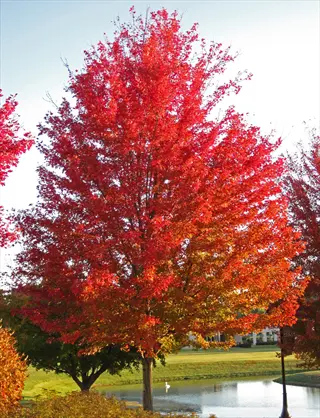
Red maple
- Mature size: Kentucky Extension lists red maple at 40 to 60 feet (12 to 18 m) tall and 25 to 40 feet (8 to 12 m) wide.
- Clearance: Half the spread is roughly 12 to 20 feet (3.7 to 6 m), the smallest setback on this shortlist.
- Between trees: Leave 25 to 40 feet (8 to 12 m), the full mature width, between this and the next large tree.
- Why it is here: It is the maple Kentucky Extension recommends, while silver maple sits on the same service's weak-limb list.
- Check the unions: Purdue Extension flags codominant stems and included bark as the first parts of a tree to be damaged.
- Placement: Its smaller footprint fits an average lot where bald cypress or tulip tree would crowd the house.
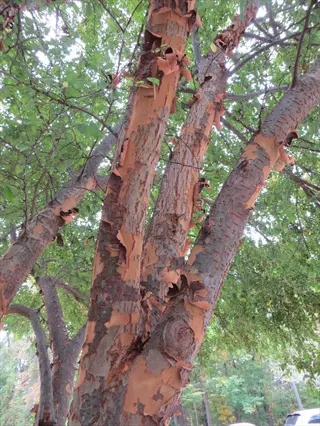
Lacebark elm
- Mature size: Kentucky Extension puts lacebark elm at 40 to 60 feet (12 to 18 m) tall and 30 to 40 feet (9 to 12 m) wide.
- Clearance: Half the spread gives about 15 to 20 feet (4.6 to 6 m) from the house, drive or property line.
- Between trees: The full mature width, 30 to 40 feet (9 to 12 m), goes between this elm and the next large tree.
- Why it is here: Kentucky Extension lists it among fast-growing shade trees, sharing the most compact height range with red maple.
- Different species: It is not an American elm, so the disease-resistant American elm selections NDSU names are a separate choice.
- Site first: Kentucky Extension says the closer your landscape meets a tree's conditions, the better that tree will perform.
Bald cypress and lacebark elm both sit on that shortlist. Neither one shows up on the consumer roundups that recycle Leyland cypress and weeping willow every spring. Japanese zelkova is scarce on them too. Ask your nursery for the species by name. You get a tree with published dimensions instead of a growth rate copied off another page.
What Speed Costs In Lifespan
Speed shows up on the tree's own bill. Brienen and colleagues put a number on it in Nature Communications in 2020. They read growth rings from boreal, temperate and tropical forests, and found that tree lifespan drops as early growth rate climbs. Raise that early rate by 50% and the tree hands back about 23% of its life. Buntgen and colleagues had reported the same pattern in the same journal a year earlier, in 2019.
The obvious objection is climate. Maybe quick trees simply grow where conditions are easy, and die young for some other reason. The ring records rule that out. Faster growth itself is what shortens the life, and it held that way in nearly every species and climate zone the authors checked. Fast growing trees are not being punished by their site. They are spending a budget that every species carries.
- Usable shade on a west wall sooner, the placement that saved the most cooling energy in the USDA modeling.
- A privacy screen that already reads as mature while a slower tree is still knee high.
- A newly built lot stops looking bare, and you are not waiting a decade on a slow species.
- Hybrid poplar at 5 feet (1.5 m) or more a year is what the top of that range looks like.
- Lifespan falls about 23% for every 50% jump in early growth rate.
- The trade-off is near-universal, across almost all species and climates studied.
- Faster growth is the cause, and not a side effect of a kinder climate or a better site.
- Bradford pear, the documented case, runs a short to moderate life span of 15 to 25 years.
Picture two trees for the same spot beside the driveway. Both fit the space, both suit your zone, and one puts on height 50% faster through its early years. That head start is real, and you will see it by year five. The bill is roughly a quarter of its lifespan. That is the whole growth-lifespan trade-off in a single choice. The proportion is what the study gives you, not a number of years for any species, so use it as an exchange rate and nothing more.
Here we show that growth-lifespan trade-offs are indeed near universal, occurring across almost all species and climates.
Fast Trees You Will Regret
Seven fast growers break in storms: Bradford pear, silver maple, eastern white pine, American sycamore, cottonwood, pin oak and weeping willow. Each one carries weak limbs, a short life, or both. Pin oak lands on that list and on Arbor Day's recommended list at the same time, so read pin oak as a caution and not a ban. The rest belong on your short list of trees to avoid planting near your house or your driveway.
Half a Bradford pear lay across the road one Sunday morning, still in bloom, snapped off the trunk in my front strip where the builder planted it. Clemson Extension puts the cause on narrow branching angles that pinch limbs into a tight V and split the trees in half. Severe splitting shows up in trees older than 15 years. That one was 16.
Brittle branching is a placement problem, not a curse on the species, and you can use several of these trees in a spot where a falling limb lands on grass. Silver maple branches grow overly long for their diameter and go brittle in wind and ice, and the shallow roots leave you fighting to grow anything underneath. Put one at your back fence and you have a shade tree. Put one over your driveway and you are waiting on a bill.
You cannot site callery pear out of trouble the way you can a silver maple. Birds eat the fruit and drop live seed into fencerows, where you get thorny thickets. South Carolina lists Pyrus calleryana as an invasive plant pest species. No cultivar is recommended for planting, including the ones you see sold as sterile.
Cleveland pear is a callery pear cultivar. Clemson Extension states that planting any Pyrus calleryana cultivar is no longer recommended, whatever the label promises.
Why Fast Trees Break Apart
Why does a 20-year-old silver maple lose half its crown in a July storm while the oak next to it drops a few twigs? You are looking at how the branches join, not at how hard the wood is. Purdue Extension sorts tree failure by defect and by branch union, not by species and not by growth rate. A bad joint gives out long before sound wood does, and you can spot one from your driveway.
That bad joint has a name. Codominant stems are two leaders of about the same size, and you can watch them both race for the top. Where they press together, the union traps a seam of bark instead of growing solid wood across it. That trapped bark is included bark, and it works like a wedge sitting inside the joint. The storm damage trees suffer in a squall tends to start right there, which is why you drag thick limbs off the lawn and not twigs. So the weak limbs in your yard are not the skinny ones. They are the thick ones with a tight V at the base.
Four structures do most of the breaking. Walk your own trees and check them against this list before you blame the tag on the trunk.
Codominant stems and included bark
- What it is: Two stems of similar size compete for the lead, and the union traps bark instead of solid wood.
- Why it matters: Purdue Extension calls these junctions the most failure-prone part of a tree and usually the first to break.
- What to look for: A tight V where two thick leaders meet, with a raised seam of bark running down into it.
Compromised root systems
- What it is: Construction, neglect and pests cut into the roots that hold the tree against a wind load.
- Why it matters: Weak roots lead to wind throw, where the whole tree tips over instead of losing a limb.
- What to do: Once more than 30% of the root system is exposed, removal beats staking.
Old wounds and decay
- What it is: Injury sites, cavities, nesting holes and fungal fruiting bodies mark wood that has already lost strength.
- Why it matters: These defects set up a stem to snap or buckle under a wind it once shrugged off.
- What to look for: Old pruning wounds that never closed, hollow spots, and fungus growing out of the trunk.
Lopsided crowns and crown twist
- What it is: An uneven crown catches wind on one side, so the trunk twists instead of just bending.
- Why it matters: That twist opens torsional splits and cracks, and old wounds are where they start.
- What not to do: Do not top the tree. Topping adds weak sprouts and decay, so it raises your risk instead of cutting it.
Topping may seem to make a tree safer, but it actually increases the potential for storm damage with unhealthy epicormic sprouting and additional decay in the stems.
Crown twist is the piece most people miss. Wind loads one side of a lopsided crown, the trunk twists rather than bending, and the split opens near an old wound. Your fast grower can come apart this way with wood that is still sound. Keep the crown even while the tree is young, pick one leader early, and you take out the two defects behind most of the damage.
Where To Plant A Fast Growing Shade Tree
My own kitchen window faces west across the lawn, and by 4 p.m. in July the counter under it is too warm to lean on. The tile holds that heat past dinner, so I gave up on that end of the room in summer. USDA Forest Service modeling ranks a tree on that side of a house first. Trees shading a home's west wall produced the largest savings in every climate zone and insulation level the researchers ran. Southwest came next, then east.
Three trees, two on the west and one on the east, cut annual cooling energy by 10 to 50% and trimmed peak electrical use by as much as 23%. Those cuts hold up anywhere. The dollars do not, since the modeling ran on California climate zones, where the same trees saved 200 to 600 kWh and $30 to $110 a year. In a hot climate you bank more actual kilowatt-hours, and in a cooler, well-sealed house the cooling energy savings show up as a bigger share of a smaller bill.
A fixed setback like 12 feet (3.7 m) from the foundation is easy to keep in your head and wrong for half the trees you might plant. Kentucky Extension scales tree spacing to the tree instead. Set a large shade tree half its mature spread from any structure or overhead obstruction, and a full mature width from the next large tree. A red maple that finishes 25 to 40 feet (7.6 to 12 m) wide wants about 20 feet (6 m) of room, which still drops the west-facing shade on your window and not on your gutter.
Start with temperature, sunlight, soil texture, drainage and fertility, because the closer the site matches what the species needs, the better the tree performs.
West-facing shade produced the largest savings in every climate zone and insulation level the USDA Forest Service modeled for California, with southwest and east placements next.
Check overhead and underground utility lines before you dig, and keep tall species clear of wires they could reach at mature size.
Set a large shade tree half its mature spread from any structure, and a full mature width from the next large tree.
Match the species width to the space you actually have, since a 40 to 50 foot (12 to 15 m) spread needs about 20 to 25 feet (6 to 7.6 m) of clearance.
Shade tree placement is the one call here you cannot redo later. Walk the utility lines and measure off the wall the same afternoon you settle on a spot, before the hole gets dug. Moving a large tree at year 5 usually means removing it, and then you start the shade clock over from a bare lawn.
What Happens By Year 25
No extension service publishes a year by year tree growth timeline for fast growing trees, and none of them will tell you the year real shade shows up. Two long records do exist. Clemson tracked Bradford pear. The University of Arkansas followed one silver maple planted next to a group of oaks, and between them the two records cover the first 25 years after planting. Read them as two things that happened, not as a schedule your tree will keep.
One detail about the Clemson figure trips people up. The 12 to 15 feet (3.7 to 4.6 m) is the total a Bradford pear gains across an 8 to 10 year stretch that starts the day you plant it. It is not growth packed into the years between the tree's eighth and tenth birthday. The first row below is a span, not an age band.
Years 8 to 10
Clemson records Bradford pear gaining 12 to 15 feet (3.7 to 4.6 m) of height over this period, counted from the day it goes in the ground.
Year 15
The Arkansas silver maple stood about 5 feet (1.5 m) above its rivals, and Clemson reports Bradford pear splitting turning severe past this age.
Year 20
The oaks planted beside that silver maple had overtaken it, per the University of Arkansas record.
Around year 25
An ice storm stripped that silver maple of its limbs and it was removed. Clemson gives Bradford pear a 15 to 25 year life span.
This is where the nurse tree idea gets tested. You put something fast next to a slow keeper, let the fast one carry the yard, then cut it out once the keeper catches up. In the Arkansas yard that handoff landed at year 20. Bradford pear is the only species here with a documented tree lifespan, 15 to 25 years, so it is the only one you can set a removal date against. Clemson also recommends against planting any callery pear cultivar, so that date buys you nothing.
Keep the silver maple account in scale. It is one tree in one yard, written up by a retired extension horticulturist, not a study of the species. It does not mean every silver maple dies at 25. What it does record is how fast the lead went. The tree was the biggest thing on the block at 15, shorter than the oaks at 20, and cut down five years later.
Common Myths
Fast growing trees live just as long as slow ones if you water, feed and prune them properly.
Tree-ring records across boreal, temperate and tropical forests show lifespan falling about 23% for every 50% rise in early growth rate.
Bradford pear was bred sterile, so a single tree in a yard cannot spread anywhere else.
Clemson Extension reports it cross-pollinates with other callery pears and produces viable fruit that birds carry into thorny wild thickets.
Any open spot works for a shade tree, because shade cools a house the same from every side.
USDA Forest Service modeling found west-facing shade gave the largest savings in every climate zone and insulation level considered.
Topping a tall, fast growing tree makes it safer once storm season arrives each year.
Purdue Extension says topping increases storm damage, because epicormic sprouts attach weakly and the cuts add decay inside the stems.
Dutch elm disease finished the American elm, so planting one now is a wasted decade.
NDSU Extension names resistant selections including Prairie Expedition, Jefferson and St. Croix that restore the arching elm habit.
Conclusion
Fast growing trees are worth planting. Every foot of hurry just gets paid for out of the tree's lifespan, and one number should shape your whole plan. A 50% faster start costs about 23% of the years that tree would otherwise get. So settle shade tree placement first. Then pick a species whose mature spread fits the spot, and keep the trunk no closer to the wall than half that width.
The west wall is where a shade tree pays you back. Shade on the west side cut the most cooling energy in every climate zone tested. That held at every insulation level too. The southwest side came next, and the east side saved less than both. Those numbers were modeled on California climate zones, so the direction travels well and the dollar figures do not. Speed will never make up for a tree planted on the wrong side of the house.
A fast grower earns its place in two situations. The first is when you want shade or a privacy screen years sooner than a slow species can deliver it. The second is the nurse tree strategy, where you plant a quick tree beside a slower keeper and cut the quick one out once the keeper has filled the space. Both cases turn tree selection into a question of what job the tree is doing for you.
Silver maple, weeping willow, cottonwood and boxelder each carry a named weakness. Each still works out in the open, where a dropped limb hits nothing but lawn. Those flaws come with the species and not with growth rate as a whole, so most of this stays a judgment call. One tree is ruled out flat. Skip every callery pear cultivar, since Cleveland pear and Bradford pear are the same species under two cultivar names. Birds carry the fruit into thorny wild thickets, and the tight branch unions split under ice by the tree's late teens.
Glossary
- Codominant stems
- Two stems of roughly equal size competing to be the main trunk, which makes the joint between them weak.
- Crown twist
- The twisting force on a trunk when an uneven crown catches wind unevenly, which can crack the wood.
- Epicormic sprouts
- Fast new shoots that pop out of a trunk after heavy cutting, and they attach only weakly.
- Growth-lifespan trade-off
- The pattern where a tree that grows faster early on tends to die younger.
- Included bark
- Bark trapped inside the joint where two branches meet, which stops the wood knitting together and lets the joint split.
- Mature spread
- How wide a tree's branches will reach once it is fully grown, used to work out how far from a building to plant it.
- Topping
- Cutting the whole top off a tree to shorten it, which makes storm damage more likely rather than less.
- Wind throw
- When a whole tree is uprooted by wind rather than losing a branch.
External Sources
Frequently Asked Questions
What tree has the fastest growth rate?
Hybrid poplar. NDSU Extension reports hybrid poplars may grow 5 feet (1.5 m) or more every year, the highest rate in the extension sources reviewed here.
How tall can a tree grow in 20 years?
It depends on the species, and on what happens after year 15:
- Bradford pear gains 12 to 15 feet (3.7 to 4.6 m) in its first 8 to 10 years, per Clemson Extension
- One documented silver maple stood about 5 feet (1.5 m) above its neighbors at year 15
- The oaks planted beside that silver maple had passed it by year 20
How fast do oak trees actually grow?
No extension source gives an annual figure. In one documented Arkansas planting the oaks had passed a fast silver maple by year 20.
Can a fast growing tree ever live for centuries?
Not on this evidence. Büntgen and colleagues put it plainly in Nature Communications: old ages are reached only if juvenile growth is slow.
How far from my house should I plant a fast growing tree?
Use the mature spread, not a fixed number:
- Kentucky Extension sites large shade trees half their mature spread from any structure
- Keep the full mature width between two large trees
- Bald cypress at 40 to 50 feet (12 to 15 m) wide needs roughly 20 to 25 feet (6 to 7.6 m) of clearance
Which fast growing trees handle cold northern climates?
NDSU Extension names hardy selections: Siouxland, Skyfest and Robusta cottonwoods, Prairie Expedition elm, Northern Acclaim honeylocust and Prairie Reflection laurel willow at 35 feet (11 m).
Why are Bradford pear trees no longer recommended?
Clemson Extension says no callery pear cultivar should be planted now: a 15 to 25 year lifespan, splitting limbs and invasive spread.
Is silver maple a bad tree to plant?
It is fast and cheap, and it sits on the Kentucky Extension weak-limb list. One documented tree was removed after an ice storm around year 25.
Can you still plant American elm trees?
Yes. NDSU Extension names Prairie Expedition, Jefferson and St. Croix as Dutch elm disease resistant American elms.
How much can shade trees cut a cooling bill?
USDA Forest Service modeling put three well-placed trees at 10 to 50% lower annual cooling energy (200 to 600 kWh, $30 to $110) in California climate zones.