Ornamental · Berberidaceae
Mayapple
Podophyllum peltatum
A forgiving woodland native that lifts its umbrella leaves in spring, then slips away to rest by midsummer.
Full shade
Every 3–7 days
730–1825 days
USDA 3–8
Overview
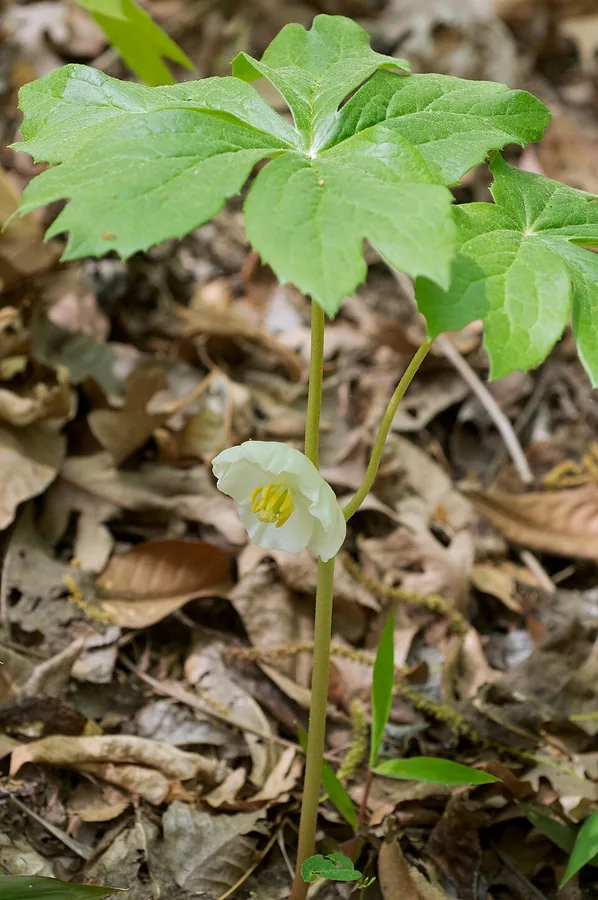
Mayapple is a kind plant to start with, spreading across the shaded floor of eastern North American woods and raising paired leaves that open like small green umbrellas. It travels by a creeping underground rhizome, so one plant slowly grows into a colony that can carpet a damp, wooded corner. It is a true woodland native, content beneath a high canopy where little else wants to settle.
A flowering plant holds two leaves and tucks a single nodding white bloom into the fork between them, shy and out of sight unless you crouch to find it. That bloom becomes one fruit that ripens to golden yellow in late summer, and this is the only part you can safely eat. Everything else carries a strong toxin, so it helps to know that early.
The real charm is the short, lively season, and there is nothing to fear in it. Mayapple rises in spring, blooms, sets its fruit, then dies back completely as summer heat settles in, leaving open ground until the following year. Once you plan for that quiet gap, it rewards you as an easygoing, low-effort groundcover for a shady spot.
Care
The short version: give it full to partial shade in moist, humus-rich, slightly acidic soil, keep it watered through spring, and simply let it go dormant and disappear on its own once summer heat arrives.
Light
Mayapple is a true shade lover that asks for full to partial shade beneath a tree canopy. It will happily take a touch of morning or dappled sun, but a hot, open site pushes it into early dormancy and can scorch the leaves, so lean toward the shadier spot and it will thank you.
Water
Offer it steady, even moisture in spring while the leaves are up, since it grows in damp woodland soil. A settled colony forgives a little drought because it simply goes dormant, so do not panic in a dry spell, though bare, exposed ground will make it fade sooner.
Soil
Plant it in moist, humus-rich soil that still drains well, anything from sandy to loamy so long as it is rich with leaf mold and organic matter. A slightly acidic pH of 5.0 to 6.0 mirrors the woodland floor it calls home, and it is a forgiving target to hit.
Temperature
Mayapple is wonderfully cold-hardy, coming through winters as low as about -29°F (-34°C) and shrugging off heat up to roughly 90°F (32°C) before it slips into summer dormancy. That wide range covers a great many temperate gardens, so most growers are well within it.
Humidity
Everyday outdoor humidity suits it just fine, so there is no number you need to chase. Cool, moist woodland air is its natural home, and shade paired with damp soil does far more for it than anything you could measure on a gauge.
Feeding
This gentle native barely wants feeding at all. A spring top-dressing of leaf mold or compost is all it needs, and heavy fertilizer does nothing helpful for a plant built for lean forest soil, so you can relax and skip it.
Pruning
There is truly no pruning to do here. The foliage yellows and dies back on its own as the plant goes dormant in summer, and you can simply leave it where it falls, with no fall cleanup on your list.
Repotting
Mayapple is rarely potted or divided, so for the most part it just stays put and grows. Lift and split a colony only when it turns crowded, the vigor drops, flowering thins, or the rhizomes begin to congest at the soil surface, and even then it is a calm, unhurried job.
Size & spacing
Each plant stays low at 12 to 18 inches (30 to 46 cm) tall and reaches about 9 to 12 inches (23 to 30 cm) wide, while the rhizome keeps quietly creeping outward. Set your divisions roughly a spread apart and let them knit into a colony over time, no rush at all.
When to plant
Mayapple keeps a gentle woodland calendar you can easily follow. Set out dormant rhizome divisions in fall or container plants in spring, enjoy the white bloom through April and May, and watch for the ripe golden fruit in late summer before the plant slips away for the year.
Northern hemisphere
Southern hemisphere
Typical months for a temperate climate: start earlier in warm zones, later where spring frosts linger.
- Sow: Not typically sown indoors; seeds need cold stratification and are slow and erratic to germinate
- Plant: Plant dormant rhizome divisions in fall, or container plants in spring after frost
- Harvest: Blooms April to May; fruit ripens to golden yellow in late summer (August to September)
Hardiness
USDA hardiness zones: 3–8
Temperature: down to -40°C
Troubleshooting
Take comfort in this: mayapple is a hardy native with very few troubles, and the one thing that looks worrying is usually just the plant lying down for the summer. Match what you see below before you reach for any treatment, and you will almost always find there is nothing to fix.
Spots of yellow or orange on the leaves
Those bumps are rust, a fungus that settles in when leaves stay wet and the patch has grown crowded. Take heart, because it is easy to handle: snip away the marked leaves, throw them out, and open up a thick colony so air can flow through. Since the plant folds down on its own in summer, the trouble rarely follows you into next year.
Fix:
- Remove and dispose of affected leaves
- Improve air circulation by thinning crowded colonies
- Avoid overhead watering to keep foliage dry
Leaves fade and disappear by midsummer
Breathe easy here, because this is summer dormancy and not a sickness. Mayapple is simply meant to yellow, lie down, and rest once the heat comes on, and the rhizome stays plump and alive under the soil the whole time. If a dry, sunny spot is pushing it down sooner than you would like, a bit more shade and gentle, steady moisture can win you a little extra leaf.
Fix:
- Do nothing; allow the plant to enter dormancy
- Mark colony location to avoid disturbing dormant rhizomes
- Maintain shade and soil moisture to delay decline in dry years
Toxicity
Please treat mayapple as a poisonous plant, and you will be fine. Every part but the fully ripe, golden-yellow fruit holds podophyllotoxin, a strong toxin that causes severe vomiting, diarrhea, and whole-body effects in people, pets, and livestock alike. Even handling it can irritate skin and eyes, so slip on gloves and keep children and animals away from the leaves, stems, roots, and unripe green fruit.
Toxic to
Cats · Dogs · Horses · Rabbits · Livestock · Birds · People
Cats Severe
A curious cat that mouths any part but the ripe fruit can be met with heavy vomiting and diarrhea, then turn dull and begin to pant. In the worst cases the toxin reaches the nerves, and sap left on the skin or in the eyes brings redness and open sores.
Dogs Severe
Dogs get caught out most often, since they love to dig up and chew the rhizome. Keep watch for hard vomiting, diarrhea, sagging energy, and panting, and know that a big mouthful can slide into collapse or, though it is rare, coma.
Horses Severe
A horse that grazes the leaves, roots, or green fruit can suffer fierce colic-like pain, loose stools, and deep tiredness. The podophyllotoxin acts on the whole body and not just the belly, so a horse can go down hard.
Rabbits Severe
The very toxin that floors dogs and horses is every bit as harsh on a rabbit's small frame. Look for severe stomach upset and fast-arriving weakness, so please tuck mayapple well beyond the reach of any rabbit that nibbles in the garden.
Livestock Severe
Cattle, goats, and sheep that pick at the foliage or roots in a wooded pasture can face hard purging, dehydration, and a broader systemic crash. The plant tastes bitter, yet hungry stock will still take a bite.
Birds Severe
Poultry and other birds are not safe either. Pecking at the leaves, rhizome, or unripe fruit can set off serious gut irritation and a sharp loss of spark, and it takes very little to put a small bird in real danger.
People Caution
Only the fully ripe, golden-yellow pulp is safe to eat, and even that in small amounts. Every other part, along with the unripe green fruit, brings severe vomiting, cramping, and whole-body poisoning, so keep children well away and let no one sample the rest of the plant.
Wear gloves when handling; sap can cause severe contact dermatitis and skin ulceration, and is especially hazardous to the eyes. Keep all plant parts and unripe fruit away from children and pets.
Helpline numbers

United States
ASPCA Animal Poison Control: (888) 426-4435 (fee applies)
Poison Control: (800) 222-1222



Canada
Poison Centres: 1-844-764-7669
Varieties
Mayapple is grown almost entirely as the plain wild species, and there is just one recognized natural form worth a quick mention.
Podophyllum peltatum f. deamii
You will find this listed as a natural form of the native eastern North American mayapple, one that botanical references gently set apart within the species.
How to propagate
The good news is that mayapple multiplies on its own through its spreading rhizome, and you can lend a hand by division. Seed works too, though only if you have a few patient years to spare.
DivisionModerate
Fall, when the plant is dormant · 1 to 2 growing seasons
Division is the friendliest route to more mayapple, and it plays to a plant that already fans out into colonies by itself. Wait until fall while it sleeps, lift and gently part sections of the creeping rhizome, tuck them back in, and let each piece take 1 to 2 growing seasons to settle and carry its own leaf and bloom. You really cannot rush it, and that is fine.
SeedDemanding
Sow fresh seed in fall to allow natural cold stratification · Several years to reach flowering maturity
Seed asks for patience more than skill, so do not let it worry you. Sow fresh seed in fall so winter cold can break the dormancy, then simply wait, because sprouting comes slow and uneven and a seedling needs several years to reach flowering size. Left alone in the right damp shade, mayapple will quietly seed itself anyway, doing the work for you.
Myths
Mayapple must be edible because it makes an edible fruit.
It is an honest mix-up, but only the fully ripe, golden-yellow pulp is safe to eat. The rhizome, roots, leaves, stems, seeds, and every unripe green fruit carry podophyllotoxin and will make a person or animal very sick. The ripe pulp is the one edible part, and all the rest is poison.