Houseplant · Orchidaceae
Jewel Orchid
Ludisia discolor
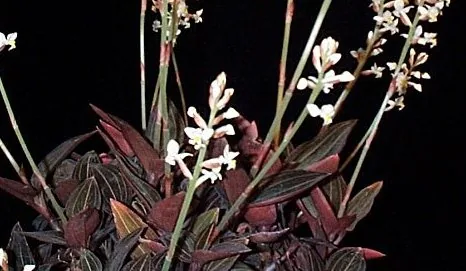
Kept for its velvet, vein-streaked leaves, the jewel orchid is the forgiving orchid you grow for the foliage.
Medium indirect
Every 4–9 days
61–84°F · 16–29°C
USDA 10–12
Overview
If orchids have ever felt out of reach, this is the one to start with. Most orchids climb trees and live for their blooms, but Ludisia discolor keeps its feet in the ground and wins you over with dark, velvety leaves threaded with glowing veins. The little white flowers it lifts up in late autumn are a sweet extra rather than the whole point, so there's no pressure to coax a show out of it.
It grew up on the warm, shaded forest floors of Southeast Asia, and once you picture that, its needs fall into place. Offer it the dappled, indirect light of that understory, steady warmth, and damp air, and it will amble slowly across the pot on a creeping stem. It really is an easy plant to live with, which is exactly why it makes such a kind first orchid for anyone the fussier kinds have scared off.
The single thing it asks you to watch is wet feet, and even that is easy to manage. The same creeping stem that lets it spread can rot fast in soggy mix, so your whole task is simply to keep it moist without ever leaving it sitting in water. Get that one rhythm right and the rest takes care of itself.
Care
The short version: give it medium indirect light, cozy warmth between 61°F and 84°F (16°C to 29°C), and high humidity. Keep the mix evenly moist but never soggy, water in the morning, and feed lightly through the growing season, and you'll do just fine.
Light
Settle it into medium indirect light, the soft, filtered brightness it would have known on a forest floor. It happily copes with low light and brighter indirect corners too, so don't stress about the perfect spot, but keep it out of direct sun, which scorches the tender leaves and washes out their color.
Water
Aim to keep the mix evenly moist but never soggy, watering every 4 to 9 days as the surface dries. Reach for tepid water in the morning so the leaves have time to dry before nightfall, since damp leaves and a wet base are what invite rot in.
Soil
Plant it in a well-drained, moisture-retentive mix meant for houseplants or terrestrial orchids, like a potting mix or fine fir bark blended with sphagnum. Leave the coarse bark for tree-dwelling orchids, and lean toward a gently acidic pH of 5.5 to 6.5.
Temperature
It feels most at home in everyday room warmth, somewhere between 61°F and 84°F (16°C to 29°C). Just tuck it away from cold drafts and chilly winter windows and it will be content.
Humidity
This one loves damp air and asks for 50% to 80%. A pebble tray, a cluster of leafy neighbors, or a humidifier in a dry room all do the trick, and pairing that moisture with steady airflow keeps leaf spots from ever getting started.
Feeding
During the growing season from spring to autumn, offer a weekly drink of balanced or orchid fertilizer watered down to a quarter or half strength. When the darker months slow its growth, simply ease off and let it rest.
Pruning
There's blissfully little to fuss over here. Snip off spent flower spikes once blooming winds down, and lift away any damaged or spotted leaves to keep the plant looking fresh and the air moving freely around it.
Repotting
Move it up every 1 to 2 years, or whenever the creeping rhizome begins spilling over the pot edge and the mix collapses into a soggy tangle. A shallow, wide pot cradles its spreading habit far more kindly than a deep one.
Size & spacing
It stays charmingly small, topping out at just 6 to 12 inches (15 to 30 cm) tall and spreading 8 to 12 inches (20 to 30 cm) across. That slow, sideways drift makes it a comfortable companion for a desk, a shelf, or a terrarium.
Troubleshooting
Nearly everything that goes wrong with a jewel orchid comes back to water, whether it's too much in the pot or too long resting on the leaves. The reassuring part is that spotting the early signs makes the fix an easy one. Find what matches below and step in gently before any rot has a chance to spread.
When the stems go soft and the plant slumps
Take heart, because even this comes down to one thing: rot from a mix that has stayed too wet. If the creeping rhizome turns soft or smells sour, you can still save the plant by lifting it out, trimming away every blackened part with a clean blade, and settling it into fresh, fast-draining mix. Water a little less after that and let the pot drain freely, and it will find its feet again.
Fix:
- Remove the plant and cut away all rotted tissue with a clean blade
- Repot into fresh, well-drained mix
- Reduce watering frequency and ensure the pot drains freely
Little spots and marks on the velvet leaves
Don't worry, leaf spotting is a gentle nudge rather than a crisis, and it usually means water lingered on the foliage overnight or the air around the plant sat too still. Water in the morning with tepid water so the leaves have all day to dry, and let a little air drift past them. Keeping the leaves dry when you water is the kindest habit you can build.
Fix:
- Water in the morning with tepid water so leaves dry before night
- Improve air circulation around the plant
- Avoid wetting the foliage when watering
Toxicity
Here's a real comfort for a home full of pets: the jewel orchid is non-toxic to cats, dogs, and the rest of the household crew. The ASPCA lists it as safe, so a nibbled leaf is nothing to lose sleep over. The very worst you might see is a touch of stomach upset if a pet manages to eat a large amount.
Safe for
People · Cats · Dogs · Horses · Rabbits · Livestock · Birds
Cats None
You can relax around a curious cat, because the ASPCA lists this orchid as non-toxic to cats. A nibbled leaf will do no harm, and the most a big mouthful might bring is a bit of drooling or a passing tummy ache.
Dogs None
Your dog is just as safe with this plant. There's no poison in it at all, and even a keen chewer would face nothing worse than a little short-lived stomach upset from the plant fiber.
Horses Safe
Horses can browse near it with nothing to fear, since it holds no toxins known to trouble them.
Rabbits Safe
A pet rabbit that tastes the leaves or stems will be perfectly fine, because the whole plant is safe for them.
Livestock Safe
Cattle, goats, and sheep can share space with it in comfort, as no part of it carries anything harmful to grazing animals.
Birds Safe
Pet birds are welcome beside this orchid. It brings no toxic threat, even if a bird pecks at a leaf now and then.
People Safe
This is a safe plant to keep near children. It isn't meant for eating, but if a toddler pops a leaf in their mouth there's no need for panic.
No special handling hazards; ingestion of large amounts of plant material may still cause mild stomach upset in pets.
Varieties
Ludisia usually comes home simply labeled as the jewel orchid, yet a few named forms do turn up, and you can tell them apart by the color of their leaves and veins.
'Nigrescens'
You'll know this one by leaves so deeply velvet they read as almost black, lit up by bright red-pink veins that seem to shine right through them.
'Alba'
This gentler form wears lighter green leaves traced with silvery-white veins rather than red.
How to propagate
Multiplying this orchid is wonderfully forgiving, so don't be shy about trying. That same creeping stem wandering across the pot is your ready-made stock of new plants, whether you take a cutting or gently split a clump in two.
Stem cuttingsEasy
Spring to summer during active growth · 4-8 weeks to root
This is where the plant makes it easy on you, so take heart: a stem cutting in spring or summer, while it's growing, is all it takes. Snip a length of the creeping rhizome that carries a few nodes, rest it on moist mix, and it will send down roots on its own over the next 4 to 8 weeks.
DivisionEasy
Spring, at repotting · 4-8 weeks
Splitting a full clump at spring repotting is just as forgiving. Ease the rhizome apart into pieces, checking that each piece keeps its own roots and growing stems, then pot them up and let them settle over the next 4 to 8 weeks.
Myths
Jewel orchids need coarse bark like every other orchid.
You can set this worry aside, because while most orchids cling to trees, Ludisia discolor is happy growing in the ground. What it truly wants is a moisture-retentive, well-drained mix, the soil-like sort or fine bark blended with sphagnum, and not the chunky bark you'd reach for with a moth orchid.
Orchids are poisonous to cats and dogs.
Rest easy on this one, since the ASPCA lists the jewel orchid, and orchids as a whole, as non-toxic to cats and dogs. A pet that nibbles a leaf is in no danger, though a large mouthful of any plant can bring on brief stomach upset.