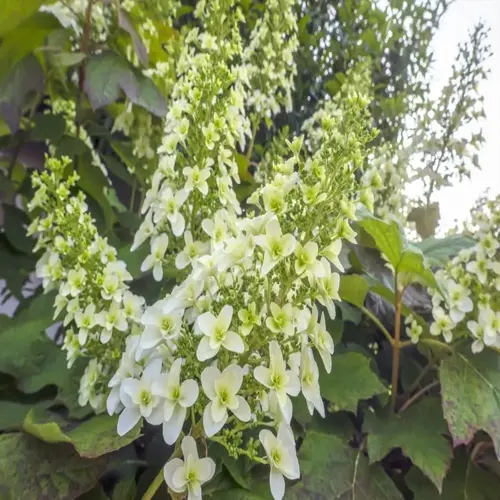

You should Hydrangea paniculata schneiden in late winter between mid-February and mid-March. This window falls after the worst frost but before new buds break. The right Rispenhortensie Schnittzeitpunkt gives you the biggest and best flower panicles by summer.
I have pruned my panicle hydrangeas in February for years now. The results are clear. When I cut in February before bud break, my plants produce panicles that reach 30 to 40 centimeters long by July. In years when I tried waiting until April, the flowers came out smaller and showed up later. That two-month gap makes a real difference in bloom size.
The link between pruning strength and flower size is easy to grasp. Panicle hydrangeas bloom on new wood from the current year. When you cut hard, fewer shoots remain. The plant then sends all its energy into those few shoots. Each one grows a big, heavy panicle. A light trim leaves more shoots but each gets less energy. You end up with many smaller flowers instead.
The Royal Horticultural Society tested this in a pruning trial. Plants with a light cut bloomed first and carried more but smaller flowers. Hard-pruned plants started later in the season. But their individual panicles were much larger. Both methods gave healthy plants. Your choice depends on whether you want many small blooms or fewer big ones.
For your Hortensie Rueckschnitt Fruehjahr, you only need a sharp pair of bypass pruners and loppers for thick stems. Cut each stem just above a pair of outward-facing buds. This sends new growth outward and keeps your plant in a nice open shape.
Main Stem Cutback
- Cut length: Shorten all main stems by one-third to one-half for a good balance between flower size and flower count.
- Cut placement: Make your cut about 5 millimeters above a healthy bud pair to avoid dieback on the remaining stem.
- Tool choice: Use a fresh-sharpened bypass pruner for clean cuts that heal fast and don't let disease into the wood.
Thinning Cuts
- Weak wood: Remove any stems thinner than a pencil at their base. These won't hold a flower head up in rain.
- Crossing branches: Cut out limbs that rub against each other. Rub spots invite disease into your plant.
- Inner growth: Take out up to one-third of the inner stems so light and air reach the center of the shrub.
Tree Form Shaping
- Trunk choice: Pick one or three strong main stems as your trunk and strip off all side shoots up to the crown height you want.
- Crown shape: Trim the crown into a round or dome shape by cutting all stems to the same length each late winter.
- Trunk sprouts: Remove new shoots on the trunk as soon as they appear so energy goes into the crown and flowers.
Keep February to March in your mind as pruning time. Cut in that window and you can hardly go wrong. Even if you take off too much, your panicle hydrangea bounces back in the same season and blooms just fine.
I tested both light and hard pruning on my own plants over three seasons. For my taste, cutting back by one-half gives the best show. You get fewer but massive panicles that stand tall in heavy rain. That dramatic look is worth the lower flower count.
One mistake you should avoid is pruning too late. Waiting past April gives your plant less time to grow. You still get flowers, but they come out smaller and later. Stick to the February-March window for the best results from you.
You also don't need to worry about the Rispenhortensie Schnittzeitpunkt being exact to the day. A week early or late won't hurt. Just check that you see no green buds popping yet. Once you spot green tips on the stems, make your cuts within the next few days. Your plant will reward you with a stunning summer display.
Read the full article: Panicle Hydrangea Growing Guide